All species › Waders, gulls and terns › Skimmers, noddies, terns and gulls › Royal Tern
Royal Tern | Thalasseus maximus
Koningsstern | Charrán real
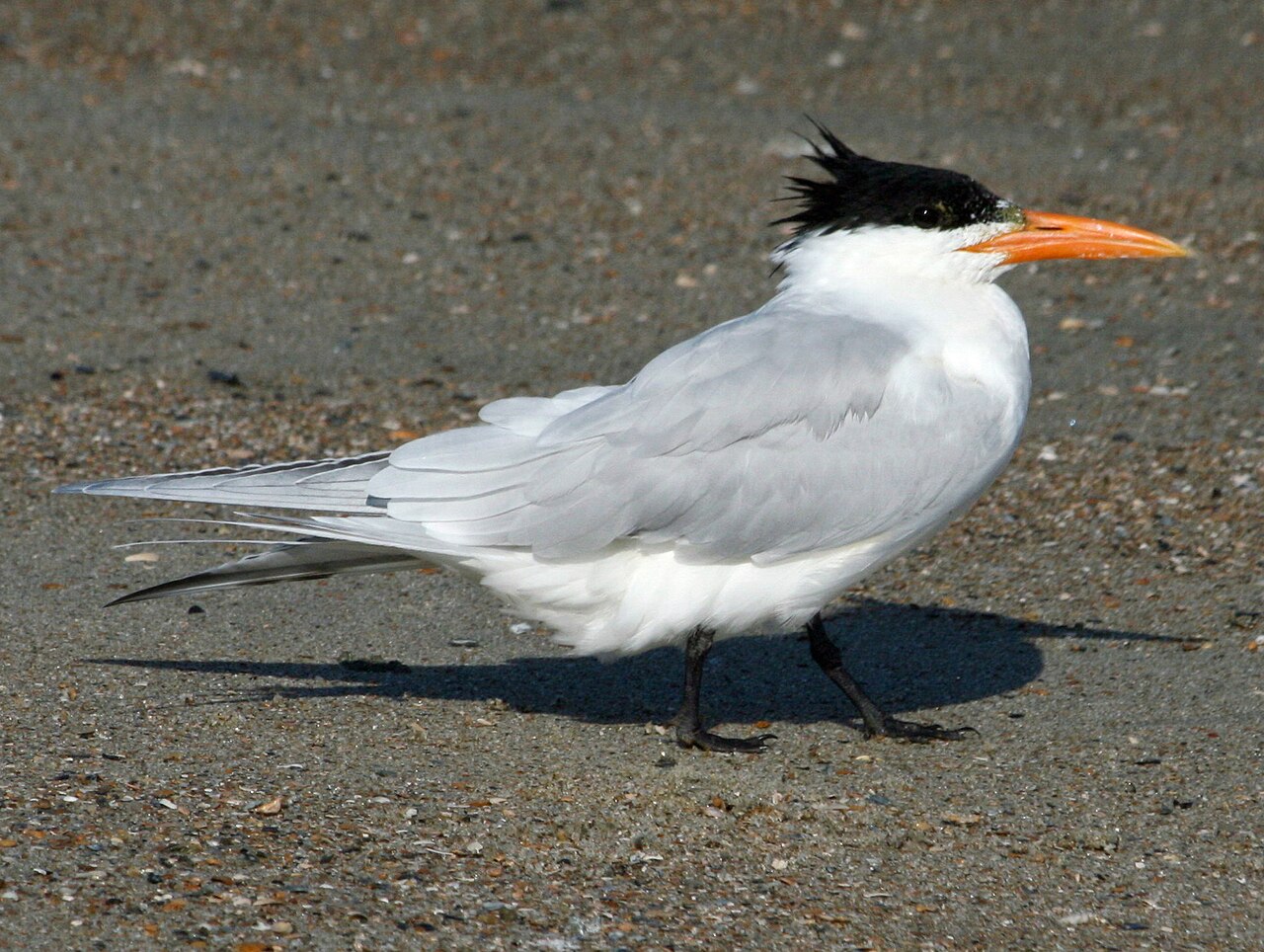
The Royal Tern is the big orange-billed tern of the American coasts: close to half a metre long, with a heavy daggerlike bill and, for most of the year, a broad white forehead under a black band across the nape. It breeds thousands at a time, packed so tightly that the nests touch, and afterwards gathers its young into one great crowd on the beach.
Voice
A short, shrill kree or tsirr, clearer and lower than the Sandwich Tern's grating call and often given in twos and threes. There is also a drawn-out, rolling whistle that recalls a plover, heard mostly over the colony. Flying birds call regularly on the move, high above the beach as well. Young in the crowd give a shrill two-syllable ki-ree by which the parent finds them among hundreds of others.
Recording: David Darrell-Lambert — CC BY-NC-SA 4.0 · Treasure Island, Pinellas County, Florida, United States · xeno-canto
Identification
A large, heavy tern with long narrow wings, a deeply forked tail and short black legs. The bill is thick, straight and bright orange, shaped like a dagger. In breeding plumage the crown is black with a ragged crest, but that plumage is short-lived: from May onwards the forehead turns white and a broad black band remains across the hindcrown, stopping short of the eye. Back and wings are pale grey, the outer primaries dark, the rest of the bird white. Juveniles show sandy markings on the back, a dark shoulder and a paler orange-yellow bill.
Confusion species
Caspian Tern is larger still and has a massive blood-red bill with a dark tip, a less deeply forked tail and a clearly dark underwing tip; it also keeps a largely dark crown all year. Elegant Tern (Thalasseus elegans) is smaller, with a longer, thinner, drooping bill, and outside the breeding season the black on the head reaches around the eye rather than stopping behind it. Sandwich Tern (T. sandvicensis) is smaller and has a black bill with a yellow tip. At distance the flight helps: Royal Tern beats slower and deeper than the smaller terns, but lighter and faster than Caspian.
Compare terns: bill, legs, head and tail side by side
Habitat
Warm coastal waters, all year round: inlets, bays, estuaries and the first few kilometres of open sea. It breeds on bare sand islands, shell banks and dredge-spoil islands, always in dense colonies and often among Laughing Gulls. When feeding young it will fly tens of kilometres offshore. It rarely uses fresh water; records far inland are almost always the work of a storm.
Where the bird is most often found, arranged by the USNVC — the vegetation classification of the United States and Canada — and CMECS for sea and coast.




Range and movements
On the Atlantic side it breeds from Virginia to Florida and on along the Gulf Coast to Texas, on the Pacific side from southern California to Sinaloa and the Islas Marías, and in addition on islands in the Caribbean. Outside the breeding season it stays on those same coasts, north to about North Carolina and south to Panama and the Guianas, so a large part of the population remains within the guide area all year. Young birds wander north in late summer to New Jersey and sometimes Long Island. The West African birds, formerly counted as the same species, were separated in 2020.
- Resident
- Breeding (summer)
- Winter
- Passage
- dark = core range, pale = thinly spread
Where and when to look
In summer watch from a pier or groyne as the terns hunt head-down along the surf: Royal Tern is the largest with an orange bill and the most visible dive, going well under the water. At low tide the sandbar holds roosts in which the crested terns stand side by side — the best place to learn to see the difference from Sandwich Tern.
Conservation
North America holds an estimated 100,000 to 150,000 breeding birds and the world about a quarter of a million; the trend is stable. Despite the recent split of the West African birds as a separate species in 2020, the Red List classes the species as Least Concern (LC). Spring tides and tropical storms can wash whole colonies away, and on the mainland foxes, raccoons and free-running dogs are a problem; islands of dredged sand, with no connection to the shore, have therefore become important breeding sites.
Scientific name
Thalasseus maximus | (Boddaert, 1783)
Pieter Boddaert described the species in 1783 as Sterna maxima, from one of the coloured plates accompanying Buffon; because it was later placed in another genus, author and year stand in parentheses. The genus Thalasseus, from Greek thalassa ('sea'), was introduced by Friedrich Boie in 1822 and has only come back into general use this century. maximus is Latin for 'the greatest': of the terns Boddaert knew, this was the heaviest. The described specimen came from Cayenne in French Guiana.