All species › Waders, gulls and terns › Skimmers, noddies, terns and gulls › Forster's Tern
Forster's Tern | Sterna forsteri
Forsters stern | Charrán de Forster
Forster's Tern is the tern of the marsh: it nests on mats of reed and sedge in inland sloughs and in salt marshes, not on the bare sand island where most terns sit. It is also the only medium-sized tern that spends the winter along the American coast — a fact that rescues many an observer in December.
Voice
The call is a low, hoarse, descending kyarr, far rougher and heavier than the Common Tern's sharp kee-yarr, and the best mark when the bird is too far off to see the bill. Over a disturbed colony there is also a short, raw zaar, given in quick series. Females beg with an unbroken run of the same descending calls. Over a salt marsh at dusk that sound is often the first sign that terns are still there.
Recording: Valerie Heemstra — CC BY-NC-SA 4.0 · Blue Goose Trail, Sabine NWR, Cameron Parish, Louisiana, United States · xeno-canto
Identification
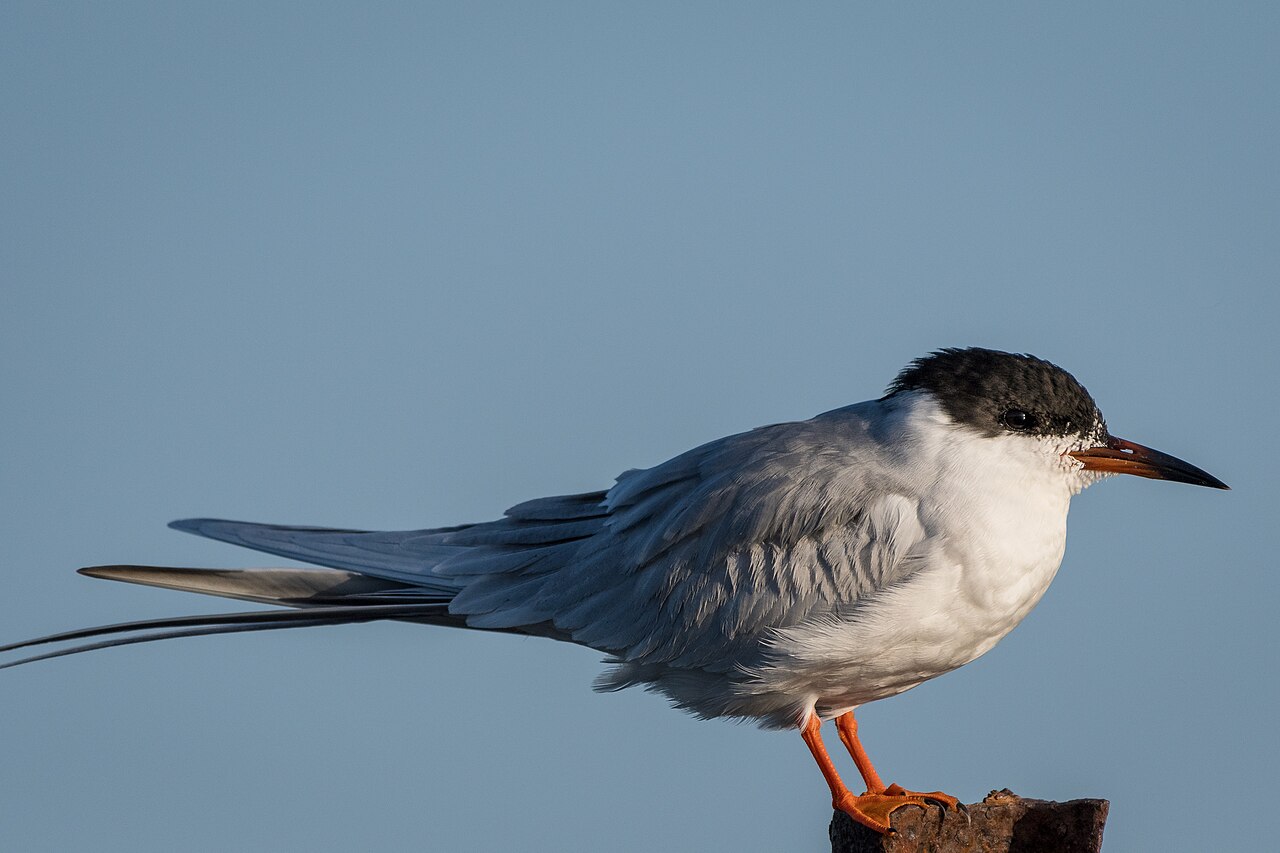
A slender, pale tern with long pointed wings and a deeply forked tail that projects well beyond the wingtips at rest. In breeding plumage: black cap, orange bill with a black tip, orange legs and — unlike any related tern — silvery-white primaries that are paler than the rest of the upperwing. The tail is grey in the centre and white on the outer edge, exactly the reverse of Common Tern's. Outside the breeding season the head is white with a single detached black comma over eye and ear-coverts; that mask is distinctive. Juveniles show a sandy wash on the back, a shorter tail and the same eye mask.
Confusion species
Common Tern (Sterna hirundo) is the hard one: in breeding plumage it has a dark wedge in the outer primaries where Forster's is silvery-white, and a tail that is grey on the outer edge and white within instead of the other way round. In winter plumage Common Tern's black cap runs through to the nape and it carries a dark shoulder bar, while Forster's has a clean white nape and only that black eye mask. Arctic Tern (S. paradisaea) has an all-red bill without a black tip, short legs and grey underparts. Inland in the west, Forster's is usually the only medium-sized tern in summer, and on the coast in December almost certainly the only one.
Compare terns: bill, legs, head and tail side by side
Habitat
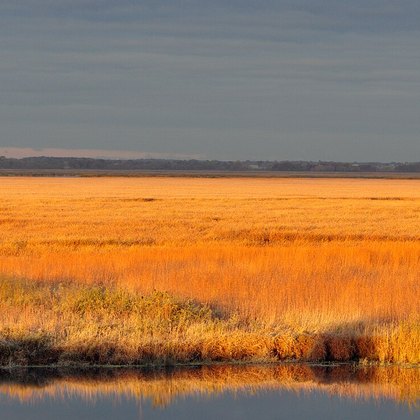
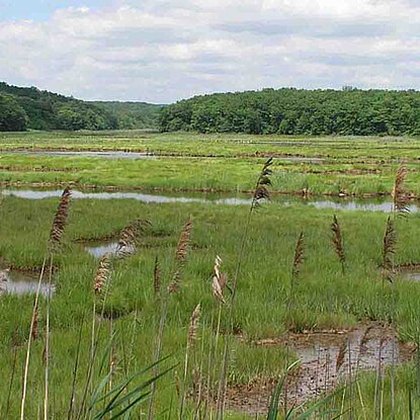
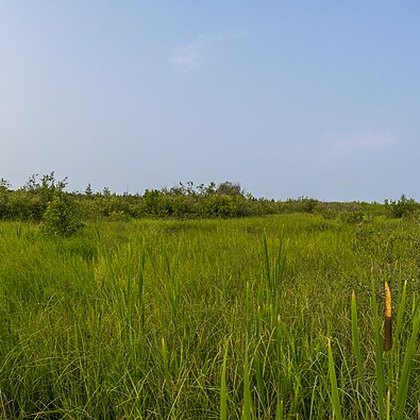
Freshwater marshes of reed and sedge, brackish lagoons and salt marsh; the nest is a mat of plant litter on a drift heap, an old muskrat lodge or a floating raft. Outside the breeding season it shifts to the coast — estuaries, river mouths, inlets and sheltered bays — and inland to large lakes and reservoirs. It needs shallow, quiet water with plenty of small fish, and avoids the open ocean. Unlike Common Tern it almost never breeds on bare sand.
Where the bird is most often found, arranged by the USNVC — the vegetation classification of the United States and Canada — and CMECS for sea and coast.


Range and movements
It breeds in two separate areas: in the inland marshes of the prairies, from Alberta and Manitoba south to Colorado and west to California, Oregon and Washington, with an arm along the Great Lakes; and in the salt marshes of the Atlantic coast from New York to North Carolina and along the Gulf coast to Tamaulipas. It winters along the coasts of California, the Gulf of Mexico and the southeast, and on to both coasts of Mexico, Cuba, the Bahamas and Belize. That makes it the northernmost-wintering tern in North America. Inland it turns up on passage at almost any sizeable water.
- Resident
- Breeding (summer)
- Winter
- Passage
- dark = core range, pale = thinly spread
Where and when to look
In September or October work along a salt marsh or a large reservoir and look for the tern with the black ear patch: every other medium-sized tern still has a dark crown or a dark shoulder bar. Watch the flight when it hunts — Forster's hangs lower and slower over the water than Common Tern and often picks from the surface instead of diving. In winter, every medium-sized tern over an American bay is a Forster's until proved otherwise.
Conservation
The world population is put at some 98,000 breeding birds; the species is listed as Least Concern (LC), but numbers track water levels in the marshes closely. Loss and drying of inland wetlands and sea-level rise in the salt marshes are the two chief threats; in Illinois and Wisconsin it is listed as endangered at state level. As a hunter of fish in shallow water it accumulates mercury, PCBs and selenium, which in polluted areas leads to failed broods. Artificial nesting rafts are used with success.
Scientific name
Sterna forsteri | Nuttall, 1834
Thomas Nuttall described the species in 1834 as Sterna forsteri; the genus has not changed since, and so author and year stand without parentheses. Sterna goes back to Old English stearn, 'tern'. The species name honours Johann Reinhold Forster, the German naturalist who sailed with Cook and who first pointed out that these American birds differed from Common Tern. The described specimen came from the banks of the Saskatchewan, between Cumberland House and Lake Winnipeg.