All species › Waders, gulls and terns › Skimmers, noddies, terns and gulls › Arctic Tern
Arctic Tern | Sterna paradisaea
Noordse stern | Charrán ártico
The Arctic Tern makes the longest annual journey of any bird: from its Arctic breeding grounds to the pack ice around Antarctica and back, averaging over seventy thousand kilometres a year in tracked Greenland birds. It therefore lives in two summers and sees more daylight than any other animal. In the field it is a pale, spare-built tern with a blood-red bill lacking any black tip and legs barely longer than a thumbnail.

Voice
The call is a sharp, nasal kee-yah that rises at the end, shorter and harsher than Common Tern's. With an intruder over the colony this turns into a rattling kt-kt-kt-kt, and the birds really do attack: an Arctic Tern will strike a human head with the bill and draw blood. The display flight is accompanied by a drawn-out, rising whistle. Over a colony on an Arctic islet the sound is unbroken and deafening.
Recording: Stanislas Wroza — CC BY-NC-SA 4.0 · Soppavann, Finland · xeno-canto
Identification
A small, slender tern: narrow wings, a deeply forked tail whose streamers project beyond the wingtips at rest, and a short neck with a rounded head. In breeding plumage the bill is wholly deep red with no black tip, the legs are short and red, and the underparts are light grey, so that the white cheek stripe below the black cap stands out. From below the primaries are translucent, with a narrow, crisply defined black trailing edge; on Common Tern that edge is broad and diffuse. Outside the breeding season bill and legs turn black, the forehead becomes white and the shoulder stays unmarked. Juveniles have finely scaled upperparts, a short tail and white inner wings.
Confusion species
Common Tern (Sterna hirundo) is the real risk: it has an orange-red bill with a black tip, longer legs, a longer neck, a dark wedge in the outer primaries and whiter underparts. Roseate Tern is paler still, with a mostly black bill red at the base, long tail streamers and pure white underparts without grey. Forster's Tern (S. forsteri) has silvery-white primaries and, in winter plumage, a detached black ear patch instead of a continuous cap. With the bird on the ground the leg length settles it: Arctic Tern stands so low that its belly all but touches the ground.
Compare terns: bill, legs, head and tail side by side
Habitat
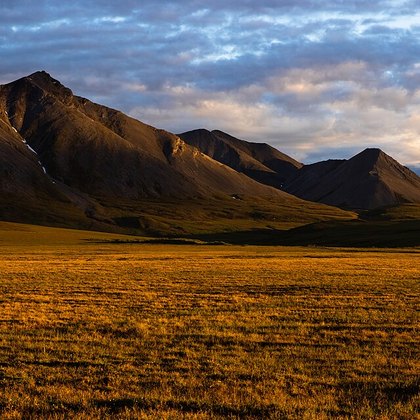
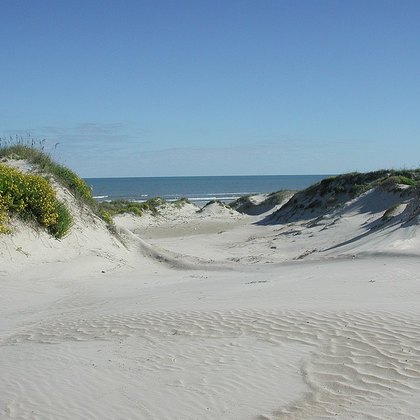
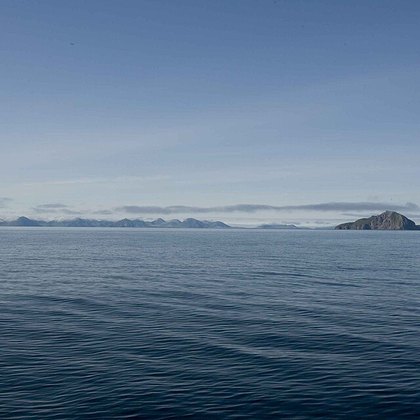
Breeds on open, treeless ground: Arctic tundra, shingle beaches, rocky islets, salt marsh and the shores of boreal lakes, always close to water and almost always in colonies. Outside the breeding season it lives entirely at sea, from the open ocean to the edge of the pack ice; it does not touch land for months. It hunts small shoaling fish and crustaceans, taken while hovering from the top few decimetres of the water. Fresh inland water it uses only rarely, on passage.
Where the bird is most often found, arranged by the USNVC — the vegetation classification of the United States and Canada — and CMECS for sea and coast.


Range and movements
It breeds right around the pole: in North America from the Aleutians and all of Alaska through Arctic Canada and Greenland to Newfoundland and Nova Scotia, and south to Maine and, in small numbers, Massachusetts. It winters in the southern oceans as far as the Antarctic pack ice, far beyond the guide area; in North America, away from the breeding grounds, it is therefore purely a passage migrant, and largely far offshore at that. Tracking gave Greenland birds an average of 70,900 kilometres a year, with an extreme of 81,600, and birds from the Farne Islands over 90,000 kilometres in ten months. The southward journey crosses the Atlantic along either the African or the South American coast; on the way back the birds describe a great loop with the wind.
- Breeding (summer)
- Winter
- Passage
- dark = core range, pale = thinly spread
Where and when to look
On the American east coast the best chance is a pelagic trip in May or late August; from the beach it is scarce, because migration passes far offshore. To see it breeding, the colonies of Maine and the Bay of Fundy are the southernmost option — take a hat, because the birds strike. With any red-billed tern, look first for the black tip: if there is none, you have an Arctic Tern.
Conservation
The world population is put at two to three million birds and the species is listed as Least Concern (LC), but the trend is unknown and at the southern edge of the range, in Maine and the Canadian Maritimes, colonies are falling back. The main cause is food shortage: warmer sea water displaces the sand lance on which the chicks live. Large gulls, foxes and flooding take their toll on the colonies as well. It is a long-lived bird — ringing recoveries of thirty years are known — so a run of poor breeding seasons shows up in the numbers only late.
Scientific name
Sterna paradisaea | Pontoppidan, 1763
Erik Pontoppidan described the species in 1763 as Sterna paradisaea; the genus has not changed since, and so author and year stand without parentheses. Sterna comes from Old English stearn, 'tern'. paradisaea goes back to Late Latin paradisus, 'paradise', most likely for the long streaming tail feathers that recall a bird-of-paradise. Pontoppidan gave no type locality; it was later fixed on Christiansø off Bornholm, in Denmark.