All species › Pelicans, herons and ibises › Herons, egrets and bitterns › Little Egret
Little Egret | Egretta garzetta
Kleine zilverreiger | Garceta común
The Little Egret is a common heron in Europe and Africa, but in North America a rare visitor that has crossed the ocean: since the first record on Barbados in 1954 it has turned up with growing, if still uneven, regularity along the Atlantic coast. It closely resembles the native Snowy Egret, sharing the same black legs and yellow feet, but is slightly larger and more heavily built. From a small, growing beachhead in the Caribbean, it is slowly extending its presence in the New World.
Voice
Like its North American counterpart, the Little Egret is generally silent away from the colony. At a breeding colony in the Caribbean it gives a hoarse, rasping croak, especially during courtship and nest-relief. Startled birds give a short, harsh throat call. To a North American observer the bird is almost always silent, since it usually appears alone, far from any colony.
Recording: MERCIER Christophe — CC BY-NC-SA 4.0 · Panazol, Haute-Vienne, Nouvelle-Aquitaine, France · xeno-canto
Identification
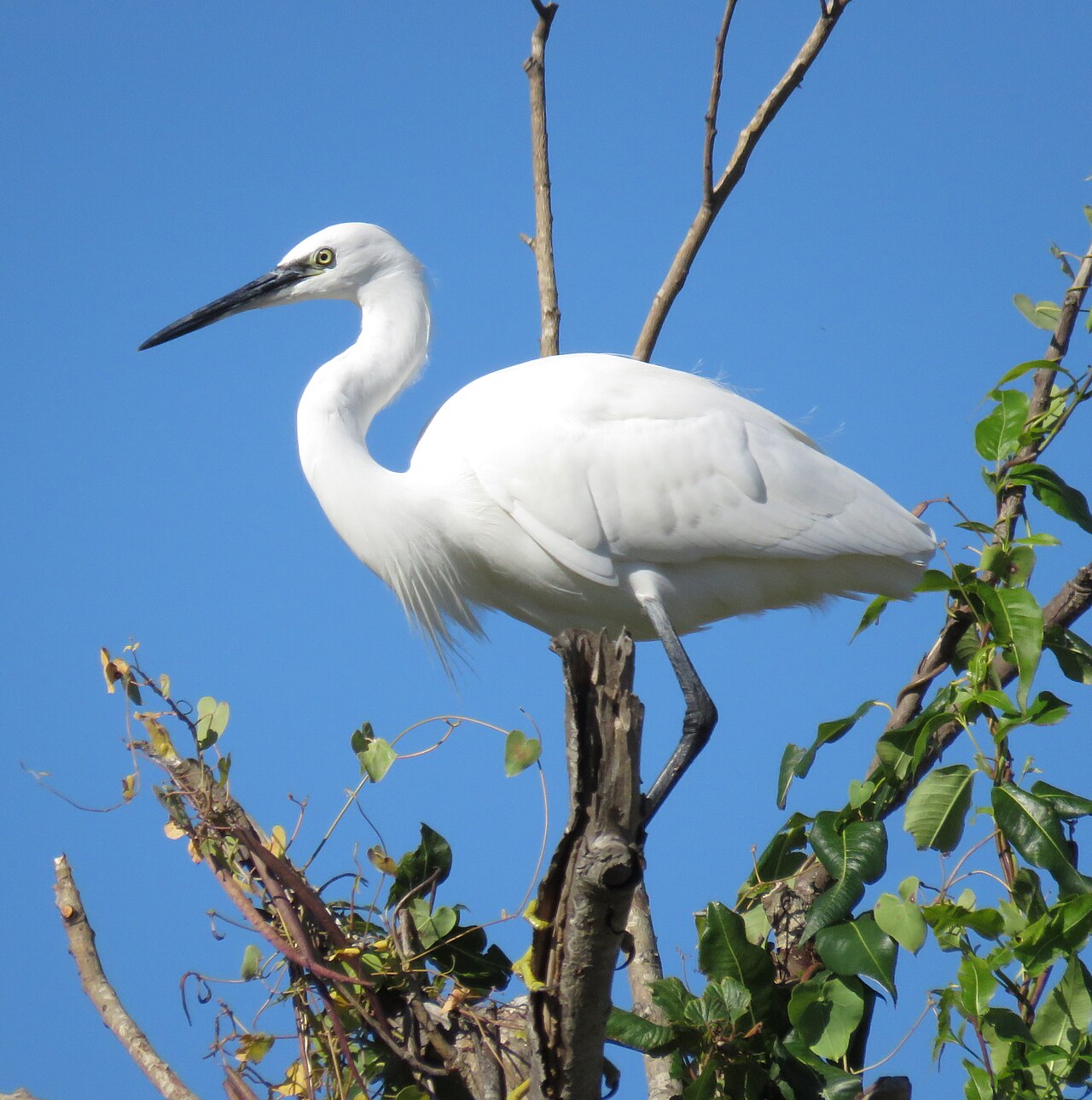
The Little Egret is entirely white, with a black bill, black legs and yellow feet — at first glance a copy of the Snowy Egret. It is, however, slightly larger and more solidly built, with a noticeably thicker bill and a greyer rather than yellow lore. In breeding plumage it grows two long, straight plumes from the nape, against the many forward-curving plumes of its American relative. Young birds show the same combination of features as adults, to a lesser degree.
Confusion species
Confusion is almost entirely with Snowy Egret (Egretta thula), which shares the same coastal marshes and identically coloured legs and feet. Check the bill: thicker, with a greyer rather than bright yellow lore, on Little Egret. In breeding plumage the difference is clearest — two loose, straight nape plumes against a full, curved crest. Outside the breeding season, when both species look more alike, any reported Little Egret in North America is reason for thorough photo documentation, precisely because the difference is so subtle.
Habitat
Where the Little Egret has established itself in the New World — chiefly on Barbados — it uses the same coastal marshes, lagoons and tidal flats as Snowy Egret, often among colonies of that species. Lone wanderers in the United States and Canada turn up in similar coastal marshes and salt ponds along the Atlantic seaboard. Inland fresh water plays almost no role in its North American occurrence.
Where the bird is most often found, arranged by the USNVC — the vegetation classification of the United States and Canada — and CMECS for sea and coast.



Range and movements
Colonisation of the New World began with a single bird on Barbados in 1954; only in 1994 was the first breeding Little Egret confirmed there. From that beachhead the species spread further through the Caribbean and now also breeds in the Bahamas. Lone birds, presumably from West Africa and arriving via the Caribbean, have since turned up with increasing regularity along the Atlantic coast of North America, from Florida to Newfoundland, Quebec and Ontario. Within the area this guide covers, it breeds only in the Bahamas; elsewhere records remain scattered and irregular.
- Resident
Where and when to look
In spring and autumn, take a second look at every presumed Snowy Egret along the east coast, checking bill shape and lore colour — a thicker bill with a grey rather than yellow lore is the first clue to this rare visitor. Photograph the bird up close if possible, since the distinction from its American cousin comes down to exactly such details.
Conservation
No dedicated IUCN assessment exists for the North American population: the species is too recent and too locally established here for a trend to be judged. Worldwide, counting the large populations across Europe, Africa and Asia, the Little Egret is in fact one of the commonest herons on Earth, and the IUCN rates it as Least Concern (LC). The small breeding populations on Barbados and in the Bahamas remain the main beachheads in the New World so far.
Scientific name
Egretta garzetta | (Linnaeus, 1766)
Linnaeus described the species in 1766 as Ardea Garzetta, based on an earlier description by the Frenchman Brisson; it has since been moved to another genus, hence the parentheses around author and year. Forster introduced the genus Egretta only later, in 1817, derived from the Provençal French aigrette, itself a diminutive of aigron, 'heron' — a name originally applied to this very species, making it the namesake of its whole genus. The epithet garzetta is Italian, a diminutive of garza, 'heron', literally 'little heron'. The type locality, 'Oriente' after Brisson, is vague and in any case lies far outside the North American range this guide covers.