All species › Pelicans, herons and ibises › Herons, egrets and bitterns › Snowy Egret
Snowy Egret | Egretta thula
Amerikaanse kleine zilverreiger | Garceta Nívea
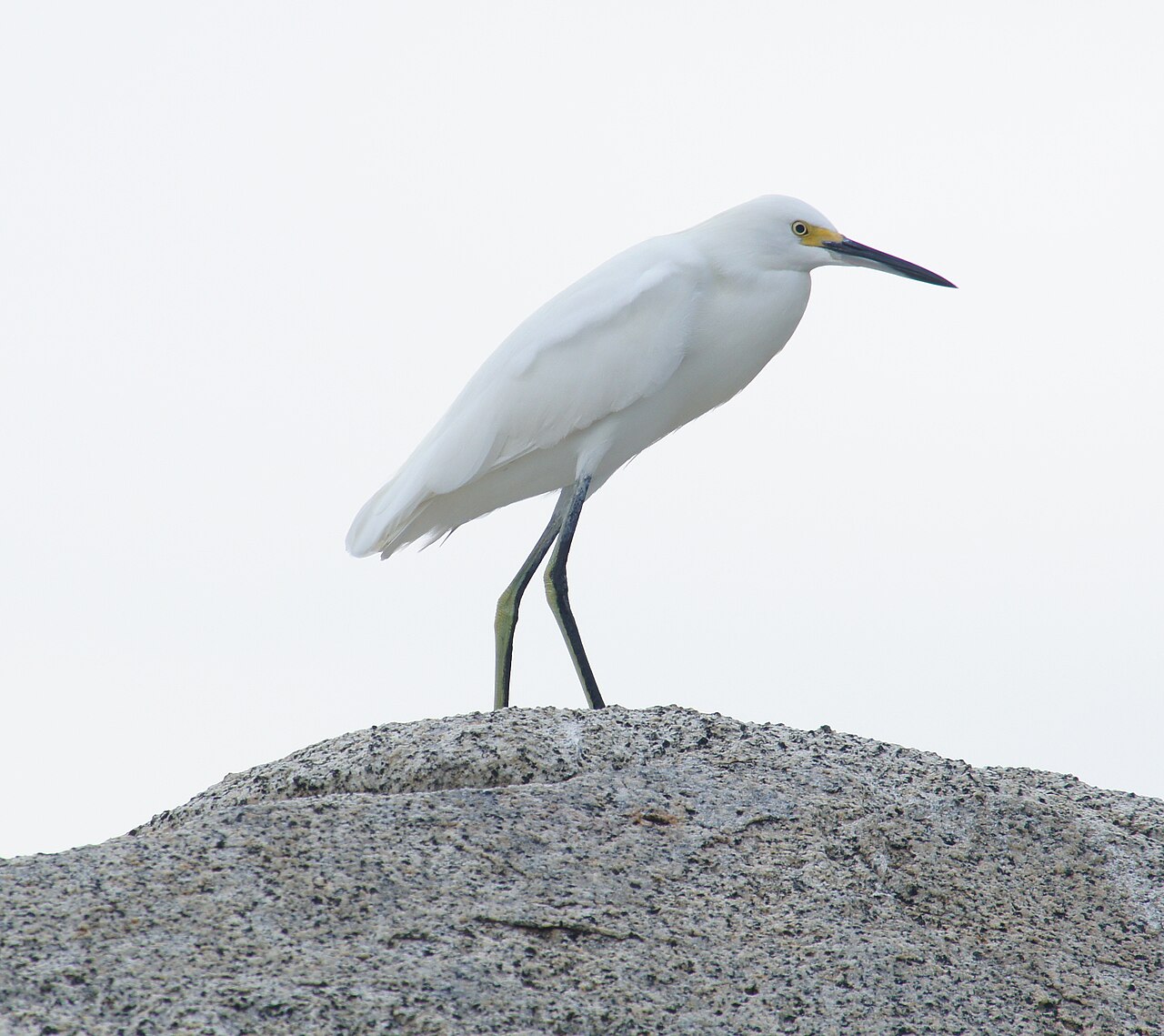
The Snowy Egret is the heron with 'golden slippers': a slim, snow-white bird with black legs and bright yellow feet, hunted for centuries for its plumes and, by 1910, nearly gone from parts of its range. Since then it has recovered strongly and is now one of the most numerous and visible herons in North America. It hunts more actively than most herons: running, hopping and stirring the water with its feet.
Voice
Outside the breeding season the Snowy Egret is largely silent. In the colony, hoarse, nasal calls pass between mates, and an intruder is driven off with loud, harsh screams. Aggression toward other birds also produces a dry clicking, made by snapping the bill shut forcefully. Chicks in the nest beg steadily and hoarsely whenever a parent approaches with food.
Recording: Paul Driver — CC BY-NC-SA 4.0 · Brigantine National Wildlife Refuge, NJ, United States · xeno-canto
Identification
Adults are entirely white with a black bill, a small patch of yellow bare skin between eye and bill, black legs and sharply contrasting bright yellow feet — the 'golden slippers' that give the species away at any distance. In breeding plumage it grows long, thin, forward-curving plumes on crown, chest and back, and the lores deepen to orange-yellow or red. Young birds resemble adults but have duller, greenish legs, making the yellow feet less sharply defined. The bird is smaller and slighter than Great Egret, with a noticeably thinner bill and neck.
Confusion species
The white juvenile plumage of Little Blue Heron (Egretta caerulea) is most often mistaken for this species, but that bird has a grey-blue bill and greenish rather than bright yellow legs, and hunts more slowly and deliberately. The rare Old World Little Egret (Egretta garzetta) is larger and heavier-built, with a thicker bill, a greyer lore and two long, straight nape plumes instead of the wispy, curved plumes of the Snowy Egret. Western Cattle-Egret has a much shorter, thick orange bill and a stockier build without the active hunting style. Great Egret (Ardea alba) is considerably larger, with a yellow bill and uniformly black legs.
Habitat
The Snowy Egret uses a wide range of shallow waters: tidal mudflats, beaches and coastal marshes, but also wet farm fields, lake edges and riverbanks inland. It nests colonially, usually alongside other heron species, in low trees and shrubs on islands safe from ground predators. It avoids deep or fast-flowing water, as well as mountainous terrain — the species stays almost entirely below a thousand metres. Outside the breeding season it also appears on artificial water bodies, from fish ponds to sewage treatment lagoons.
Where the bird is most often found, arranged by the USNVC — the vegetation classification of the United States and Canada — and CMECS for sea and coast.





Range and movements
The species breeds from the Pacific coast and interior west — California, Nevada, Utah, Colorado, Arizona and New Mexico — through Texas and from there across nearly the whole of the United States and southern Canada. In Florida, along the Gulf Coast and in the Caribbean it is present year-round; northern breeders move south in autumn to Mexico, Central America and the Caribbean. Beyond North America the species breeds on through South America, present year-round as far south as Chile and Argentina. After its near-collapse from the plume trade, protection under the Migratory Bird Treaty Act of 1918 brought the population back; since then its range has again shifted north.
- Resident
- Breeding (summer)
- Winter
- Passage
- dark = core range, pale = thinly spread
Where and when to look
When you see an actively hunting white heron, check the legs first: black with bright yellow feet, stirring and paddling through shallow water to flush prey, is enough to confirm Snowy Egret. Only then check the bill — entirely black with a small yellow spot by the eye — before ruling out the look-alikes.
Conservation
Worldwide the IUCN rates the species as Least Concern (LC); after protection from the plume trade in the early twentieth century the population recovered strongly, and North America again holds hundreds of thousands of birds. Wetland loss and water pollution remain local threats, especially in fast-urbanising coastal areas.
Scientific name
Egretta thula | (Molina, 1782)
Molina described the species in 1782 as Ardea Thula, based on a specimen from Chile; it has since been moved to another genus, hence the parentheses around author and year. Forster introduced the genus Egretta in 1817, derived from the Provençal French aigrette, a diminutive of aigron, 'heron'. The epithet thula is not Latin but Mapudungun, the language of the Mapuche of Chile, and originally meant 'black-necked swan' — Molina apparently applied the name to this egret by mistake. The type locality is Chile, well outside the North American range this guide covers.