All species › Pelicans, herons and ibises › Herons, egrets and bitterns › Reddish Egret
Reddish Egret | Egretta rufescens
Roodhalsreiger | Garceta Rojiza
The Reddish Egret is the most theatrical heron on the American coast: it hunts by running, staggering and lurching through shallow salt water with wings flung wide, in sharp contrast to the patient herons around it. The species comes in a dark and a white colour morph and breeds in only a handful of states around the Gulf of Mexico. Centuries of hunting for its plumes once pushed it close to extinction.
Voice
Away from the colony the Reddish Egret is a quiet bird; when startled it gives a low, hoarse croak. In the colony it is different: displaying pairs clatter their bills loudly and give a series of gurgling, guttural notes while winding their necks around each other's. Chicks beg with a steady, hoarse peeping that in a busy colony blends into constant noise. Compared with the song of a cormorant colony, a Reddish Egret colony is mostly a racket of clattering bills.
Recording: Isain Contreras Rodríguez — CC BY-NC-SA 4.0 · Paredones, Ahome, Sinaloa, Mexico · xeno-canto
Identification
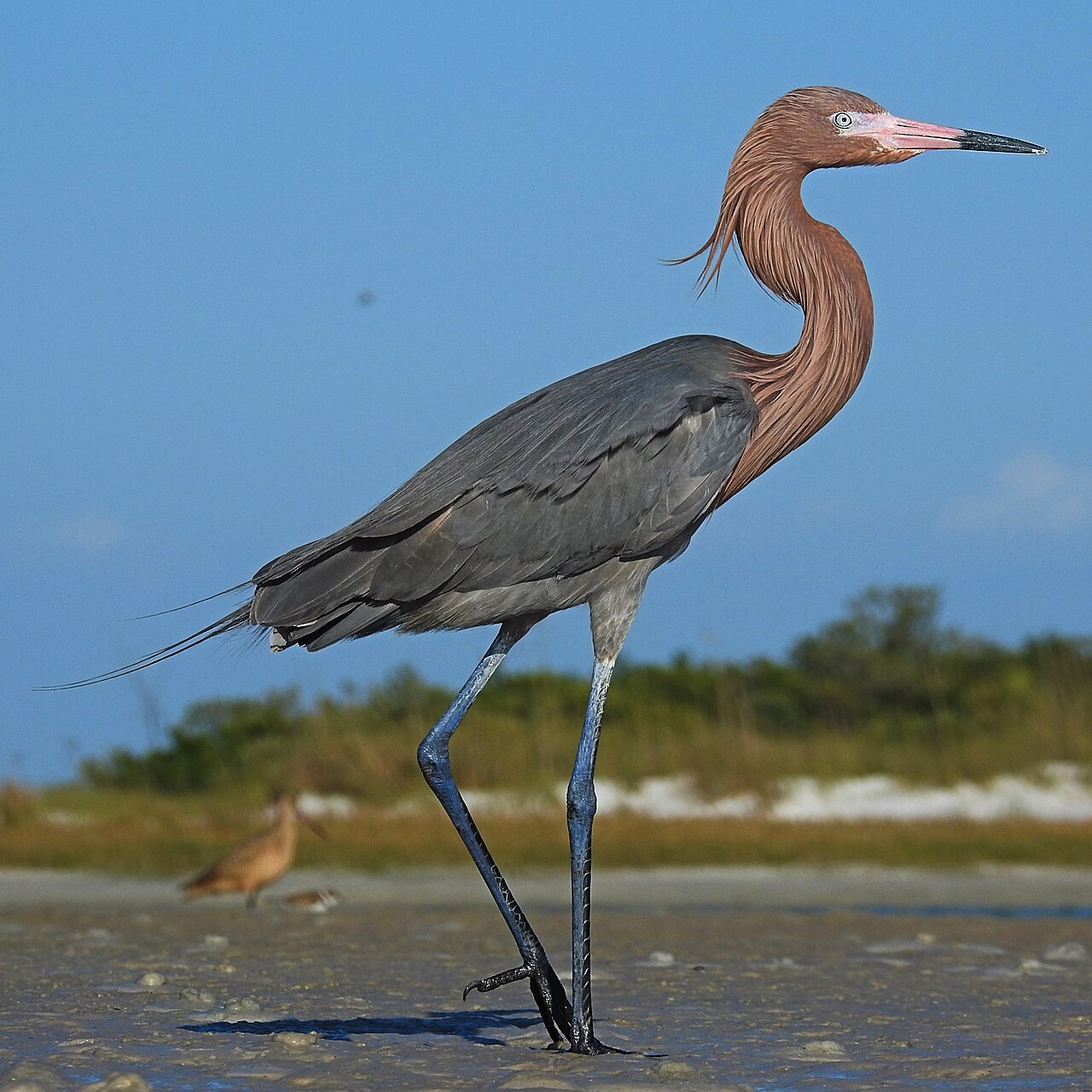
An adult dark-morph Reddish Egret is slate-grey in the body with a rusty cinnamon head and neck whose feathers stick out shaggy and unkempt — a scruffy silhouette no other North American heron shares. The rarer white morph is entirely snow white and can only be told from other white herons by behaviour and bill. Both morphs carry, in the breeding season, a two-toned bill, pink at the base and black at the tip, on cobalt-blue legs. Juveniles are ashy with a coppery tinge and have, uniquely among herons, a mostly dull grey bill and legs without sharp colour contrasts. The bird hunts with its neck held low and outstretched, staggering and lunging, which sets it apart from most other herons even at a distance.
Confusion species
The white morph is confused with Great Egret (Ardea alba), which is much larger with a yellow bill and black legs, and with Snowy Egret (Egretta thula), which has a black bill with a yellow base and bright yellow feet against the Reddish Egret's flesh-toned bill base and blue-grey legs. The dark morph resembles Little Blue Heron (Egretta caerulea), which is uniformly dark and smooth-feathered without the shaggy neck, and Tricolored Heron (Egretta tricolor), which has a sharply contrasting white belly. When in doubt, behaviour settles it: no other heron hunts as wildly, running and holding its wings out like a parasol over the water, as the Reddish Egret.
Habitat
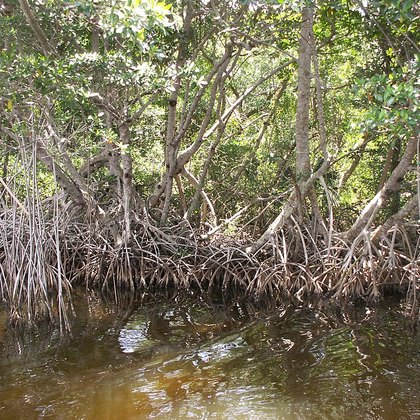
The Reddish Egret is almost entirely tied to salt water: shallow salt flats, lagoons and tidal flats around barrier islands and mangrove coasts. It nests in low mangrove or shrubs on small, predator-free islands, often alongside other herons and pelicans. It avoids fresh water and the interior almost entirely — a Reddish Egret far from the coast is an exception. Outside the breeding season it stays faithful to the same shallow bays and tidal creeks.
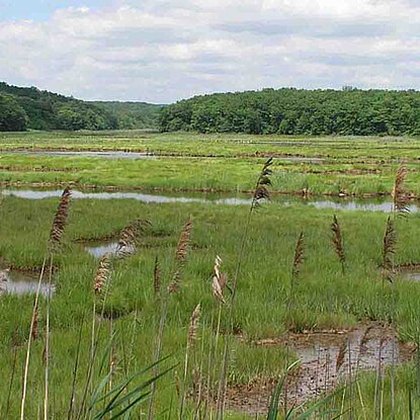
Where the bird is most often found, arranged by the USNVC — the vegetation classification of the United States and Canada — and CMECS for sea and coast.


Range and movements
In the United States the species breeds mainly along the Texas Gulf Coast, with the country's largest population around the Laguna Madre, and in smaller numbers in Louisiana and, in steadily growing numbers, on both coasts of Florida. Outside the United States it also breeds along the Gulf Coast of Mexico to Yucatán, and, as a separate, paler-headed subspecies, along the Pacific coast of Mexico including Baja California, and on the Bahamas and Cuba. The Reddish Egret does not migrate: it stays year-round in or near its breeding grounds. Over the past few decades, growing numbers of young and adult birds have wandered north after breeding as far as Georgia and the Carolinas, possibly a sign of range expansion to come.
- Resident
- Breeding (summer)
- Winter
- Passage
- dark = core range, pale = thinly spread
Where and when to look
Look for the Reddish Egret on a shallow salt flat along the Texas or Florida coast, and check behaviour before colour: a heron that runs, stops abruptly, staggers and opens its wings like a parasol over the water is almost certainly this species, even at a distance too great to see its colours. Early morning at low tide gives the best chance of seeing this hunting behaviour.
Conservation
The Reddish Egret is sensitive enough worldwide for the IUCN to rate it Near Threatened (NT): the US population numbers no more than fifteen hundred to two thousand breeding pairs, most of them in Texas and a few hundred in Florida. Nineteenth-century plume hunting brought the species close to extinction; since then it has recovered slowly, helped by protection of breeding islands. Its narrow, strictly coastal habitat leaves it vulnerable to oil spills, disturbance of colonies and the loss of shallow salt flats to coastal development.
Scientific name
Egretta rufescens | (Gmelin, 1789)
Gmelin described the species in 1789 as Ardea rufescens, based on earlier work by the Englishman Latham and the Frenchman Buffon, who had already illustrated the bird as 'L'Aigrette rousse de la Louisiane'; because it has since been moved to another genus, author and year stand in parentheses. Forster introduced the genus Egretta in 1817, derived from the Provençal French aigrette, a diminutive of aigron, 'heron'. The epithet rufescens is Latin for 'growing reddish', after the cinnamon head and neck of the dark morph — the white morph therefore played no part in the naming. The type locality is Louisiana.