All species › Pelicans, herons and ibises › Herons, egrets and bitterns › Yellow-crowned Night-heron
Yellow-crowned Night-heron | Nyctanassa violacea
Geelkruinkwak | Martinete coronado
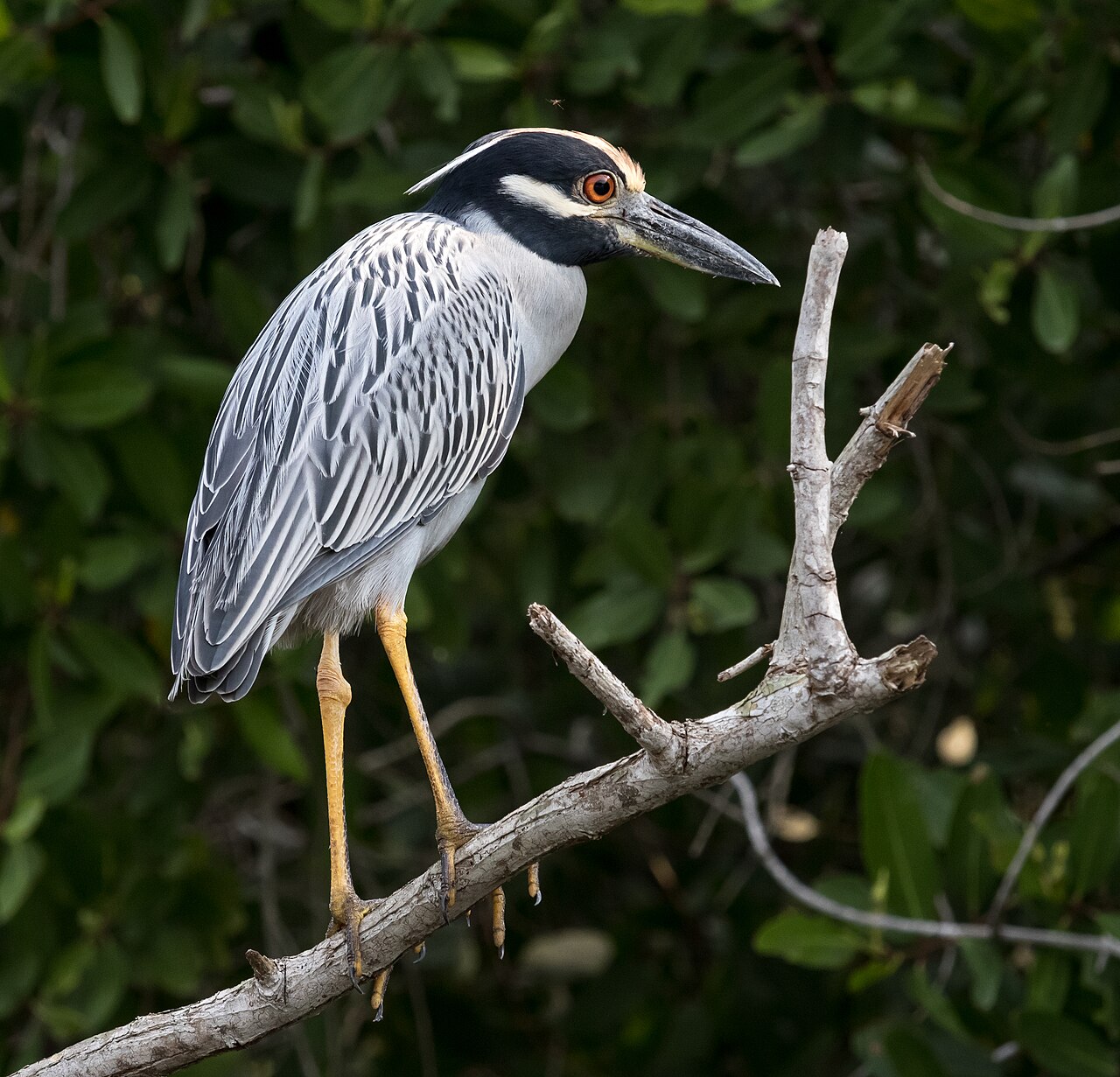
The Yellow-crowned Night-Heron is a stocky, red-eyed heron that specialises, by day and by night, in crabs and crayfish, which it cracks open with a sharp lunge of its heavy bill. Its black-and-white head pattern with a creamy yellow crown is unique among North American herons and identifies it at any distance. As the only living species in its genus, its closest relative is an extinct species from Bermuda.
Voice
On taking flight or when disturbed, the Yellow-crowned Night-Heron gives a loud, sharp squawk, which may be repeated several times in quick succession. Courting birds greet each other with a soft yup-yup and form a pair with a single, short huh. During display flights over the nest, heavy, deliberately slow wingbeats produce a dull, hollow whomp. Chicks in the nest beg with a soft chu-chu-chu that grows louder as they age.
No freely licensed recording has been found for this species yet; what to listen for is described below.
Identification
The adult Yellow-crowned Night-Heron is cloudy grey in the body, with a black head, a broad white cheek patch and a creamy yellow crown that rises into a short crest when the bird is excited. The legs are orange-yellow, brighter in older birds, and the heavy black bill is shorter and thicker than in most herons. Young birds are brown with fine white spots on the back and wings and a streaked breast, standing straighter and sturdier on their legs than young Black-crowned Night-Herons. In every plumage the posture is hunched, the neck often drawn in between the shoulders until the bird strikes.
Confusion species
By far the greatest confusion is with Black-crowned Night-Heron (Nycticorax nycticorax): adults are told apart by the black head with white cheek against the Black-crowned's plain black crown and back, but young birds of the two species are harder to separate. A young Yellow-crowned stands straighter, has longer legs and a heavier bill, and shows finer, more sharply defined white spots than the coarser, blurrier spotting of a young Black-crowned. American Bittern (Botaurus lentiginosus) is streaked brown all over and lacks the contrasting head pattern. Green Heron (Butorides virescens) is considerably smaller, with a chestnut neck.
Habitat
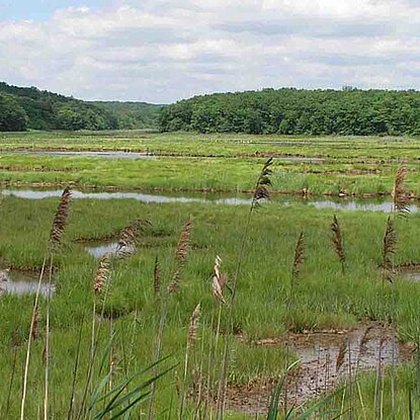
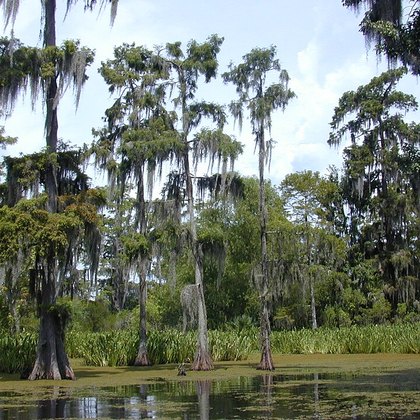
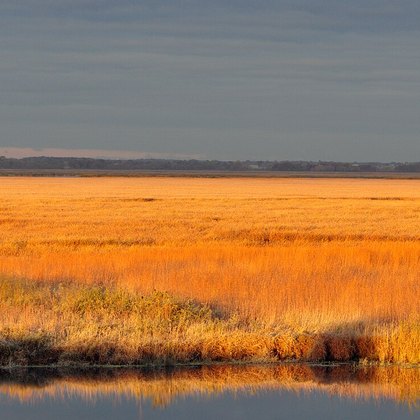
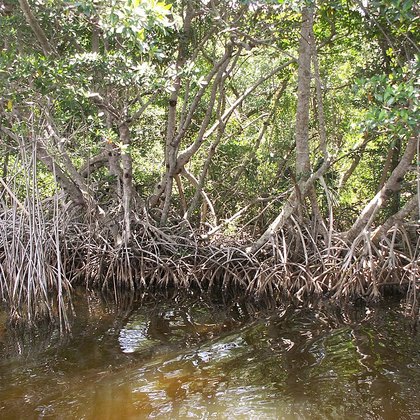
The Yellow-crowned Night-Heron hunts in shallow, often brackish water: salt marsh, mangrove, tidal creeks and ditches along the coast, where crabs are its main prey. Inland it uses swamp forest, stream banks and wet fields, where crayfish take the place of crabs. By day it rests hidden in dense trees or shrubs directly above or beside the water, becoming active at dusk and after dark. It has little use for open water without bank vegetation.
Where the bird is most often found, arranged by the USNVC — the vegetation classification of the United States and Canada — and CMECS for sea and coast.

Range and movements
The Yellow-crowned Night-Heron breeds from the Gulf Coast and Florida north along the Atlantic coast into the Midwest and northeastern states, with small, vulnerable populations at the northern edge of that range in states including Indiana, Illinois and Pennsylvania. In Florida and along the Gulf Coast it is present year-round; northern breeders move south in autumn to Mexico, Central America and the Caribbean. Beyond the United States the species breeds on through Mexico, Central America, the Caribbean and along the coast of South America to Peru and Brazil. Between 1925 and 1960 the breeding range gradually expanded north to the Canadian border, an expansion that has largely held since.
- Resident
- Breeding (summer)
- Winter
- Passage
- dark = core range, pale = thinly spread
Where and when to look
Look for the Yellow-crowned Night-Heron at dusk along a tidal creek or salt marsh, where it stands motionless and hunched, waiting for crabs; when flushed it gives itself away with a sharp squawk. Beneath a regular roost in dense trees, discarded crab claws often litter the ground — a reliable sign the bird spends its days there.
Conservation
Worldwide the IUCN rates the species of least concern, and the population is stable. At the northern edge of its range the picture differs: states such as Indiana, Illinois, Pennsylvania and Delaware list the Yellow-crowned Night-Heron as endangered, and Kentucky as threatened, owing to low numbers and the loss of swamp forest. Because crabs and crayfish accumulate heavy metals and pesticides low in the food chain, the species is also sensitive to pollution of the waters it hunts in.
Scientific name
Nyctanassa violacea | (Linnaeus, 1758)
Linnaeus described the species as early as 1758 as Ardea violacea, from the description and plate by the Englishman Catesby from Carolina; it has since been moved to another genus, hence the parentheses around author and year. The Norwegian-American zoologist Stejneger introduced the genus Nyctanassa only in 1887, built from the Greek nyx, 'night', and anassa, 'queen'. The epithet violacea is Latin for 'violet-coloured', though the Yellow-crowned Night-Heron's plumage looks grey rather than purple. The type locality is Carolina, in the southeastern United States.