All species › Waders, gulls and terns › Sandpipers and allies › Long-billed Dowitcher
Long-billed Dowitcher | Limnodromus scolopaceus
Grote Grijze Snip | Agujeta escolopácea
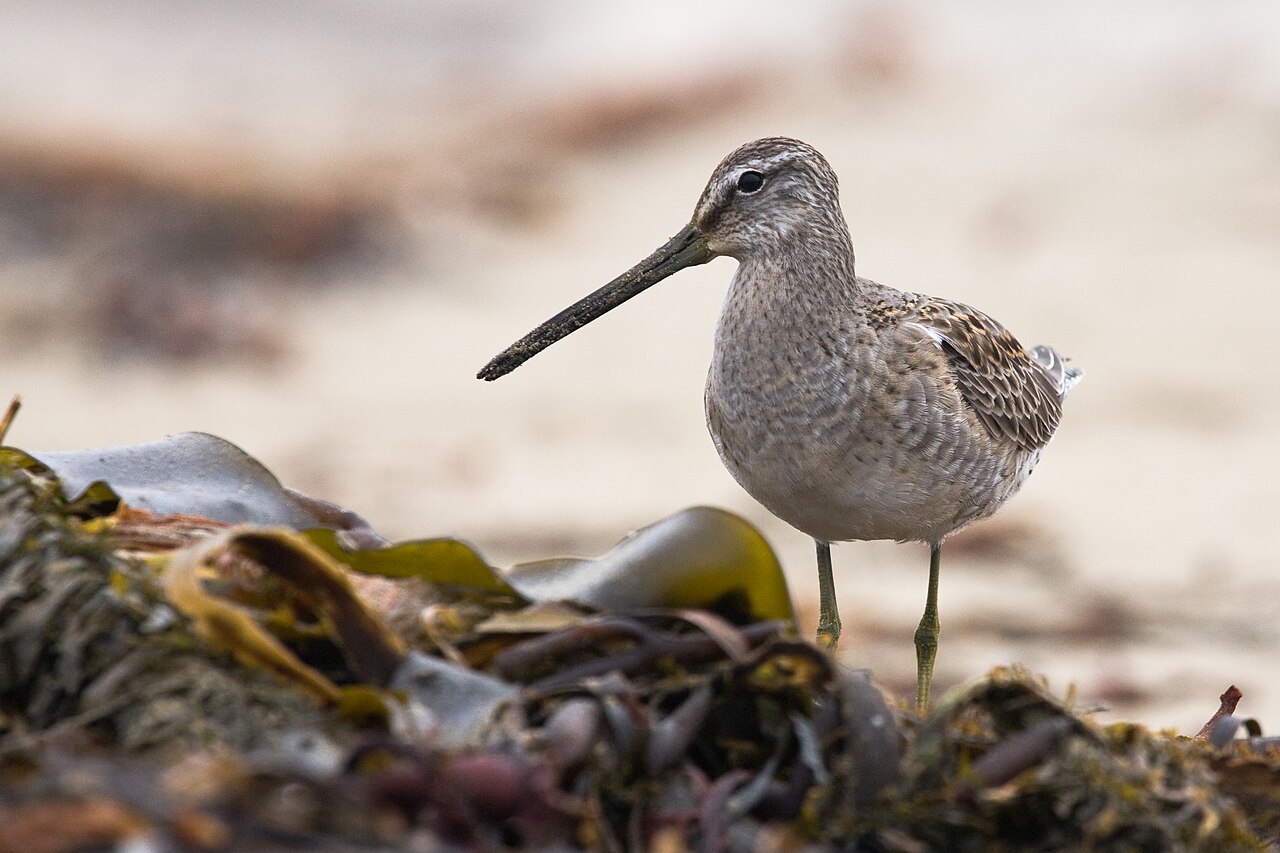
A thickset wader with a straight bill nearly twice the length of its head, which it drives into the mud up to the eyes in a fast sewing motion. From Short-billed Dowitcher it can often only be told with certainty by the call: a thin, high keek. It wants fresh water, and inland in the south it is the dowitcher that sits out the winter.
Voice
The call is a thin, high and sharp keek of one syllable, which from a rising flock runs together into a rattling keek-keek-keek. Feeding birds talk to one another softly and steadily in a fine twitter that sounds over a flock like a light rustle. Over the tundra the male hangs some twenty metres up on shivering, raised wings and repeats a rolling phrase, pee-ter-wee-too, for minutes on end. Away from the breeding grounds the flight call is the only thing heard from it, and that call is exactly the mark that decides.
Recording: AUDEVARD Aurélien — CC BY-NC-SA 4.0 · Utqiagvik, North Slope Borough, Alaska, United States · xeno-canto
Identification
A solid, rather hump-backed bird with a straight black bill about twice the length of the head, medium-long dark legs and a short tail. In flight a white wedge runs from the rump far up the back and the trailing edge of the wing has a narrow white border. In breeding plumage the upperparts are marked in black, gold and rufous and the entire underside, undertail coverts included, is brick red, with dark bars on the sides of the breast and on the flanks. In winter plumage the bird is even grey above and across the breast, sharply cut off from the white belly, with a pale supercilium. Juveniles have grey tertials with only a thin rufous edge and no markings inside the feather. It feeds with the body tilted up and the head deep under water, in a fast up-and-down motion that recalls a sewing machine.
Confusion species
Short-billed Dowitcher (Limnodromus griseus) is the most similar species, and the call is the surest division: the thin high keek of this species against a soft, full tu-tu-tu of two to four notes. The bill here averages longer and straighter with a flat tip, but the overlap is wide — a male of this species and a female of the other have the same bill — so never decide on it alone. In breeding plumage the red here runs on into the undertail coverts and the sides of the breast are barred, where Short-billed Dowitcher has spots there, orange feather edges and, in most birds, a white belly. On juveniles in August and September the tertial decides: here plain grey with a thin edge, on the other with stripes and bars inside the feather. Wilson's Snipe (Gallinago delicata) has a striped head and back, no white wedge up the back, and flies off in a fast zigzag.
Compare sandpipers, snipes and allies: bill, legs, wing bar and rump
Habitat
It breeds on wet sedge meadow in coastal tundra, with many small pools and a nest on a tussock close to the water. Outside the breeding season it looks for fresh and brackish water: flooded fields and rice fields, the drying shores of reservoirs, prairie pools, sewage lagoons and the reedy margins of shallow lakes. What it needs is a soft bottom with at most a few centimetres of water over it; deeper water it leaves to other species. On the Pacific it also uses tidal flats and lagoons, but the saltmarsh and the open tidal mud are rather the ground of Short-billed Dowitcher.
Where the bird is most often found, arranged by the USNVC — the vegetation classification of the United States and Canada — and CMECS for sea and coast.





Range and movements
The breeding range runs from the Lena in northeastern Siberia eastward by way of St. Lawrence Island to western and northern Alaska and the northwest of the Northwest Territories. Migration goes mainly through the western interior and over the Great Plains; in the east it is less numerous and appears later than Short-billed Dowitcher. It winters inland in the southern United States and throughout Mexico, along the Pacific from the Northwest to northwestern Costa Rica, and on the Atlantic and Gulf Coasts from the mid-Atlantic states to Yucatán. That the two species could only be told apart reliably from about 1950 makes older distribution data unusable: what was written down before that often does not say which of the two it was.
- Resident
- Breeding (summer)
- Winter
- Passage
- dark = core range, pale = thinly spread
Where and when to look
Go in October or November to a drying reservoir shore or a sewage lagoon in the interior: at that time of year nearly every dowitcher there is this species. Put the flock up — a walker or a passing Northern Harrier is enough — and listen for the thin keek; that settles what the bill does not settle. In winter the rule of thumb is that a flock on fresh water inland is this species and a flock on the tidal mud of an estuary is more likely Short-billed Dowitcher.
Conservation
The Red List holds the species as Near Threatened (NT), the step below the threatened categories, and the breeding population is put at about 650,000 birds. In the 2025 North American State of the Birds report it stands in the second heaviest category: more than half the birds have gone in fifty years, and the fall has steepened of late. The threats lie in the loss of shallow wetlands in the west, in pollution and pesticides in rice fields and treatment ponds, and in change on the tundra it breeds on.
Scientific name
Limnodromus scolopaceus | (Say, 1822)
Say described the species in 1822 as Limosa scolopacea, among the godwits; because it was later placed in the genus Limnodromus, author and year stand in parentheses. Limnodromus is formed from the Greek limne, 'marsh', and dromos, 'runner': the bird that runs over the marsh. scolopaceus means 'snipe-like', after the resemblance to the genus Scolopax. The described specimen was collected at Boyer Creek near Council Bluffs in Iowa, during Stephen Long's expedition to the Rocky Mountains in 1819 and 1820.