All species › Waders, gulls and terns › Sandpipers and allies › Short-billed Dowitcher
Short-billed Dowitcher | Limnodromus griseus
Kleine Grijze Snip | Agujeta Gris
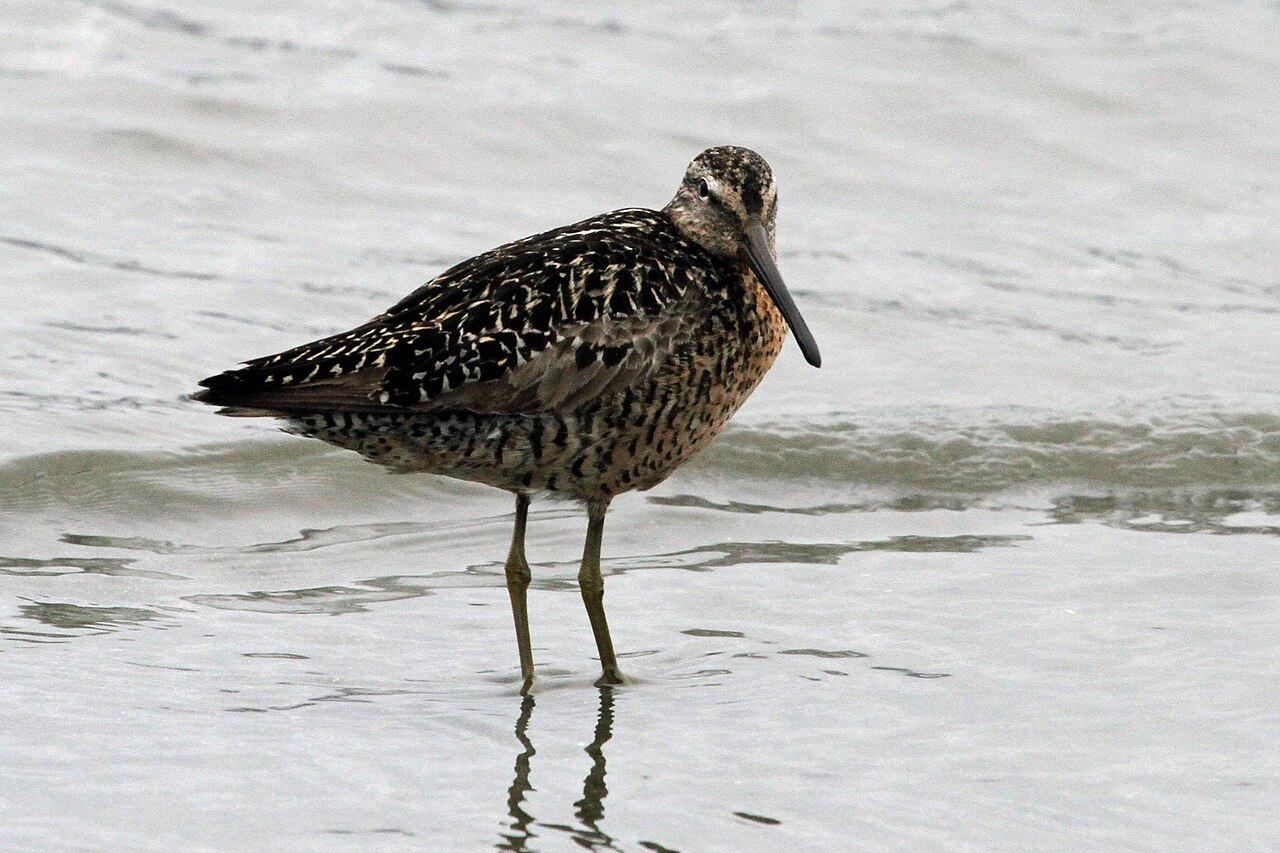
The dowitcher of salt water: on the tidal flats of both coasts, in July and August, flocks of these thickset birds stand probing the mud with a sewing motion. From Long-billed Dowitcher it is separated above all by the soft call, a full tu-tu-tu. Three subspecies breed in three widely separated places and differ in how much orange they carry below.
Voice
The call is a soft, full and slightly wistful tu-tu-tu of two to four notes, far lower and rounder than the sharp sound of Long-billed Dowitcher. When alarmed that series runs into a faster, rattling sound, but its tone stays the same. Over the breeding ground the male climbs in a display flight and repeats a rolling, swelling phrase that goes on for minutes. On the flats a feeding flock is nearly silent; the lifting of the flock is the moment the call comes, and with it the identification.
Recording: Stanislas Wroza — CC BY-NC-SA 4.0 · Isle aux Coudres, Canada · xeno-canto
Identification
A thickset, rather barrel-shaped bird with a long straight bill, medium-long legs and a short tail, a little larger than Lesser Yellowlegs and smaller than Greater. In flight a white wedge runs from the rump far up the back and the trailing edge of the wing has a narrow white border; the tail carries black and white bars of about equal width. In breeding plumage the upperparts are marked in gold and black and the underside is orange, with spots on the sides of the breast, small bars on the flanks and, in most birds, a white belly and undertail. In winter plumage the bird is grey-brown above and pale below, with a finely speckled breast less sharply cut off from the belly than in Long-billed Dowitcher. Juveniles are warmly marked, with an orange breast and with tertials and greater coverts that carry stripes and bars inside the feather. Feeding goes in a fast, vertical up-and-down motion, the bill deep in the mud and the head under water up to the eyes.
Confusion species
Long-billed Dowitcher (Limnodromus scolopaceus) is very similar, and the call is the surest division: the soft, full tu-tu-tu of this species against a thin and high keek, single or in a rattling series. The bill here averages shorter, a little thicker and with a blunt, slightly drooping tip, but the overlap is so wide that the bill on its own decides nothing. In breeding plumage the sides of the breast are spotted here and the feather edges of breast and flanks are orange, with a white belly in most birds, where Long-billed Dowitcher has bars, white edges and red running into the undertail coverts. On juveniles the tertial decides: here with stripes and bars inside the feather, on the other plain grey with only a thin edge. Place helps too: in winter this is the dowitcher of the tidal mud and the lagoon, the other that of fresh water inland.
Compare sandpipers, snipes and allies: bill, legs, wing bar and rump
Habitat
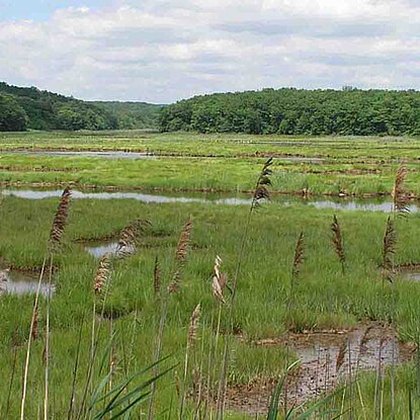
It breeds at the transition from taiga to tundra, in peat bogs and wet sedge meadows by lakes, the nest in a tussock close to the water. Outside the breeding season it is bound almost entirely to salt and brackish water: tidal flats in estuaries and bays, lagoons, salt pans and the edge of the mangrove. On passage inland it uses flooded fields, impounded pools and treatment ponds, always with a soft bottom and shallow water. Rocky coast and deep water it avoids, and in winter it leaves fresh inland water to Long-billed Dowitcher.
Where the bird is most often found, arranged by the USNVC — the vegetation classification of the United States and Canada — and CMECS for sea and coast.




Range and movements
The three subspecies breed far apart. Limnodromus griseus subsp. caurinus breeds on the south coast of Alaska, in southwestern Yukon and northwestern British Columbia and moves down the Pacific to California and beyond; subsp. hendersoni breeds from the southeast of the Northwest Territories through northern Alberta, Saskatchewan and Manitoba to the Hudson Bay lowland of Ontario and the islands of James Bay, and winters on the Atlantic and Gulf Coasts, in the Caribbean and in Central America; subsp. griseus breeds in northern Quebec and central Labrador and travels down the Atlantic coast to the Caribbean and northern South America. In May tens of thousands gather at Delaware Bay, where they feed themselves fat on horseshoe crab eggs. The adults move south in July and the juveniles only in August and September, a difference of weeks that shows on every tidal flat.
- Resident
- Breeding (summer)
- Winter
- Passage
- dark = core range, pale = thinly spread
Where and when to look
Go in July or early August on a falling tide to a tidal flat in an estuary: at that moment the adults are in and nearly every dowitcher there is this species. Put the flock up and listen — the soft tu-tu-tu settles what the bill does not settle. From late August it is the juveniles, and then the tertial with stripes inside it is the mark to watch for.
Conservation
The Red List holds the species as vulnerable, and in the 2025 State of the Birds report for North America it stands in the second heaviest category: more than half the birds have gone in fifty years. The breeding population is put at about 150,000 birds. Canada assessed the subspecies separately in 2024 and set caurinus on the heaviest step of its own list and hendersoni and griseus together on the step below. The heaviest threat is hunting on the wintering grounds; beyond that come loss of coast to building and sea-level rise, disturbance at the stopovers, and the decline of the horseshoe crab at Delaware Bay.
Scientific name
Limnodromus griseus | (Gmelin, 1789)
Gmelin described the species in 1789 as Scolopax grisea, among the snipes; since it was placed in the genus Limnodromus, author and year stand in parentheses. Limnodromus is formed from the Greek limne, 'marsh', and dromos, 'runner'. griseus is Medieval Latin for 'grey', after the winter plumage the described specimen was in. That specimen came from the shore of New York, that is to say from Long Island.