All species › Owls › Owls › Long-eared Owl
Long-eared Owl | Asio otus
Ransuil | Búho chico
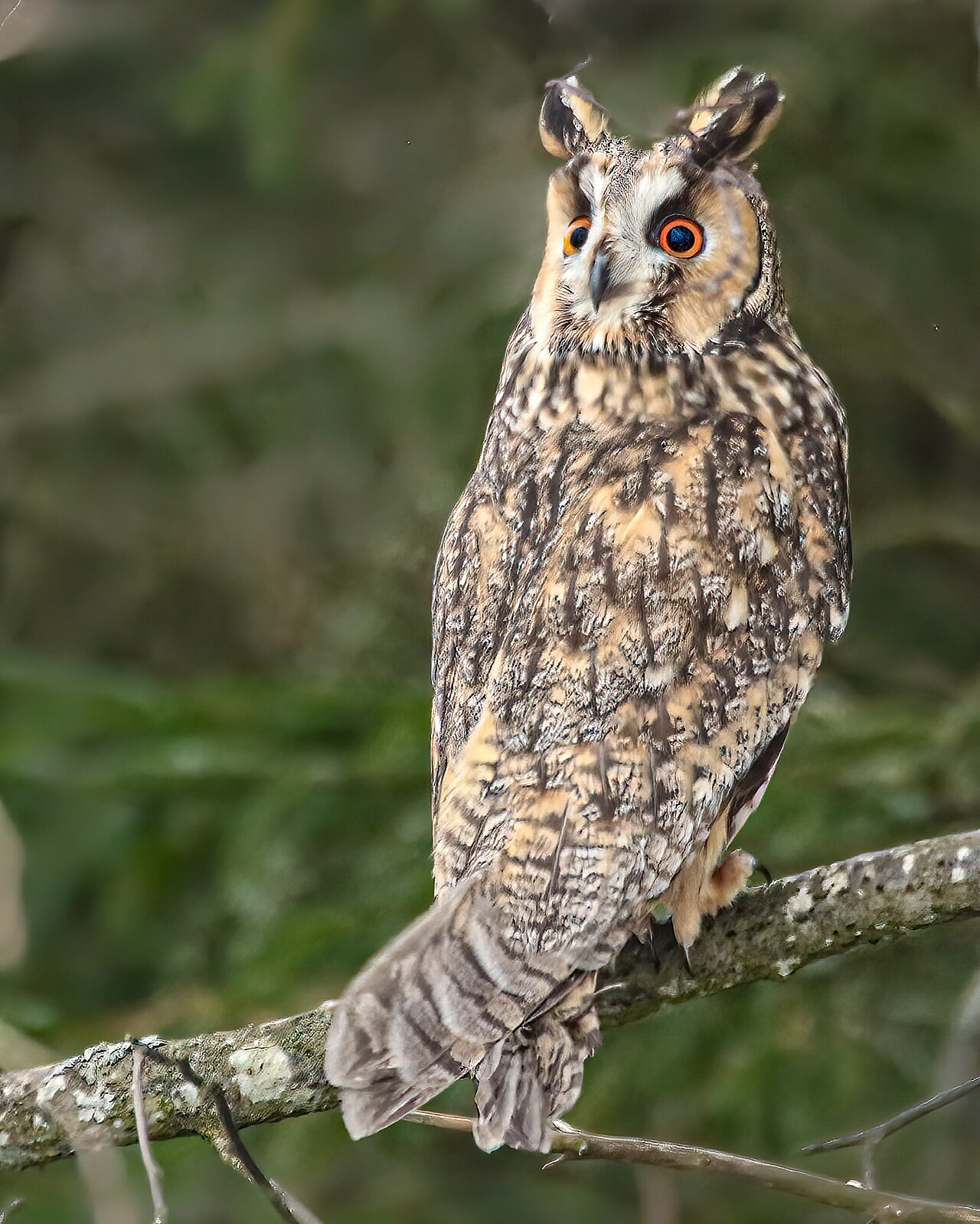
The Long-eared Owl is a slim night owl with long ear tufts set close together and orange-yellow eyes. By day it presses itself motionless against a trunk inside a dense spruce or willow, where it is hard to tell from the bark. In winter these owls roost in company, sometimes dozens in a single copse — almost the only time this inconspicuous bird is regularly seen.
Voice
The male gives a deep, soft hoo at intervals of two to four seconds, sometimes hundreds of times in succession; on a still night it carries more than a kilometre. The female answers higher, weaker and more nasal, like a thin tin whistle. Around the nest there are also barking and mewing notes, and, when the bird is disturbed, a dry clap of the wings beneath the body. Young birds beg with a long, grating squee-ip widely likened to a gate on a rusty hinge; in June that sound gives away nearly every breeding attempt.
Recording: Jean Pierre Sciolla — CC BY-NC-SA 4.0 · Arrondissement de Castres (near Caucalières), Tarn, Occitanie, France · xeno-canto
Identification
A medium-sized, slender owl with long ear tufts set close together in the middle of the crown and usually held upright. The narrow face is rusty orange, with a white vertical figure between the orange-yellow eyes that shows as a narrow X. The underparts are ochre-brown, streaked lengthwise and crossed by fine bars, producing a herringbone pattern. Male and female look alike; the female averages heavier and darker. In flight the wing is long and narrow, with a rusty orange panel at the base of the primaries and a dark mark at the wrist; the ear tufts lie flat and cannot be seen.
Confusion species
Short-eared Owl is the same size but paler and more buff, with yellow eyes in a black surround, barely visible tufts and streaking confined to the breast; it often hunts in the last of the daylight, while Long-eared Owl leaves only after sunset. Great Horned Owl (Bubo virginianus) is twice the weight, has widely spaced tufts and is barred rather than streaked below. The screech-owls are less than half as long and far stockier, with a big head on a short tail. If you find an owl in a dense conifer: when approached, Long-eared Owl draws itself tall and thin and raises its tufts, a posture neither of the others adopts.
Habitat
It needs two things at once: a dense stand to roost and nest in, and open ground to hunt over. The roost is usually a clump of spruce, juniper, willow or cottonwood; hunting is done low over grassland, rough ground, pasture and sagebrush (grey-green wormwood scrub of the dry western interior), searching by ear. It builds no nest of its own, taking over old nests of crows, magpies or raptors, and occasionally a cliff recess. Closed high forest without open country beside it is avoided, and in the arid west it is all but tied to groves along watercourses.
Where the bird is most often found, arranged by the USNVC — the vegetation classification of the United States and Canada — and CMECS for sea and coast.





Range and movements
The species occurs right around the northern hemisphere; in North America it breeds from southern Yukon and the Mackenzie Valley south to California and New Mexico. A broad middle band from British Columbia and southern Ontario to the Great Basin and New England holds birds all year, while northern breeders move south to the Gulf Coast and central Mexico. Movement is irregular and follows the vole supply: in a good rodent year many birds stay north, in a poor one they push far south, so a roost can be full one winter and empty the next. In the eastern United States it has declined sharply as a breeder with the loss of hayfields, hedgerows and small woodlots.
- Resident
- Breeding (summer)
- Winter
- Passage
- dark = core range, pale = thinly spread
Where and when to look
In winter, search beneath dense conifer shelterbelts next to open fields: under an occupied roost tree there is whitewash and a carpet of pellets five to eight centimetres long. Look up along the trunk from a distance — the birds sit tight against the wood, high in the crown and with their backs to the open side. A roost is abandoned once people walk in under the trees, so stay on the track or at the edge of the block.
Conservation
The species is listed globally as Least Concern (LC); Partners in Flight puts the breeding population at around 520,000 birds and gives the species a mid-range concern score; the trend is hard to establish, because a nocturnal, wandering owl is barely registered by standard breeding-bird surveys. There are signs of decline all the same, particularly where streamside woodland and isolated groves in the arid west disappear. As it builds no nest of its own it depends on crows and magpies being present; wire baskets placed in dense trees are accepted.
Scientific name
Asio otus | (Linnaeus, 1758)
Linnaeus described the species in 1758 as Strix Otus, among the wood owls; because it was later moved to another genus, author and year stand in parentheses. The genus Asio was introduced by Brisson in 1760; asio was the name used by the Roman writer Pliny for an owl with ear tufts. The specific name otus goes back to Greek ōtos, likewise 'owl with ears', so genus and species in A. otus name the same feature twice. The described specimen came from Europe; the type locality was later restricted to Sweden, after Linnaeus's Fauna Svecica.