All species › Passerines › Wrens › Marsh Wren
Marsh Wren | Cistothorus palustris
Moeraswinterkoning | Cucarachero pantanero
The Marsh Wren spends almost its whole life among cattail, bulrush and reed, and rarely rises above the vegetation. You hear it before you see it: a rattling, gurgling song from the thickest part of the marsh, in the breeding season also in the middle of the night.

Voice
The song opens with a few loose ticking notes and runs into a dry, gurgling rattle a second or two long, rising out of the reeds with the bird itself out of sight. Males sing from early morning until after sunset and often through the night as well. Western males command a far larger number of song types than eastern ones, and their rattle sounds drier and harder; eastern birds sound more liquid. The call is a sharp, hard tchek, often in a short series when the bird is uneasy.
Recording: Andrew McCafferty — CC BY-NC-SA 4.0 · Kidd Lake, Thompson-Nicola, British Columbia, Canada · xeno-canto
Identification
A small, compact wren, warm brown above with a rufous rump and a black back patch crossed by sharp white streaks. The white eyebrow is broad and clear, the crown dark and unstreaked. The underparts are white and unstreaked, with a buff wash on the flanks and undertail. The tail is short, finely barred and often cocked; the bill is thin and fairly long for a wren. Eastern birds are rustier, western birds greyer and more strongly marked.
Confusion species
Sedge Wren is smaller and paler, with a streaked crown, a short faint eyebrow and no sharply outlined black-and-white back patch; it sits in dry sedge and grass rather than standing water with cattail. Northern House Wren lacks both the eyebrow and the back streaking and does not breed in marsh. Marsh-dwelling sparrows such as Swamp Sparrow have a much thicker conical bill and do not cock the tail.
Habitat
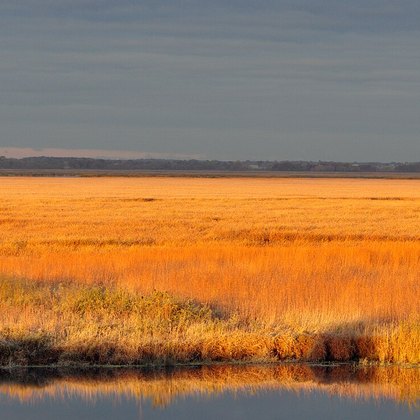
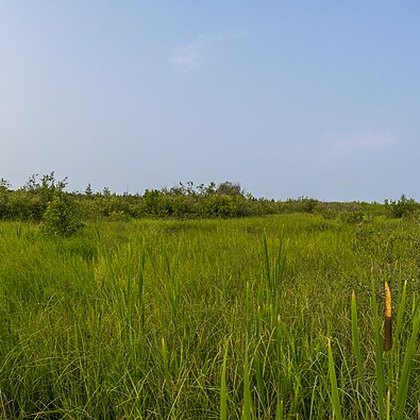
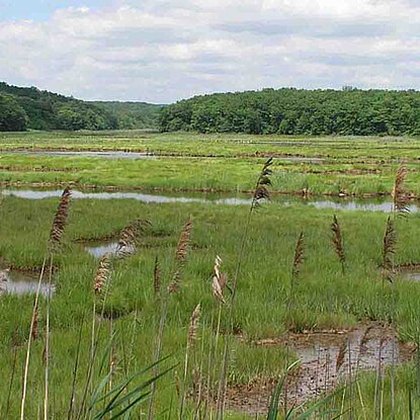
Freshwater marsh with cattail, bulrush, reed and sedge, and along the coast saltmarsh with cordgrass. It needs standing water under the vegetation; the nests are woven above the water between the stems. Outside the breeding season it also moves into reed fringes along canals, bankside rank growth and scrub close to water.
Where the bird is most often found, arranged by the USNVC — the vegetation classification of the United States and Canada — and CMECS for sea and coast.


Range and movements
It breeds from southern British Columbia and the Canadian prairie provinces east to the Atlantic coast, and south through the Midwest and the northern Atlantic states. Eastern and northern birds leave and winter in the southern United States, along the Gulf Coast and into northern Mexico. Along the Pacific coast, in the Great Basin and along the southern Atlantic coast it stays all year. Isolated resident populations hold on in the marshes of the Mexican plateau, in Hidalgo, the State of Mexico and Puebla.
- Resident
- Breeding (summer)
- Winter
- Passage
- dark = core range, pale = thinly spread
Where and when to look
The best chance is a windless morning in May or June along a reed fringe: the song gives away the spot, and a short pishing sound often brings the bird up onto a stem for a few seconds. Watch for the empty globular nests on the way — a male builds a series of them, and they stay visible among the cattail all year.
Conservation
The species is listed as Least Concern (LC), with a breeding population estimated at about 9.4 million birds. The pressure is the loss and fragmentation of marsh: drainage, lowered water levels and reed beds growing over remove local populations, while restored and created marshes are taken up again quickly. The small resident populations of the Mexican plateau are the most vulnerable, through their limited size.
Scientific name
Cistothorus palustris | (Wilson, 1810)
Alexander Wilson described the species in 1810 as Certhia palustris; because it was later moved to another genus, author and year stand in parentheses. The type material came from the banks of the Schuylkill and the Delaware at Philadelphia. The genus name Cistothorus is formed from Greek kistos 'shrub' and thouros 'leaping', after its leaping through the marsh vegetation. The species name palustris is Latin for 'of the marsh', from palus 'marsh'.