All species › Passerines › Wrens › Northern House Wren
Northern House Wren | Troglodytes aedon
Huiswinterkoning | Chivirín saltapared
The Northern House Wren is a handful of brown feathers with an enormous voice: barely twelve centimetres long, and still audible well above the background noise of a back garden. It nests in almost anything hollow — a nest box, a letter box, an upturned boot — and in summer it is one of the commonest birds of the woodland edge from southern Canada to Texas.

Voice
The song is a hurried cascade: a few hesitant squeaks, then a rolling, bubbling tumble of two or three seconds that climbs halfway through and falls away again. A male keeps it up from sunrise until evening, with hardly a pause between one burst and the next. Come too close to the nest and you get a sustained, angry churrr, alternating with a dry chek. In August the song stops and only that scolding still betrays where the bird is.
Recording: radrat — CC BY-SA 4.0 · Yolo Bypass Wildlife Area, Yolo County, California, United States · xeno-canto
Identification
Small, compact and plain warm brown, with fine dark barring on wings and tail and a faint paler line above the eye. Below it is greyish brown, a little paler on the throat, with barring only on the flanks and under the tail. Male and female cannot be told apart; juveniles have a slightly scaly breast. The tail is fairly long for a wren and by no means always held upright; the silhouette is that of a small mouse with a thin, slightly curved bill.
Confusion species
Winter Wren (Troglodytes hiemalis) and its western counterpart T. pacificus are darker and more rufous, with a much shorter, steeply cocked tail and heavy black barring on flanks and belly. Carolina Wren (Thryothorus ludovicianus) is a third larger, rusty, and has a broad white eyebrow visible far off. Bewick's Wren (Thryomanes bewickii) also has a white eyebrow and a long tail with white corners, which it swings from side to side. Of the four the house wren is the least marked: no face pattern, no contrast, only that faint line.
Habitat
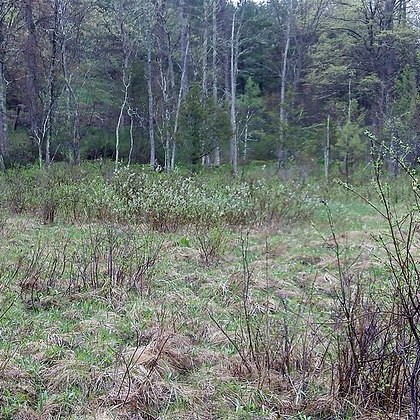
Half-open country with plenty of edges: woodland margins, hedgerows, neglected gardens, orchards, farmyards with brush piles and old sheds. What it needs is a cavity at low height with dense cover around it; closed high forest without an understorey and bare arable land are equally empty. In the west it goes high into the mountains, in aspen woods and along stream valleys. In winter it drops into dense rank growth, reed edges and scrub in the south, where it becomes almost invisible.
Where the bird is most often found, arranged by the USNVC — the vegetation classification of the United States and Canada — and CMECS for sea and coast.




Range and movements
Breeds from southern Canada to the southern United States, with a gap in the southeastern coastal plain, where it only winters. It spends the winter in the southern states and in Mexico, roughly as far as Oaxaca; in California, Arizona, New Mexico and Texas part of the population stays all year. In the northeast the birds now return earlier than they did half a century ago. Further south a related species takes over, and that is where this range ends.
- Resident
- Breeding (summer)
- Winter
- Passage
- dark = core range, pale = thinly spread
Where and when to look
In March hang a nest box with a small entrance hole at eye height on the edge of a garden with shrubs, and watch it: a male that sings around it all day will be there within a few weeks. In the field the song itself is the find — walk a woodland edge and stop at every bubbling outburst; the bird is usually three metres away, low in the scrub.
Conservation
The IUCN has not assessed this bird: AviList treats the northern house wren as a species of its own, while the Red List still uses the wider species concept that takes in the southern birds as well. That is why the entry reads 'not evaluated' and carries no category. The bird itself is doing well: it is numerous, numbers have risen rather than fallen since the 1960s, and nest boxes and untidy garden edges work in its favour.
Scientific name
Troglodytes aedon | Vieillot, 1809
Vieillot described the species in 1809 as Troglodytes aedon and introduced the genus Troglodytes in the same work; because the species has stayed in it ever since, author and year stand without parentheses. Troglodytes is Greek for 'cave dweller', from trogle 'hole' and duein 'to creep into'. aedon is the Greek word for nightingale and, in myth, the name of Aedon, who was turned into one. Vieillot gave no locality; Oberholser fixed the type locality at New York City in 1934.