All species › Gannets and cormorants › Boobies and gannets › Masked Booby
Masked Booby | Sula dactylatra
Maskergent | Piquero Enmascarado
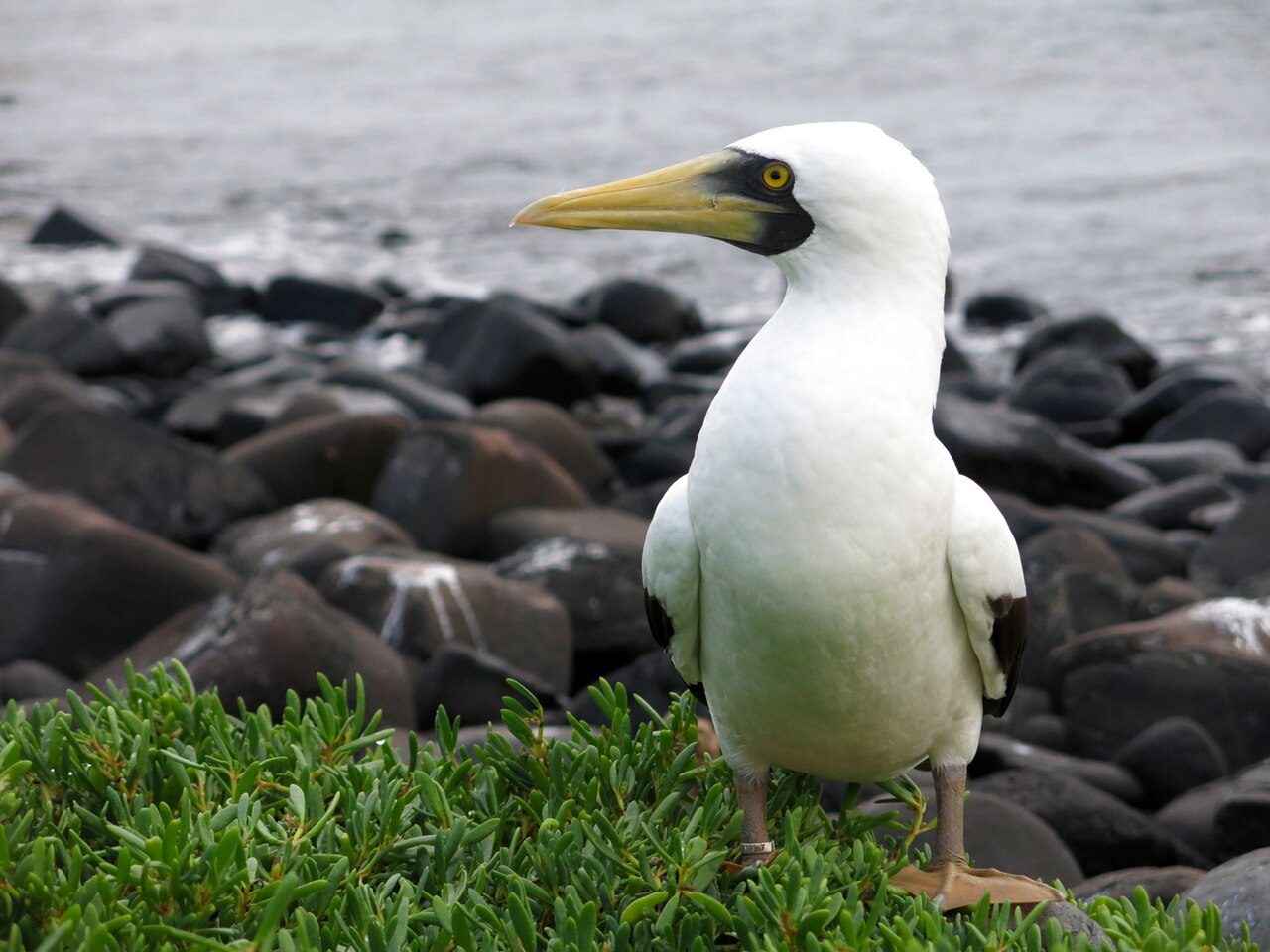
Masked Booby is the largest of the tropical boobies in this area: snow-white with black flight feathers and a black tail, and a black mask of bare skin around the yellow bill. On the Dry Tortugas off the coast of Florida breeds the only permanent colony within the United States.
Voice
At sea it is, like the other boobies, generally silent. At the colony the male gives a thin, whistling call, while the female produces a loud, hoarse trumpeting that carries across the whole colony. In greeting between partners they throw the head back and briefly clatter the bill, as in almost all boobies.
Recording: Eric S. J. Tan — CC BY-NC-SA 4.0 · Cliffs north of Red Road, Norfolk Island, South Pacific Ocean, Australia · xeno-canto
Identification
Adults are entirely snow-white apart from the black primaries, secondaries and tail, with a yellow-orange bill, yellow iris and a blue-black facial mask. The legs are grey-green, less brightly coloured than in Blue-footed or Red-footed Booby. Young birds are dark brown on the head and upperparts with a pale collar and a white lower belly, and only gain the white adult plumage after several years. In flight it is a heavy, stiff-winged booby with straight, narrow wings, travelling low over the water with short wingbeats and glides. Two eggs are the norm, but almost always only one chick survives: the first-hatched young drives out or kills its younger nest mate.
Confusion species
In the North Atlantic part of the range, Northern Gannet is the main confusion species: it has an entirely white tail, only black wingtips rather than black primaries and secondaries, a blue-grey rather than yellow bill, and a golden wash over the head that Masked Booby lacks. Nazca Booby (Sula granti) is nearly identical but has an orange-pink rather than yellow bill; the two overlap only along the Pacific coast of Mexico. Young birds are confused with young Brown Booby, which is more evenly brown, lacks the pale collar, and has yellowish rather than grey-green legs.
Habitat
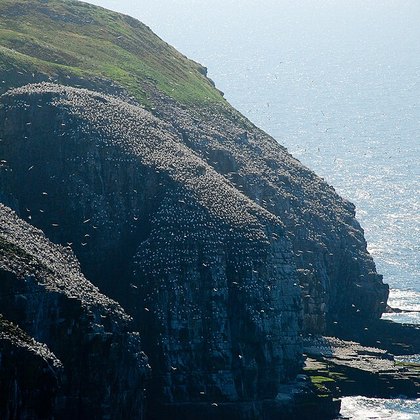
Breeding colonies sit on bare, open ground on low coral islands and sandbanks, such as the Dry Tortugas, or on more rocky terrain elsewhere in the range. Outside the breeding season it is a true ocean bird, hunting fish and squid far from shore, often in the company of tuna shoals that drive prey fish to the surface. It makes little use of sheltered waters close to the mainland.
Where the bird is most often found, arranged by the USNVC — the vegetation classification of the United States and Canada — and CMECS for sea and coast.


Range and movements
The species breeds around the equator in all three oceans; within the area of this guide the main colony is on the Dry Tortugas, where protection since the early twentieth century allowed a population once thinned by egg and feather hunting to recover. It also breeds on reefs and cays in the southern Gulf of Mexico, including Alacrán Reef off the coast of Yucatán. Outside the breeding season it wanders over the tropical Atlantic and turns up irregularly as far north as the Gulf Stream off North Carolina.
- Resident
- Breeding (summer)
- Winter
- Passage
- dark = core range, pale = thinly spread
Where and when to look
The boat trip to the Dry Tortugas, from Key West, is the most reliable way to see the species within the United States, year-round at the colony on Hospital Key. Look for the black tail and yellow bill to separate it at once from Northern Gannet, should that species also show up.
Conservation
The species is listed worldwide as Least Concern (LC), with a stable to slightly increasing trend. The Dry Tortugas colony, once nearly wiped out by egg and plume hunting, is one of the earliest bird-conservation success stories in the United States: the area was declared a federal bird reservation as early as 1908. Hurricanes, which can sometimes wash entirely over the low breeding islands, remain the chief natural threat.
Scientific name
Sula dactylatra | Lesson, 1831
Lesson described the species in 1831 as Sula dactylatra; it has remained in the same genus, so author and year do not stand in parentheses. The type locality is Ascension Island, in the middle of the South Atlantic Ocean. The epithet dactylatra is built from Greek for 'finger' and Latin for 'black', and probably refers to the black primaries that project like 'fingers' at the wingtip.