All species › Gannets and cormorants › Boobies and gannets › Nazca Booby
Nazca Booby | Sula granti
Nazcagent | Piquero de Nazca
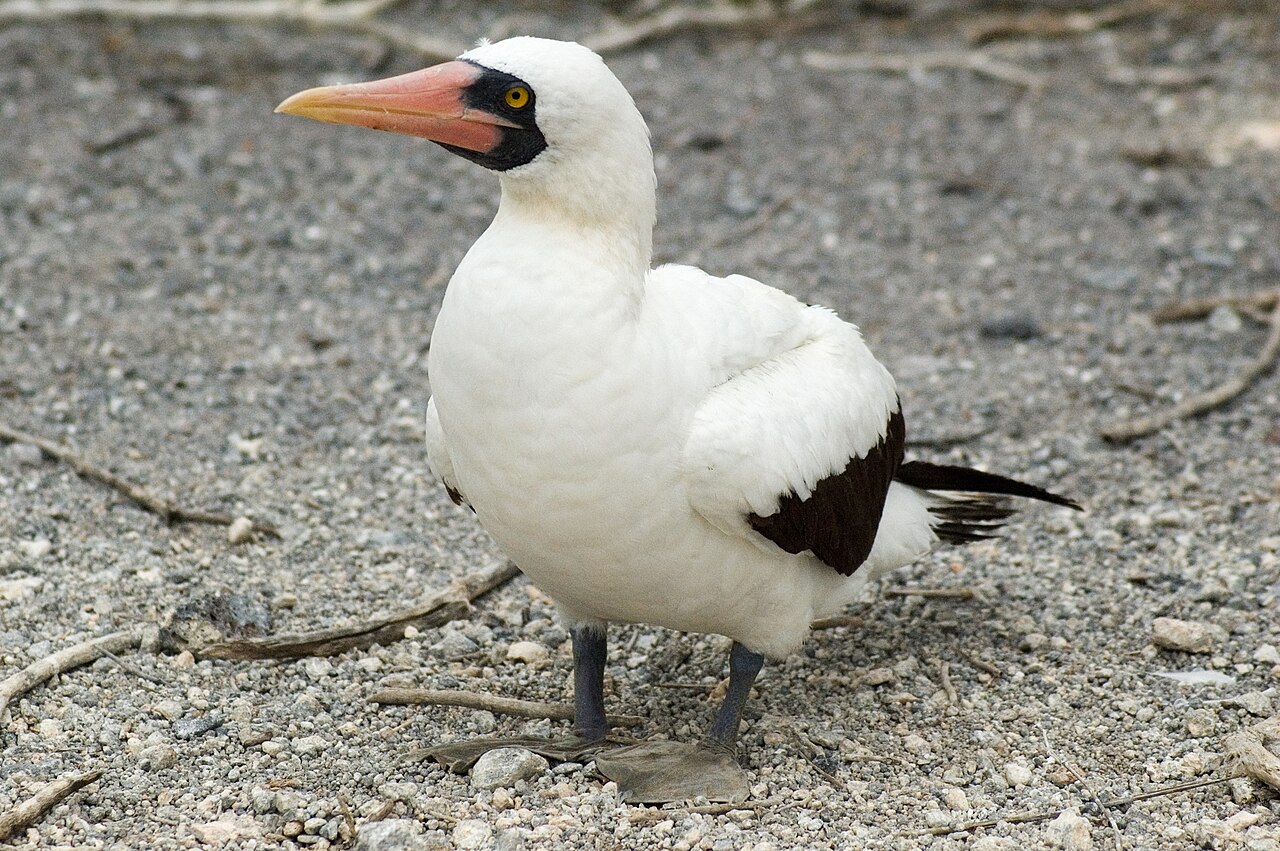
Nazca Booby was treated as a subspecies of Masked Booby until 2002, when research into behaviour, voice and bill colour showed it to be a species in its own right. It resembles Masked Booby in almost every respect, but the orange-pink bill, rather than yellow, is the one difference recognisable at any distance.
Voice
As in most boobies, the voice differs sharply between the sexes: the male gives a thin, sustained whistle, the female a loud, hoarse quacking that sounds almost like a bark. At the colony it is mainly the female's call that carries far, for instance during the courtship greeting in which partners point the bill skyward. Away from the colony, at sea, the species is, like Masked Booby, almost entirely silent.
Recording: Bram Vogels — CC BY-NC-SA 4.0 · Punta Suarez, San Cristobal, Islas Galápagos, Ecuador · xeno-canto
Identification
Adults are snow-white with black primaries, a black tail and a dark facial mask around the base of the bill and the eyes, exactly as in Masked Booby. The distinguishing feature is the bill: orange to pink rather than yellow in Nazca Booby, often with a slightly pinker tone in the male than the female. The legs are grey-blue and the iris is yellow. Young birds are brown with a white lower back and belly and a dark head, and only reach adult plumage after several years; at that stage they are barely told from a young Masked Booby. In flight, like Masked Booby, it is a heavy, straight-flying booby with narrow, pointed wings.
Confusion species
By far the greatest confusion is with Masked Booby (Sula dactylatra): apart from bill colour — orange-pink versus yellow — the two are all but identical, and only late-twentieth-century research separated them for good. Nazca Booby's silhouette is on average slightly heavier with a marginally longer tail, but that difference is hardly usable in the field. Where its range meets the breeding grounds of Blue-footed Booby (Sula nebouxii), that species is told apart at once, in any plumage, by its blue legs.
Habitat
Breeding colonies sit on bare, open ground near cliffs, with little to no vegetation — similar terrain to that used by Masked Booby, but more often on the rocky, volcanic soil of islands in the eastern Pacific. Outside the breeding season it hunts far out over the open ocean for fish and squid, plunge-diving at times from tens of metres up. It uses coastal waters close to the mainland mainly on passage or as a non-breeding wanderer.
Where the bird is most often found, arranged by the USNVC — the vegetation classification of the United States and Canada — and CMECS for sea and coast.

Range and movements
Most of the world population breeds on the Galápagos Islands; within the area of this guide the nearest colonies lie on the Revillagigedo Islands off the coast of Colima, Mexico, with smaller numbers on the remote Clipperton Island further west. After breeding, mainly young birds disperse north along the coast of Baja California, where they are regularly seen on boat trips from the tip of the peninsula. Further south the species also breeds on Isla Malpelo (Colombia), Isla de la Plata (Ecuador) and Lobos de Afuera (Peru), outside the guide area.
- Resident
- Breeding (summer)
- Winter
- Passage
- dark = core range, pale = thinly spread
Where and when to look
Pelagic boat trips from Cabo San Lucas or La Paz, at the southern tip of Baja California, give the best chance of the species within this area, especially in late summer and autumn when young birds from the Revillagigedo colonies wander north. Check bill colour, not size, to tell it from Masked Booby.
Conservation
The species is listed as Least Concern (LC), with the largest, well-studied colonies on the Galápagos Islands. Strong El Niño years, with warmer seawater and less fish, can sharply reduce breeding success in the short term, but no sustained long-term decline has been established. Introduced predators on uninhabited breeding islands remain the main local threat.
Scientific name
Sula granti | Rothschild, 1902
Rothschild described the species in 1902 as Sula granti; it has remained in the same genus, so author and year do not stand in parentheses. The type came from Culpepper (now Darwin) Island in the Galápagos. The epithet granti bears the surname of someone named Grant, to whom Rothschild dedicated the species; exactly who is meant is not stated in the original source. Until 2002 the species was treated as a subspecies of Masked Booby, until DNA research, differences in courtship behaviour and the distinct bill colour raised it to full species.