All species › Passerines › Finches, euphonias and allies › Maui Alauahio
Maui Alauahio | Paroreomyza montana
Mauikruiper | Alauahio de Maui
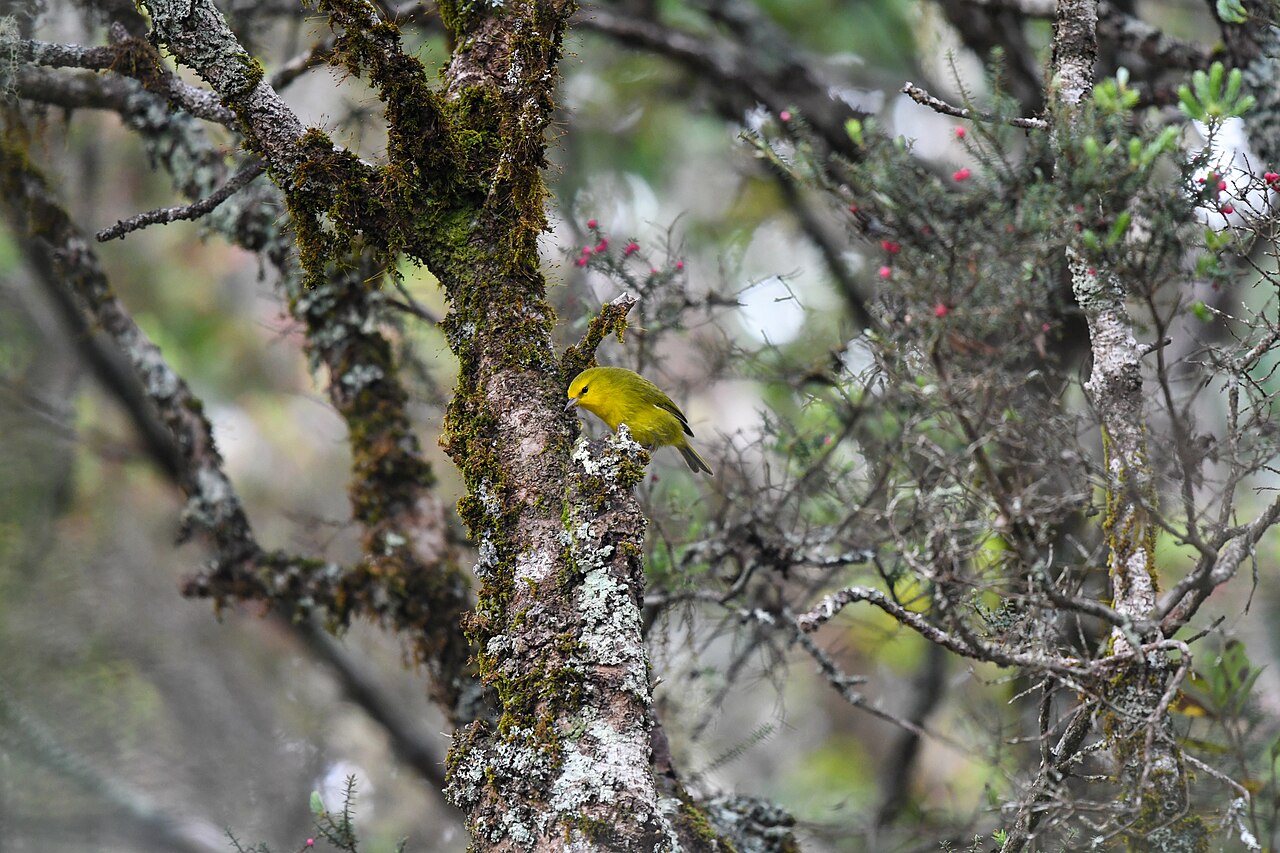
The Maui Alauahio is a small yellow-green honeycreeper with a short, straight bill that moves through ohia and koa canopy in small parties. It is the most numerous native forest bird of East Maui; the Lanai form, from which the type came, died out in the 1930s.
Voice
The call is a loud, clear cheep, far stronger than the size of the bird suggests and often the first sign of a roving party. The song is a short whistled phrase repeated several times over, without the buzzy edge of an amakihi. Family groups keep almost continuous contact with soft notes as they work through the canopy.
No freely licensed recording has been found for this species yet; what to listen for is described below.
Identification
The male has a yellow head, throat and breast and olive-green upperparts; the female is duller and greener on the head. The bill is short, straight and pointed, and there is no dark lore. Juveniles are greyish green above and pale grey below with two faint wingbars, and need several years to reach adult plumage. It forages fast and acrobatically over branches and twigs, also climbing up and down trunks and flipping bark flakes and lichen for spiders and the larvae and pupae of moths. Young stay with their parents for up to twenty months, and in intact forest nearly every pair has an older offspring helping at the nest.
Confusion species
Hawaii Amakihi, which shares the forest on Maui, has a clearly decurved bill, a black lore and a duller, greyer green, and hangs at flowers more often. Kiwikiu is far larger with a heavy hooked upper mandible. The introduced Warbling White-eye has a broad white eye-ring and a finer, slightly curved bill. In doubt: a straight bill plus the absence of a dark lore points to Maui Alauahio.
Habitat
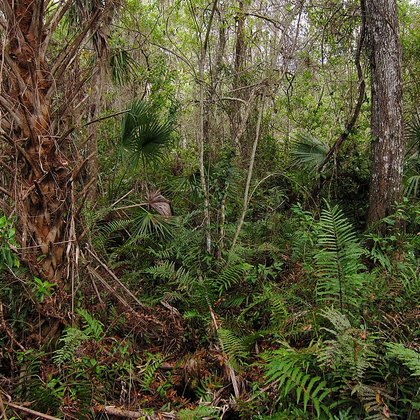
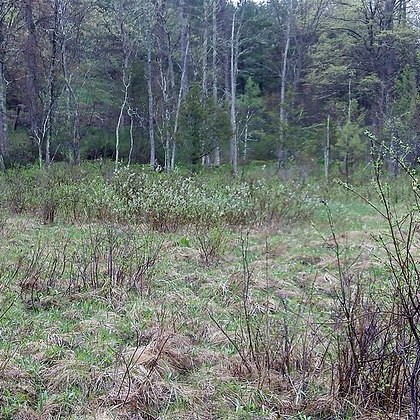
Native montane rainforest of ohia and koa above about 900 metres on East Maui, plus a planted conifer stand at Polipoli and a remnant of dry forest on the lee side of Haleakala. It uses both canopy and understorey and is less tied to flowers than the nectar-feeding honeycreepers, which makes it less dependent on the ohia flowering season.
Where the bird is most often found, arranged by the USNVC — the vegetation classification of the United States and Canada — and CMECS for sea and coast.

Range and movements
Endemic to the Maui Nui islands. The nominate form held Lanai and was not found after the 1930s; the subspecies newtoni survives on East Maui, where three populations remain: the rainforest of Haleakala National Park and the Hanawi reserves, the conifer plantation at Polipoli and the dry forest of Kahikinui. It has gone from West Maui. Between 1980 and 2001 no statistically detectable trend emerged, though estimates vary widely from survey to survey. The species is resident; there is no seasonal migration, at most altitudinal movement.
- Resident
- dark = core range, pale = thinly spread
Where and when to look
The trail at Hosmer's Grove in Haleakala National Park and Polipoli Springs give the best chance in the early morning. Do not look for a perched bird but for movement in the middle storey: parties give themselves away by the loud call and pass through a tree within minutes. Watch the straight bill in silhouette, since the yellow tones wash out against the light.
Conservation
The Red List treats the species as Endangered, mainly for its small range and its susceptibility to avian malaria: about three-quarters of birds die after the bite of an infected mosquito. The range therefore lies above the elevation at which mosquitoes persist year-round, and that line is moving upward with temperature. Forest damage by feral pigs, goats and deer and the spread of alien plants such as strawberry guava add to the pressure. Fencing around the Hanawi and Haleakala reserves and ungulate removal are the running measures; mosquito suppression with sterile males is under way on East Maui.
Scientific name
Paroreomyza montana | (Wilson, 1890)
Scott Wilson described the species in 1890 as Himatione montana from a specimen taken on Lanai; because it later moved to another genus, author and year stand in parentheses. Paroreomyza is formed from Greek para 'beside, near' and the genus name Oreomyza, marking the close relationship with the creepers of Kauai and Hawaii. The species name montana is Latin for 'of the mountains'. The Hawaiian name Alauahio is the one used here; older literature calls the bird Maui Creeper.