All species › Parrots › African and New World parrots › Monk Parakeet
Monk Parakeet | Myiopsitta monachus
Monniksparkiet | Cotorra argentina
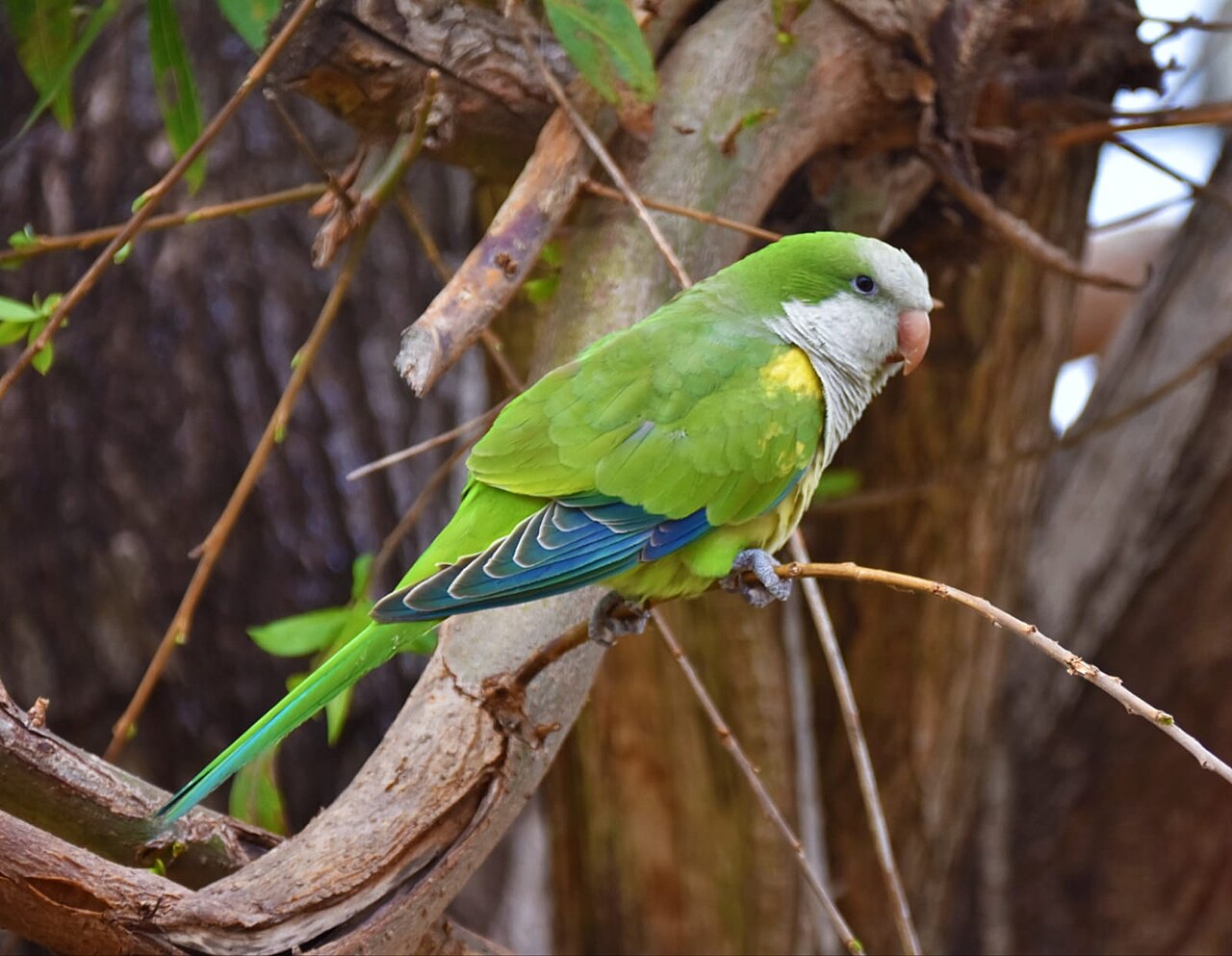
The Monk Parakeet is the only parrot that builds its own stick nest, and it builds it next door to the neighbours: a single structure can reach the size of a small car, with some twenty chambers and in extreme cases more than two hundred. It is grass green with a grey forehead and a grey breast — the hood that gave it its name. The nest is occupied all year, through the snow of Chicago and New York as well.
Voice
Loud, shrill and unrelenting: a harsh, throaty quak quaki quak-wi quarr that carries the length of a street, and a sharp skveet as a bird takes off. A working colony sounds like an argument with no end; birds call as they arrive, as they drag branches, and from inside the chambers. Unlike most songbirds it is loudest in the middle of the day, and as vocal in winter as in spring. Anyone looking for the species in a city almost always hears it first.
Recording: Tanguy Loïs — CC BY-SA 4.0 · Comarca Metropolitana de Sevilla (near Seville), Seville, Andalusia, Spain · xeno-canto
Identification
Bright grass green on head, back and wing bend, with a pale grey forehead, grey cheeks and a grey, finely scalloped throat and breast; the belly is yellow-green. In flight the dark blue flight feathers stand out, along with the long pointed tail, which makes up nearly half the bird. The bill is heavy and orange-horn, the legs grey. Male and female cannot be told apart in the field; females average slightly smaller, but the difference is too small to work with. Young birds show a greener wash across the forehead. The flight is fast, straight and low, on short quick beats, usually in noisy parties of a handful of birds.
Confusion species
The other naturalised parakeets of the same cities are smaller and lack the grey breast: White-winged and Yellow-chevroned Parakeet (Brotogeris) are shorter-tailed and flash a white or yellow wing panel in flight. Rose-ringed Parakeet, naturalised in California and Hawaii, is slimmer, far longer-tailed and has a red bill; the male wears a black and rose collar. Large green parrots such as Red-crowned Parrot have a short broad tail, red on the head and a much heavier flight. When in doubt, look at the breast: grey and scalloped is Monk Parakeet and nothing else.
Habitat
Cities, suburbs, parks, cemeteries and college campuses, wherever tall palms, old trees and feeders come together; also farmland with tree lines, ranch buildings and grain silos. For the nest it picks a high, free-standing site no climbing predator can reach: palm crowns, light poles, transmission towers, stadium floodlights and above all the steel frames of electrical substations. It does not use closed forest, and away from human building it is scarcely found in this region at all. In its original range it lives in open dry woodland and savanna.
Where the bird is most often found, arranged by the USNVC — the vegetation classification of the United States and Canada — and CMECS for sea and coast.





Range and movements
Its original range lies in South America, from Bolivia and southern Brazil to central Argentina; that falls outside this map. In North America it began as a cage bird: thousands were imported between 1960 and 1980, the first free-flying birds appeared in New York in 1968, and the first Florida nesting was recorded in 1969. By the early 1970s it held seven states and by 1995 fifteen; the settled colonies now lie mainly in Florida, Texas, Louisiana, Illinois, New York, New Jersey, Connecticut and Rhode Island, with smaller ones in Oregon and California and a strong population in Puerto Rico. In Mexico it appeared in Mexico City around 1994 and by 2015 had been reported from ninety-seven cities. It does not migrate: the colony stays in one place all year.
- Resident
- Breeding (summer)
- Winter
- Passage
- dark = core range, pale = thinly spread
Where and when to look
Look for the nest rather than the bird: a dark bundle of sticks high in a palm, on a light pole or against a substation, visible from a distance and lived in year round. Stand near one in the first hour after sunrise, when the residents come in carrying branches and the number of pairs can be counted. In winter the nests are easiest to find, with the trees bare.
Conservation
The species is of Least Concern worldwide and is still increasing in North America. The conflict is with the power companies: in one south Florida study sixty per cent of nests sat on energised electrical equipment, and removing 3,126 nests between 2003 and 2007 was estimated to cost 1.3 to 4.7 million dollars. The large-scale damage to fruit and grain that was feared on its arrival has not materialised, though tropical crops such as longan and mango are locally pecked.
Scientific name
Myiopsitta monachus | (Boddaert, 1783)
Boddaert described the bird in 1783 as Psittacus monachus, from a coloured plate by Daubenton; because it was later moved to another genus, author and year stand in parentheses. The genus Myiopsitta was introduced by Bonaparte in 1854 and is built from Greek muia, 'fly', and psitta, 'parrot'. monachus is Latin for 'monk', after the grey hood and breast, which suggest a friar's habit. The plate carried no locality; it was later fixed on Montevideo in Uruguay.