All species › Passerines › New World sparrows › Nelson's Sparrow
Nelson's Sparrow | Ammospiza nelsoni
Nelsons spitsstaartgors | Chingolo de Nelson
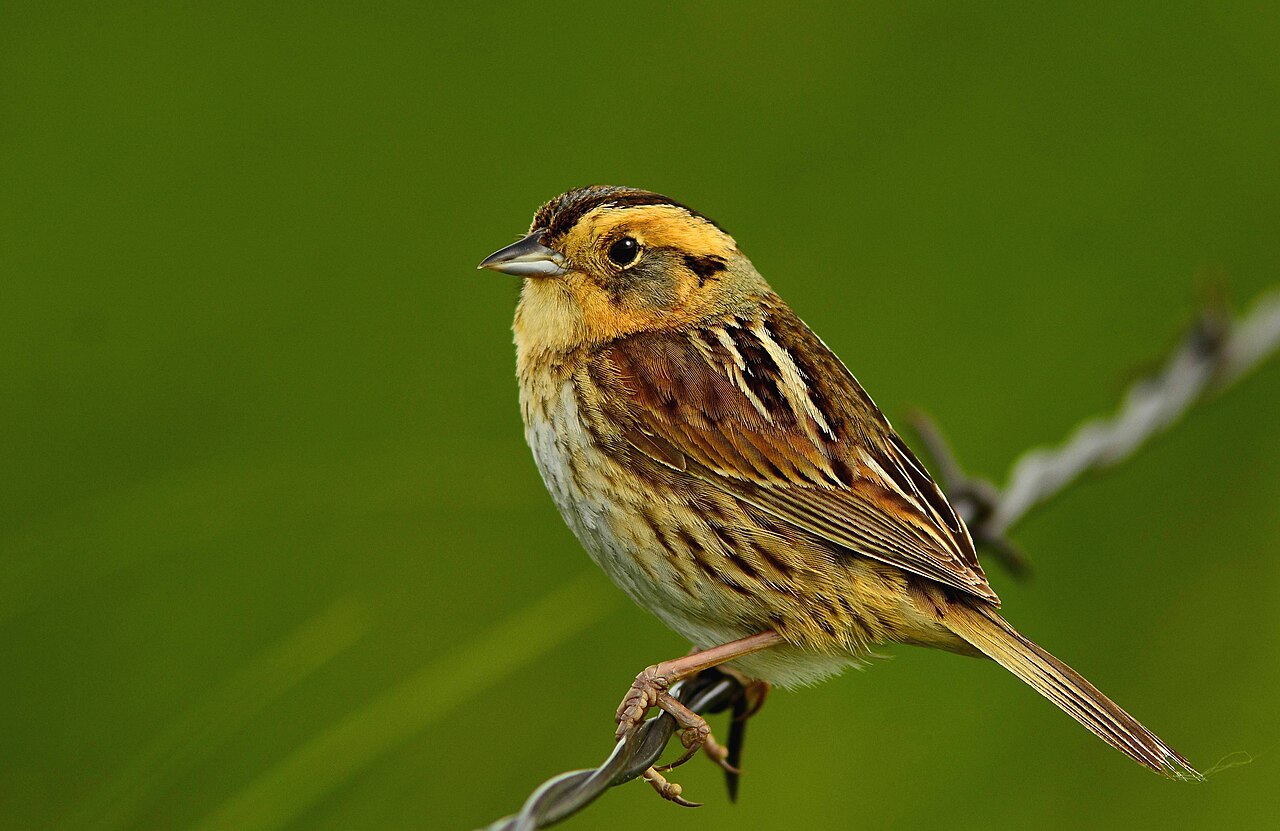
Nelson's Sparrow is a small marsh sparrow with an orange face triangle and a grey nape, breeding in three separate areas: the freshwater marshes of the prairie provinces, the sedge fens along Hudson Bay, and the tidal marshes of Atlantic Canada and Maine. Until 1995 it was treated as one species with Saltmarsh Sparrow.
Voice
The song is short and barely musical: a hurried, raspy trill of about a second that sounds like a drop of water on a hot pan, introduced by two or three soft ticks. It is delivered both from cover and in a low song flight, and is heard mainly in the early morning and after sunset. The call is a thin, high tsip.
Recording: Matt Wistrand — CC BY-NC-SA 4.0 · Prairie Green, Kane County, Illinois, United States · xeno-canto
Identification
The head is orange to ochre on the eyebrow and the edge of the cheek, with a grey ear patch and a grey central crown stripe; the nape is grey. The breast is orange-buff with faint, soft streaking that strengthens towards the flanks; throat and belly are white. The back is greyish brown with white mantle stripes, the tail short and pointed. The subspecies differ: Atlantic birds are greyer and duller, prairie birds the brightest orange.
Confusion species
Saltmarsh Sparrow, which breeds alongside it in Maine and New Brunswick, has sharply defined black streaking on a white breast, a longer and finer bill and a flatter forehead; on Nelson's the breast streaking is faint and diffuse and the orange runs unbroken across the breast. Seaside Sparrow is much larger, greyer and longer-billed and lacks the orange face. LeConte's Sparrow has a white central crown stripe and fine chestnut streaks on a lilac nape, and lives in freshwater sedge meadow.
Habitat
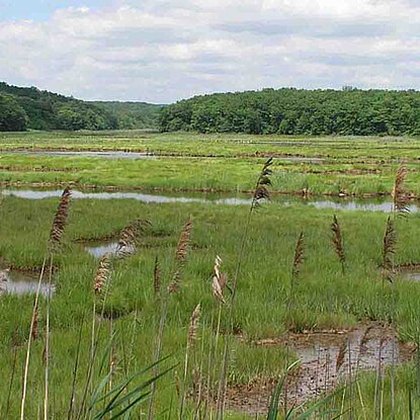
Inland, shallow freshwater marsh, filling-in prairie potholes and wet sedge meadow with cattail and bulrush; on Hudson Bay, sedge fen just above tidal influence; on the Atlantic coast, the higher parts of brackish and salt marsh, often alongside Saltmarsh Sparrow, and adjoining rough grassland. In winter, salt and brackish coastal marsh only.
Where the bird is most often found, arranged by the USNVC — the vegetation classification of the United States and Canada — and CMECS for sea and coast.




Range and movements
The inland breeding range runs from Alberta through Saskatchewan and Manitoba to North Dakota, South Dakota, Minnesota and Montana; the Hudson Bay population breeds along the coast of Manitoba, Ontario and Quebec; the Atlantic population in Quebec, New Brunswick, Nova Scotia, Prince Edward Island and Maine. Inland birds migrate through the Great Plains and the Mississippi valley to the Gulf Coast. It winters in coastal marsh from Texas to Virginia, with the largest numbers along the Gulf Coast and the Carolinas.
- Breeding (summer)
- Winter
- Passage
- dark = core range, pale = thinly spread
Where and when to look
In September and October, when inland and coastal birds move through the marshes together, high water gives the best chance: walk a marsh trail slowly and watch for small, short-tailed sparrows coming up out of the cordgrass. On every bird look at the breast first — faint and orange on Nelson's, sharply black-streaked on white on Saltmarsh.
Conservation
The species is listed as Least Concern (LC). Partners in Flight puts the world population at about one million birds and the Breeding Bird Survey shows a stable to slightly increasing trend between 1966 and 2015; the Continental Concern Score (the North American concern score from 1 to 20) is 12 out of 20. The picture differs by population: the Atlantic subspecies is estimated at no more than 25,000 birds, nearly all breeding in tidal marsh being flooded by sea level rise. Inland, drainage of prairie potholes and mowing during the breeding season are the pressures.
Scientific name
Ammospiza nelsoni | (Allen, 1875)
Joel Asaph Allen described the form in 1875 as Ammodromus caudacutus nelsoni, from a specimen taken in the Calumet marshes near Chicago; because the name now stands in another genus and at species rank, author and year are in parentheses. The species name honours the American naturalist Edward William Nelson, who collected the bird in Illinois. The genus Ammospiza comes from Greek ammos 'sand' and spiza 'finch'.