All species › Passerines › New World sparrows › Seaside Sparrow
Seaside Sparrow | Ammospiza maritima
Kweldergors | Chingolo costero
The Seaside Sparrow is the largest and darkest of the marsh sparrows and occurs virtually nowhere but the salt and brackish marshes of the Atlantic and Gulf Coasts. It has a long, heavy bill, used to work seed from cordgrass stems and to probe the mud for small crabs and worms.
Voice
The song is a hoarse, muffled sequence: a few short introductory notes followed by a raspy buzzy trill, comparable to a distant Red-winged Blackbird. It carries badly and disappears in wind across open marsh. Males sing from a stem top or in a short song flight a few metres above the grass. The call is a sharp, low chek.
Recording: Linda Stehlik — CC BY-NC-SA 4.0 · Little Egg Harbor Township (near Galloway), Ocean County, New Jersey, United States · xeno-canto
Identification
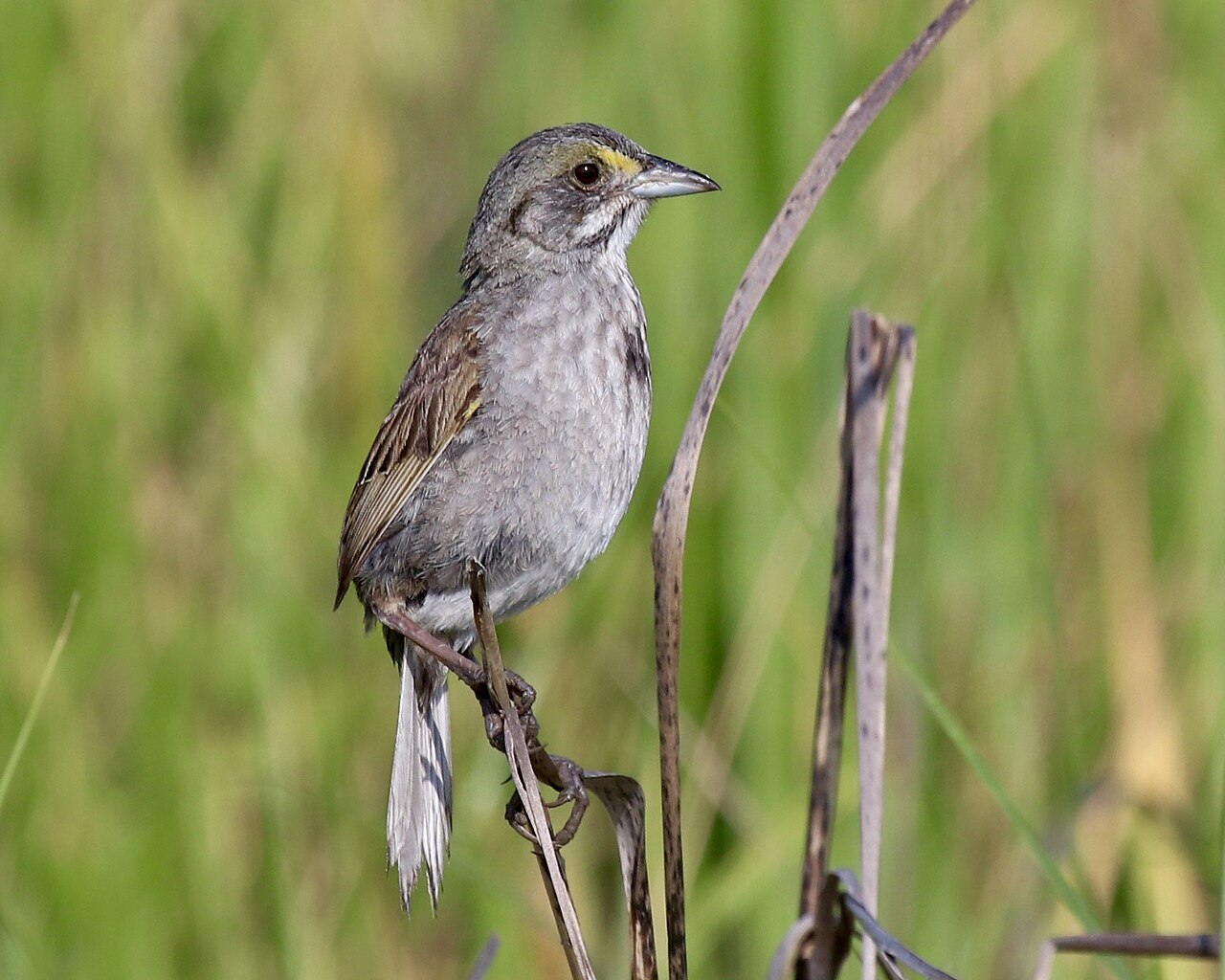
A large, solid sparrow with a short pointed tail and a long, spike-like bill clearly heavier than in the other marsh sparrows. The upperparts are greyish brown and little streaked, the underparts greyish buff with faint dark streaking. The head shows a yellow spot in front of the eye, a white throat and a dark malar stripe. The eight subspecies differ strongly in colour: Gulf Coast birds are browner and warmer, Atlantic birds greyer, and mirabilis of Cape Sable is grey-green and more sharply streaked.
Confusion species
Saltmarsh Sparrow and Nelson's Sparrow are smaller, have a shorter bill and an orange face triangle that Seaside Sparrow lacks entirely; on them the face is orange with grey, on Seaside grey with a yellow spot. The saltmarsh forms of Savannah Sparrow are smaller, shorter-billed, clearly streaked on the breast and show a yellow eyebrow rather than a yellow spot. Tail length and bill shape remain usable in poor light.
Habitat
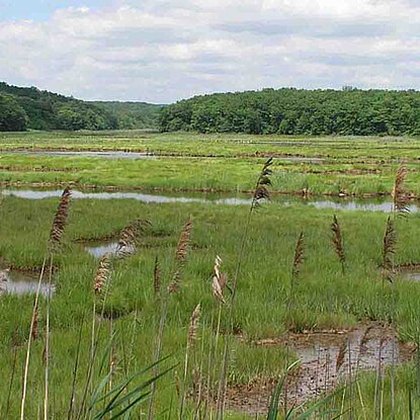
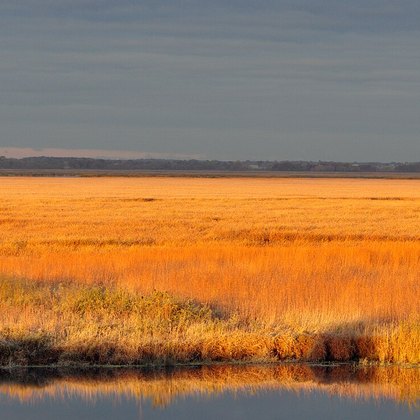
Salt and brackish marsh with cordgrass and saltmeadow grass, especially the higher margins and creek banks where the nest stays above spring tides. It forages walking over the mud and climbing the stems. The Cape Sable population in southern Florida is the exception and holds to freshwater Everglades prairie with sedges and muhly grass. Away from marsh it is almost never found.
Where the bird is most often found, arranged by the USNVC — the vegetation classification of the United States and Canada — and CMECS for sea and coast.


Range and movements
The range runs along the Atlantic coast from southern New Hampshire and Massachusetts south to Florida, and on along the Gulf Coast to southern Texas. Only the northern subspecies maritima migrates: it leaves the marshes of New England, New York, New Jersey and Chesapeake Bay in autumn and winters along the coast of the southern states. Birds of the Carolinas, Georgia, Florida and the Gulf Coast stay in the same marsh all year.
- Resident
- Breeding (summer)
- Winter
- Passage
- dark = core range, pale = thinly spread
Where and when to look
Pick high water on a spring tide: the birds are then pushed to the highest marsh margins and sit briefly in the open on stems and wrack. On a marsh trail in May the males sing; watch the silhouette with its long bill and short tail, since colour says little from one place to the next.
Conservation
The species is listed worldwide as Least Concern (LC); Partners in Flight puts the breeding population at about 200,000 birds, essentially all in the United States, and the Breeding Bird Survey shows no clear trend since 1966, though confidence in that series is low. The species is on the Yellow Watch List because of its small, continuous range. Threats are mosquito ditching, filling and building on marsh, pesticide runoff and sea level rise. The subspecies mirabilis of Cape Sable is federally listed as Endangered; nigrescens of Florida's Atlantic coast became extinct in 1987.
Scientific name
Ammospiza maritima | (Wilson, 1811)
Alexander Wilson described the species in 1811 as Fringilla maritima, from birds of the sea islands of the Atlantic coast; the type locality was later fixed at Great Egg Harbor, New Jersey. Because the species now stands in another genus, author and year are in parentheses. The species name maritima is Latin for 'of the sea'. The genus Ammospiza comes from Greek ammos 'sand' and spiza 'finch'.