All species › Passerines › New World sparrows › Saltmarsh Sparrow
Saltmarsh Sparrow | Ammospiza caudacuta
Spitsstaartgors | Chingolo colifino
The Saltmarsh Sparrow breeds only in the tidal marshes of the Atlantic coast of the United States and nowhere else in the world. The nest sits a few centimetres above the water and the whole breeding cycle is timed to the rhythm of the spring tides; that dependence makes the species one of the fastest-declining songbirds in North America.

Voice
The song is soft: a series of raspy buzzes, trills and gurgling notes that is already hard to hear at a few tens of metres. Only males sing, often in a short flight over the grass. There is no song post and no territory boundary defended by song — males range across the marsh. The call is a short, sharp chip.
Recording: Kelly Faller — CC BY-NC-SA 4.0 · Cattus Island County Park (near Toms River), Ocean County, New Jersey, United States · xeno-canto
Identification
A small sparrow with a short pointed tail, a flat forehead and a long, fine bill. Eyebrow and cheek edge are bright orange and stand out sharply against a grey ear patch and a grey central crown stripe. The breast is white to pale orange with narrow, sharply defined black streaks continuing onto the flanks. The back is brown with clear white mantle stripes. The sexes look alike.
Confusion species
Nelson's Sparrow is the only real problem and breeds in the same marshes in Maine and New Brunswick: it has faint, diffuse breast streaking over an unbroken orange-buff ground colour, a shorter bill and a rounder forehead. On Saltmarsh Sparrow the streaks are narrow, black and crisply defined on white. Seaside Sparrow is considerably larger and greyer with no orange on the face; the saltmarsh forms of Savannah Sparrow have a notched tail and a yellow eyebrow.
Habitat
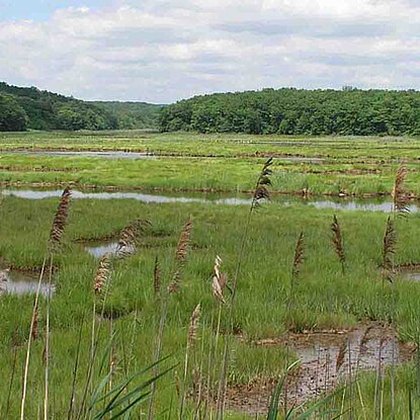
Salt and brackish tidal marsh with saltmeadow and cordgrass, especially the higher parts that flood only on spring tides. It nests in the dense sward six to fifteen centimetres above the ground and completes the brood within the three weeks or so between two spring tides. Outside the breeding season it stays in marsh, somewhat further south along the same coast. It does not use inland or freshwater marsh.
Where the bird is most often found, arranged by the USNVC — the vegetation classification of the United States and Canada — and CMECS for sea and coast.


Range and movements
The breeding range lies on the Atlantic coast from southern Maine and New Hampshire south through Massachusetts, Connecticut, New York, New Jersey and Delaware to Chesapeake Bay in Maryland and Virginia. In winter the population shifts to the coast from North Carolina to northern Florida, with the largest concentrations in the Carolinas and Georgia. Away from this coastal strip the species is an exception.
- Resident
- Breeding (summer)
- Winter
- dark = core range, pale = thinly spread
Where and when to look
Walk a marsh trail in New Jersey or Connecticut on a rising tide in June and watch for birds skimming over the grass; they rarely sit long on a perch. Then look deliberately for the crisp black breast streaks, since that is the only field mark that separates the species from Nelson's Sparrow.
Conservation
The IUCN lists the species as Endangered (EN). Partners in Flight puts the breeding population at about 60,000 birds, and rangewide surveys between 1998 and 2012 indicated a decline of some 9 per cent per year, around three quarters of the population in total. The 2025 State of the Birds lists it as a red-alert tipping-point species. The main cause is nest flooding through sea level rise and heavier storm surges; filling, mosquito ditching, spread of common reed and a relatively high mercury load add to it. Proposed measures are restricting tidal flow in the short term and keeping higher ground open so that the marsh can migrate inland.
Scientific name
Ammospiza caudacuta | (Gmelin, 1788)
Johann Friedrich Gmelin described the species in 1788 as Oriolus caudacutus, from a bird taken in New York; the placement among the orioles was corrected later, and author and year therefore stand in parentheses. The species name combines Latin cauda 'tail' and acutus 'pointed', after the sharp tail feathers. The genus Ammospiza comes from Greek ammos 'sand' and spiza 'finch'.