All species › Woodpeckers and allies › Woodpeckers › Pileated Woodpecker
Pileated Woodpecker | Dryocopus pileatus
Noord-Amerikaanse helmspecht | Picamaderos norteamericano
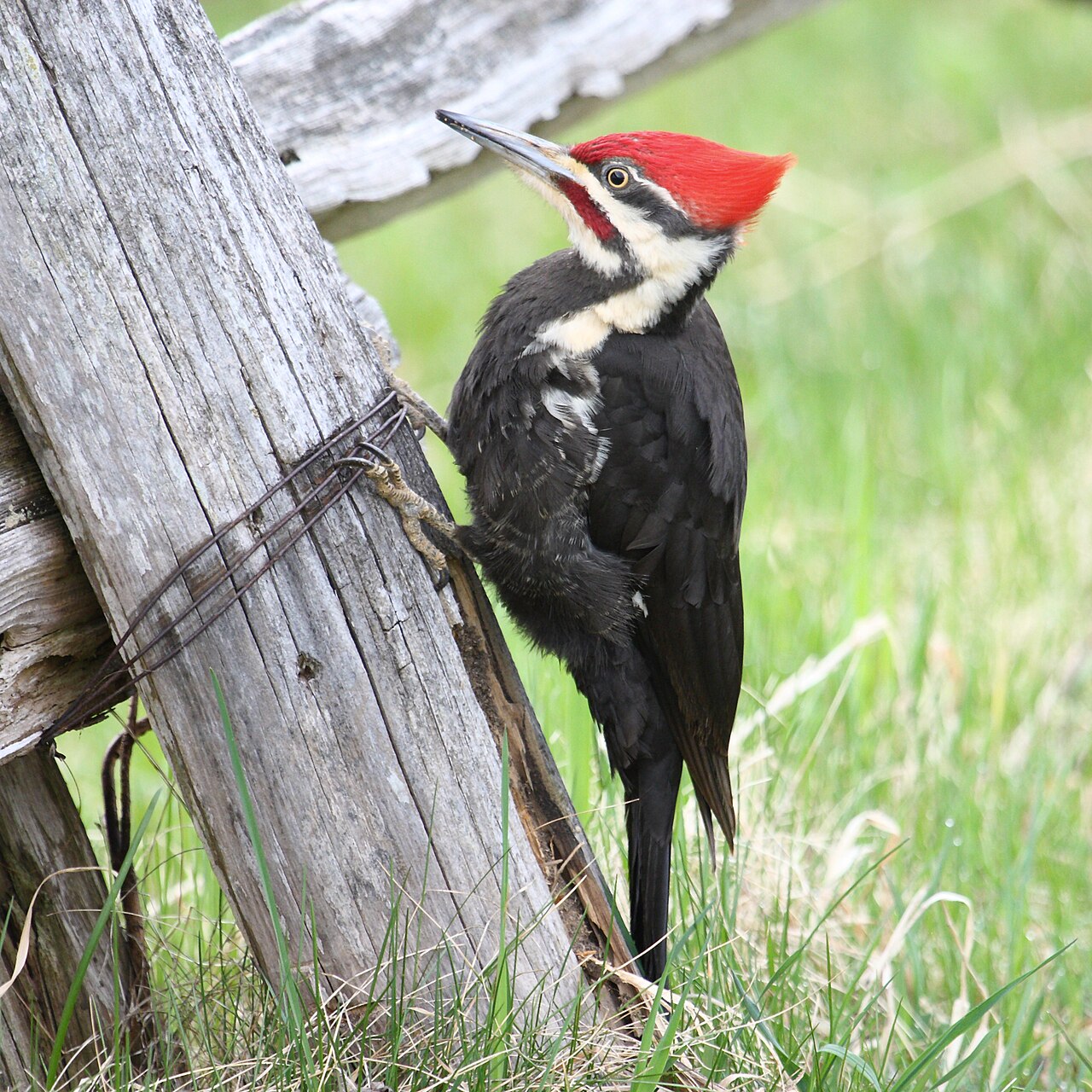
The Pileated Woodpecker is the largest woodpecker confirmed to still occur in North America: a mostly black bird the size of a crow, with a flaming red crest and broad white stripes down the neck. It chisels long, rectangular holes in dead trees in search of carpenter ants.
Voice
The call is a loud, rapidly repeated series, kuk-kuk-kuk-kuk, recalling the Northern Flicker's call but heavier and more far-carrying. It drums slowly and irregularly, with heavy, far-carrying strikes that betray the presence of a large cavity.
Recording: Jonathon Jongsma — CC BY-SA 4.0 · Forestville/Mystery Cave State Park, Fillmore County, Minnesota, United States · xeno-canto
Identification
A large, mostly black woodpecker with a long red crest, a white stripe running from the bill to the neck, and white underwing stripes clearly visible in flight. The male shows a red moustache stripe, the female a black one. The bill is long, heavy and chisel-shaped.
Confusion species
The extinct Ivory-billed Woodpecker had a similar pattern but carried white on the trailing edge of the wing rather than only on the neck, and had a pale rather than black bill; no confirmed recent record of that species exists. The much smaller Northern Flicker gives a similar call but lacks the crest and is mostly brown.
Habitat
Forest with large, old and dead trees, both deciduous and mixed or coniferous, from the eastern lowlands to the western mountains and the coastal forests of the Great Lakes and Canada.
Where the bird is most often found, arranged by the USNVC — the vegetation classification of the United States and Canada — and CMECS for sea and coast.



Range and movements
Resident across nearly all of the eastern United States and Canada, from the Gulf Coast to the boreal forest, and in a separate band along the Pacific coast from British Columbia to California.
- Resident
- Breeding (summer)
- Winter
- Passage
- dark = core range, pale = thinly spread
Where and when to look
Look for large, oblong holes in dead tree trunks from eye level up to several metres high; the bird itself more often reveals itself through its loud call than through sight.
Conservation
Widespread and not threatened; the species benefits from standing dead wood in maturing forest. Its abandoned nest cavities are reused by many other animals, from owls to squirrels.
Scientific name
Dryocopus pileatus | (Linnaeus, 1758)
Linnaeus described the species in 1758 as Picus pileatus; because it has since been moved to another genus, author and year stand in parentheses. Dryocopus is Greek for 'tree-striker', from drys ('tree') and kopos ('to strike'); pileatus is Latin for 'capped', after the prominent crest.