All species › Woodpeckers and allies › Woodpeckers › Northern Flicker
Northern Flicker | Colaptes auratus
Gouden grondspecht | Carpintero escapulario
The Northern Flicker is the woodpecker most often seen on the ground: a brown, black-spotted bird with a white rump that hops after ants in short bounds. It occurs in two different forms — Yellow-shafted in the east, Red-shafted in the west — treated here as a single species, and the two interbreed freely where their ranges overlap.

Voice
In spring it gives a long, rapidly repeated series, a loud, far-carrying wick-wick-wick-wick-wick that can run for ten seconds and carries a long way. There is also a single, far-carrying klee-yer, often used as a contact call between mates, and in courtship a soft, repeated wicka-wicka-wicka given while birds face each other and bob their heads. It also drums, though more softly and less persistently than most other woodpeckers.
Recording: Don Profota — CC BY-NC-SA 4.0 · South Bozeman, Gallatin County, Montana, United States · xeno-canto
Identification
A large brown woodpecker with black barring on the back, a black crescent across the breast, and spotted light-brown underparts, always showing a bright white rump in flight. In the east — the Yellow-shafted form — the underwings and undertail are lemon yellow and the male carries a black moustache stripe; in the west — the Red-shafted form — the same parts are salmon red and the moustache is red, while the male there also has a grey head instead of the brown head of the eastern form. Both forms show a red nape patch, though in the Red-shafted form it is often less sharply defined. Females lack the moustache stripe; juveniles resemble the adult but are duller with denser spotting.
Confusion species
On the ground it is sometimes mistaken for a thrush because of its brown colour and bounding gait, but the dagger-like bill and the white rump in flight are conclusive. In the west the Red-shafted form is confused with Gila Woodpecker, which has an entirely different, zebra-like back pattern and lacks the broad black breast band. Where the Yellow-shafted and Red-shafted forms meet, intergrades occur with a mix of yellow, orange and red feather shafts that do not sort neatly into either form.
Habitat
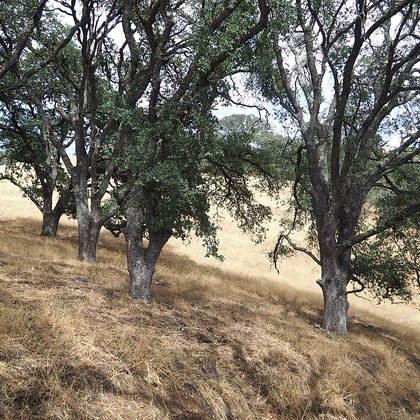
Open woodland, forest edges, scattered trees in grassland and savanna, and also gardens, parks and leafy suburbs — anywhere with open ground nearby to forage on. It avoids closed, dense forest as well as bare, treeless land; it needs dead or decaying trees to excavate its nest cavity. In the west it reaches into dry country of pinyon (a low-growing pine of the dry south-western foothills) and juniper and mountain landscapes with scattered pines.
Where the bird is most often found, arranged by the USNVC — the vegetation classification of the United States and Canada — and CMECS for sea and coast.




Range and movements
The Yellow-shafted form breeds from Alaska and forested Canada south through the eastern United States to Texas; the Red-shafted form from southern Alaska across western North America south into the Mexican highlands. Across most of its range the species is resident; northern and Canadian populations move partly south in winter. The broad overlap zone with intergrades lies in the Great Plains and the northern Rocky Mountains, first described there in the late nineteenth century and fairly stable since.
- Resident
- Breeding (summer)
- Winter
- Passage
- dark = core range, pale = thinly spread
Where and when to look
Look for it on open lawns and grassland at the edge of woodland, where it hops after ant colonies and instantly flashes its white rump when flushed. In the Great Plains overlap zone feather-shaft colour and head colour decide whether a bird is pure or an intergrade.
Conservation
The IUCN rates the species as Least Concern (LC). Widespread and still one of the most numerous woodpeckers in North America, though the population has declined gradually over recent decades, possibly through competition for nest cavities with the introduced European Starling. It benefits from standing dead trees and gardens with open ground, and is locally regarded as a nuisance when it drums on house siding.
Scientific name
Colaptes auratus | (Linnaeus, 1758)
Linnaeus described the species in 1758 as Cuculus auratus, among the cuckoos, presumably for its general shape and barring; because it has since been moved to another genus, author and year stand in parentheses. Colaptes derives from the Greek word for 'to chisel' or 'to peck', after its foraging habit; auratus is Latin for 'gilded', after the golden feather shafts of the eastern form. The type locality lies in South Carolina.