All species › Woodpeckers and allies › Woodpeckers › Gilded Flicker
Gilded Flicker | Colaptes chrysoides
Californische grondspecht | Carpintero dorado
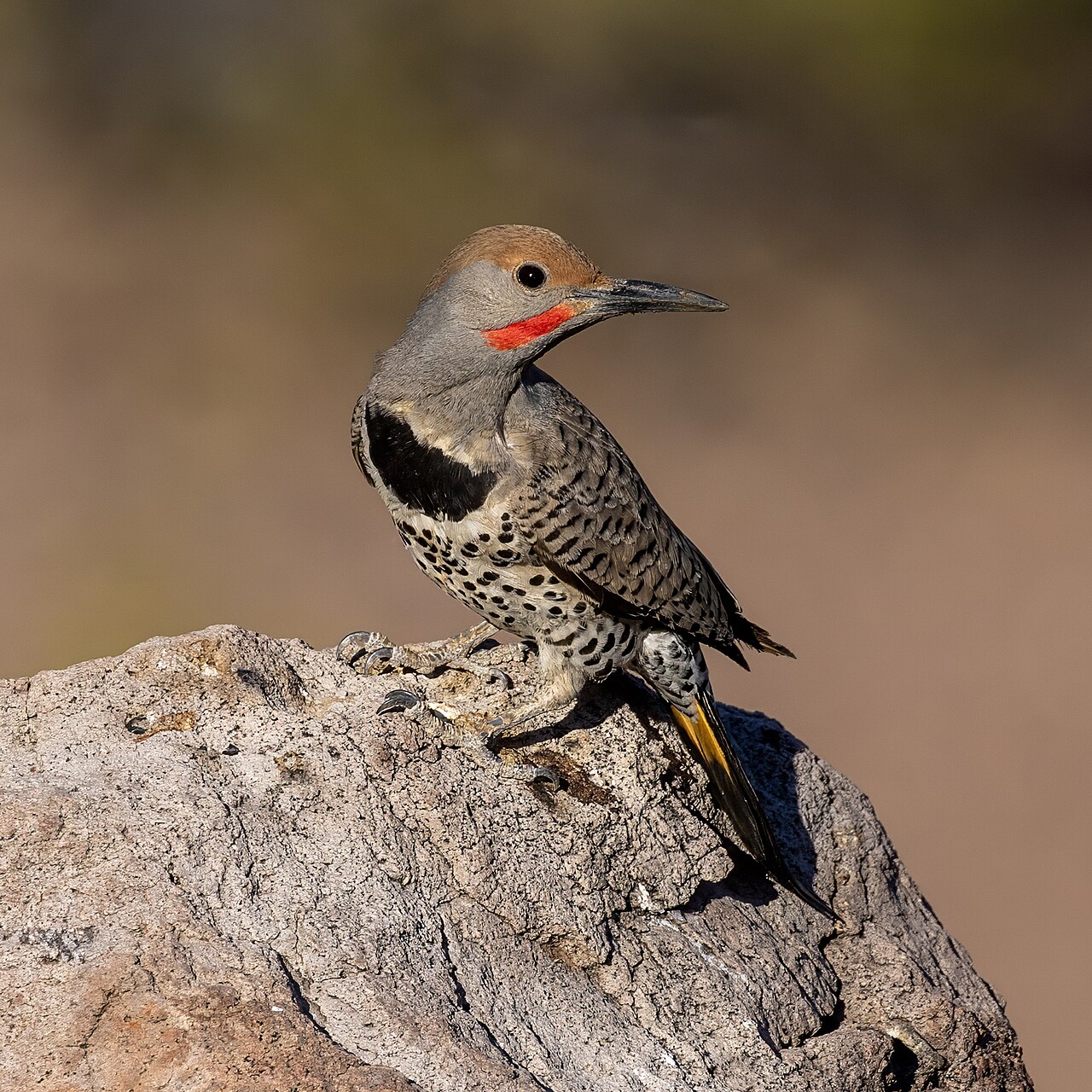
The Gilded Flicker is the flicker of the Sonoran Desert: a large brown woodpecker with a white rump and golden-yellow undersides to the wings and tail, which excavates its nest cavity high in a giant cactus. It closely resembles Northern Flicker, with which it was long treated as one species, but combines features of both its forms: the yellow feather shafts of the eastern form with the grey face and red moustache of the western one. Its abandoned nest holes are indispensable to other cavity-nesters of the desert.
Voice
Its voice is virtually identical to that of Northern Flicker. In spring it gives a long, rapid, far-carrying series wick-wick-wick-wick-wick, and all year round a single, piercing klee-yer or peah. At encounters between birds a soft, repeated wicka wicka follows, accompanied by bowing and swinging of the head. It also drums, on dead limbs, poles and sometimes on metal gutters, but less often than most other woodpeckers.
Recording: Pat Goltz — CC BY-NC-SA 4.0 · Tucson, Pima County, Arizona, United States · xeno-canto
Identification
A large woodpecker with a greyish-brown, finely black-barred back, a black crescent on the breast and pale, black-spotted underparts; in flight the white rump and golden-yellow undersides to wings and tail stand out. The crown is cinnamon-brown and the face grey. The male has a red moustache stripe, the female has none. Unlike the eastern form of Northern Flicker it has no red nape patch. It is slightly smaller and paler than Northern Flicker, with narrower bars on the back, and seen from below the black at the tip of the tail is more extensive.
Confusion species
The main problem is the western, Red-shafted form of Northern Flicker, which occurs in the same region in streamside woodland and in the mountains. It has salmon-red rather than yellow undersides to wings and tail and a greyish-brown rather than cinnamon crown. Where the two species meet, hybrids occur with orange shafts or an aberrant head colour. Wandering eastern Northern Flickers, with yellow shafts, can be told by the brown head, red nape patch and, in the male, a black moustache. Gila Woodpecker, which nests in the same cacti, is smaller, with a zebra-barred back and a plain, pale brown head and belly.
Habitat
Desert with giant cacti — in Arizona mainly the saguaro and in Baja California also the cardón — mostly between sea level and about 1,000 metres. It prefers to excavate its nest cavity high in a cactus, higher than Gila Woodpecker. The cactus seals the wall of the cavity with a hard layer of scar tissue, which survives after the plant's death as a so-called saguaro boot. Locally it also nests in cottonwoods or willows along dry washes. It feeds mainly on ants and beetle larvae taken on the ground, and in winter also on cactus fruit and seeds.
Where the bird is most often found, arranged by the USNVC — the vegetation classification of the United States and Canada — and CMECS for sea and coast.


Range and movements
From southern Arizona and a small area along the Colorado River in south-eastern California south through Sonora into northern Sinaloa, and across almost all of Baja California. Four subspecies are recognised: mearnsi in Arizona, California and north-western Sonora, tenebrosus from Sonora to Sinaloa, brunnescens in northern and central Baja California and chrysoides in the south of the peninsula. It is resident.
- Resident
- Breeding (summer)
- Winter
- Passage
- dark = core range, pale = thinly spread
Where and when to look
In a saguaro forest around Tucson or Phoenix, check the highest holes in the cacti: the large, round cavities just below the top usually belong to this species, the smaller, lower ones often to Gila Woodpecker. Old flicker holes are later occupied by, among others, Elf Owl, so a good flicker cactus often yields several species. With a bird that flushes, always check the colour of the underwing and the crown.
Conservation
The IUCN rates the species as Least Concern (LC). Partners in Flight puts the global breeding population at about 770,000 birds and places the species on its Yellow Watch List; numbers in the United States fell by an estimated 54 per cent between 1970 and 2014. In California, where it has almost disappeared, it has been on the state list as Endangered since 1988. The main threats are the spread of cities into the desert and fires, fuelled by non-native grasses, that kill saguaros.
Scientific name
Colaptes chrysoides | (Malherbe, 1852)
Alfred Malherbe described the species in 1852 as Geopicus (Colaptes) chrysoides; because it was described in another genus, author and year stand in parentheses. The type locality, Cabo San Lucas in Baja California, was fixed in 1895. For decades it was treated as one species together with both forms of Northern Flicker, until the American Ornithologists' Union recognised it as a separate species again in 1995 because of the limited hybridisation and the differences in habitat and way of life. Colaptes derives from the Greek word for 'to chisel'; chrysoides comes from Greek khrusos 'gold' and means 'golden', after the yellow feather shafts.