All species › Woodpeckers and allies › Woodpeckers › Williamson's Sapsucker
Williamson's Sapsucker | Sphyrapicus thyroideus
Bergsapspecht | Chupasavia oscuro
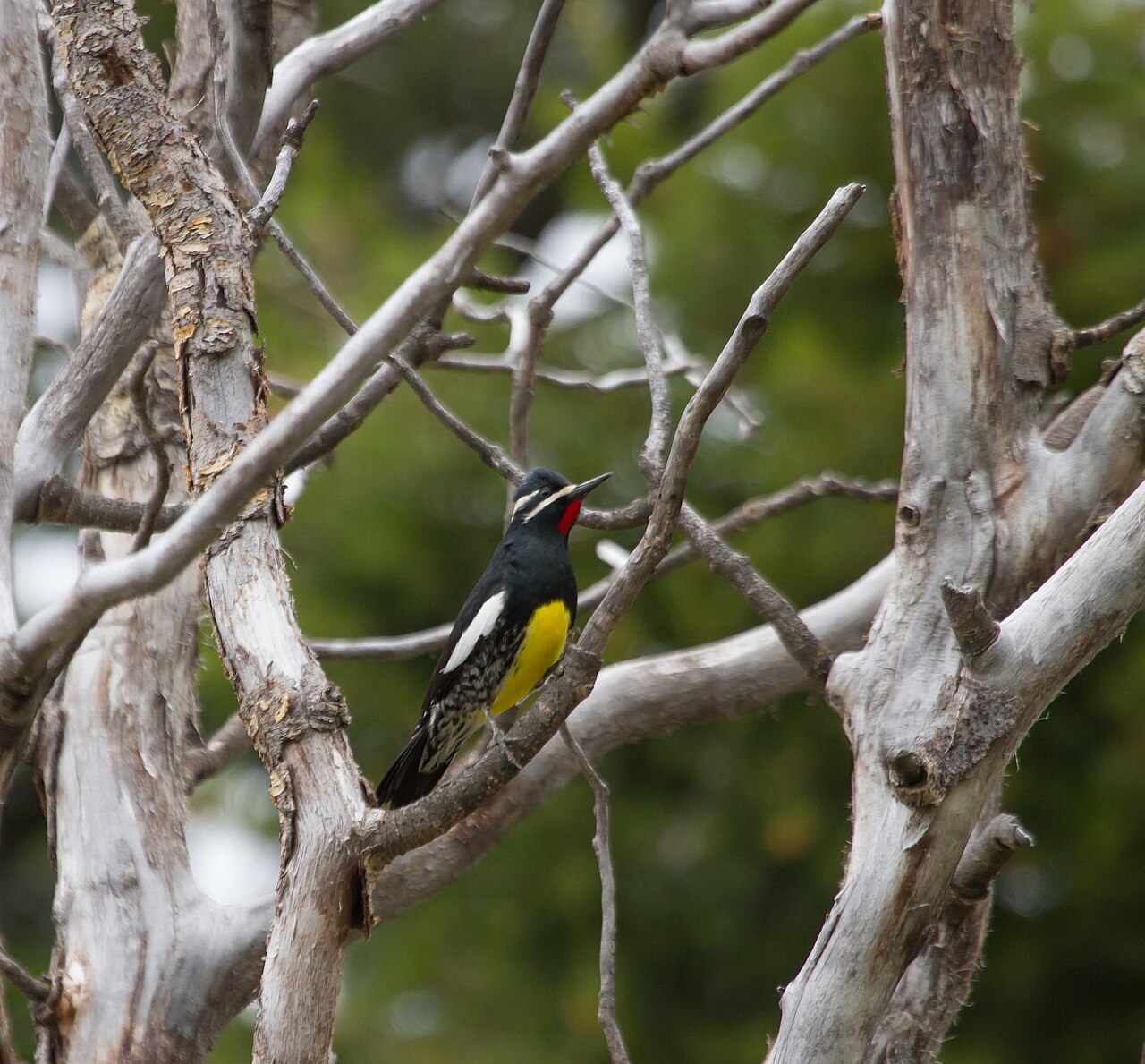
Williamson's Sapsucker is the sapsucker of open conifer forest in the western mountains, and the North American woodpecker with the greatest difference between the sexes. The male is glossy black with white head stripes, a red chin, a large white wing patch and a bright yellow belly; the female is brown with fine black barring and a black breast patch. So different are they that the two sexes were described as separate species in the nineteenth century.
Voice
The call is a nasal, harsh churr or queeer, somewhat rougher and less mewing than in the other sapsuckers. In spring a series of such nasal notes is also heard. The drum has the typical sapsucker rhythm: a short, rapid opening that breaks into a few separate, slower taps, like a fading Morse signal. Males drum a great deal early in the season, often on resonant dead limbs or on a pole.
Recording: Paul Marvin — CC BY-NC-SA 4.0 · Ellis Rd, Amador County, California, United States · xeno-canto
Identification
The male has a black head with a white stripe behind the eye and a second white stripe from the base of the bill to the neck, a small red chin and throat patch, a black back and breast, and a bright yellow belly with black-and-white barred flanks. In flight the large white wing patch and white rump stand out. The female has a brown head, brown-and-black barred back, wings and flanks, a black breast patch and a yellow centre to the belly, and also a white rump, but no white wing patch. Young males soon resemble the adult male but still lack the red on the throat.
Confusion species
The male, with its black back and black crown, is distinctive: Red-naped and Yellow-bellied Sapsuckers have a red crown, a black-and-white barred back and a black-and-white rather than black breast. At a distance the female looks more like a small female Northern Flicker, with her brown, barred plumage, black breast patch and white rump. Northern Flicker, however, is much larger, has a greyer or browner head, a spotted rather than yellow belly and coloured undersides to the wings and tail.
Habitat
Open, fairly dry conifer forest at middle to high elevations in the mountains, with ponderosa pine, Douglas fir, western larch, lodgepole pine, fir and Engelmann spruce. The nest is often in a relatively open patch of forest below a ridgeline. In the Rocky Mountains it prefers to nest in large aspens, in southern British Columbia mainly in old larches, usually in a living tree with fungus-softened heartwood. It taps sap mainly from conifers; during the nesting period it switches to ants, which can make up four-fifths of the nestlings' food.
Where the bird is most often found, arranged by the USNVC — the vegetation classification of the United States and Canada — and CMECS for sea and coast.

Range and movements
Breeds from southern British Columbia south through the Cascades and the Sierra Nevada into the mountains of northern Baja California, and in the Rocky Mountains and the ranges of the Great Basin from Montana and Idaho into Arizona and New Mexico. Northern and high-elevation birds move in winter to lower, more southerly country in the south-western United States and the Mexican highlands; females winter on average lower than males. Two subspecies are traditionally recognised, thyroideus in the west and nataliae in the Rocky Mountains, although the distinction is genetically disputed.
- Resident
- Breeding (summer)
- Winter
- Passage
- dark = core range, pale = thinly spread
Where and when to look
In June, look for an open ponderosa or larch forest with a stand of old aspens, and watch for rows of small, regular holes in the bark of conifers: these sap wells are tended daily, and a pair often stays close by. Male and female of a pair then come in by turns, so that both plumages can be seen side by side in a single sighting.
Conservation
The IUCN rates the species as Least Concern (LC). Partners in Flight estimated the global breeding population in 2020 at about 300,000 birds; a recent recalculation using additional field data arrives at a much higher figure of some 870,000. The Breeding Bird Survey shows a more or less stable picture between 1968 and 2015. In Canada, where only a few hundred birds breed, the species has been listed as Endangered since 2005 because of the loss of old larch forest. Elsewhere, clear-felling and the loss of large nest trees are the main threats.
Scientific name
Sphyrapicus thyroideus | (Cassin, 1852)
John Cassin described the female in 1852 as Picus thyroideus, from a bird from Georgetown in El Dorado County, California; in 1857 John Strong Newberry described the male as Picus williamsonii, after Lieutenant Robert Stockton Williamson, leader of a survey for the railway to the Pacific. Only in 1873 did Henry Henshaw show that they were one species, and the older name took priority. Because Baird moved the species to the genus Sphyrapicus in 1858, author and year stand in parentheses. Sphyrapicus is from Greek sphura 'hammer' and Latin picus 'woodpecker'; thyroideus means 'shield-shaped', after the black breast patch.