All species › Gannets and cormorants › Cormorants and shags › Red-faced Cormorant
Red-faced Cormorant | Urile urile
Roodmaskeraalscholver | Cormorán Carirrojo
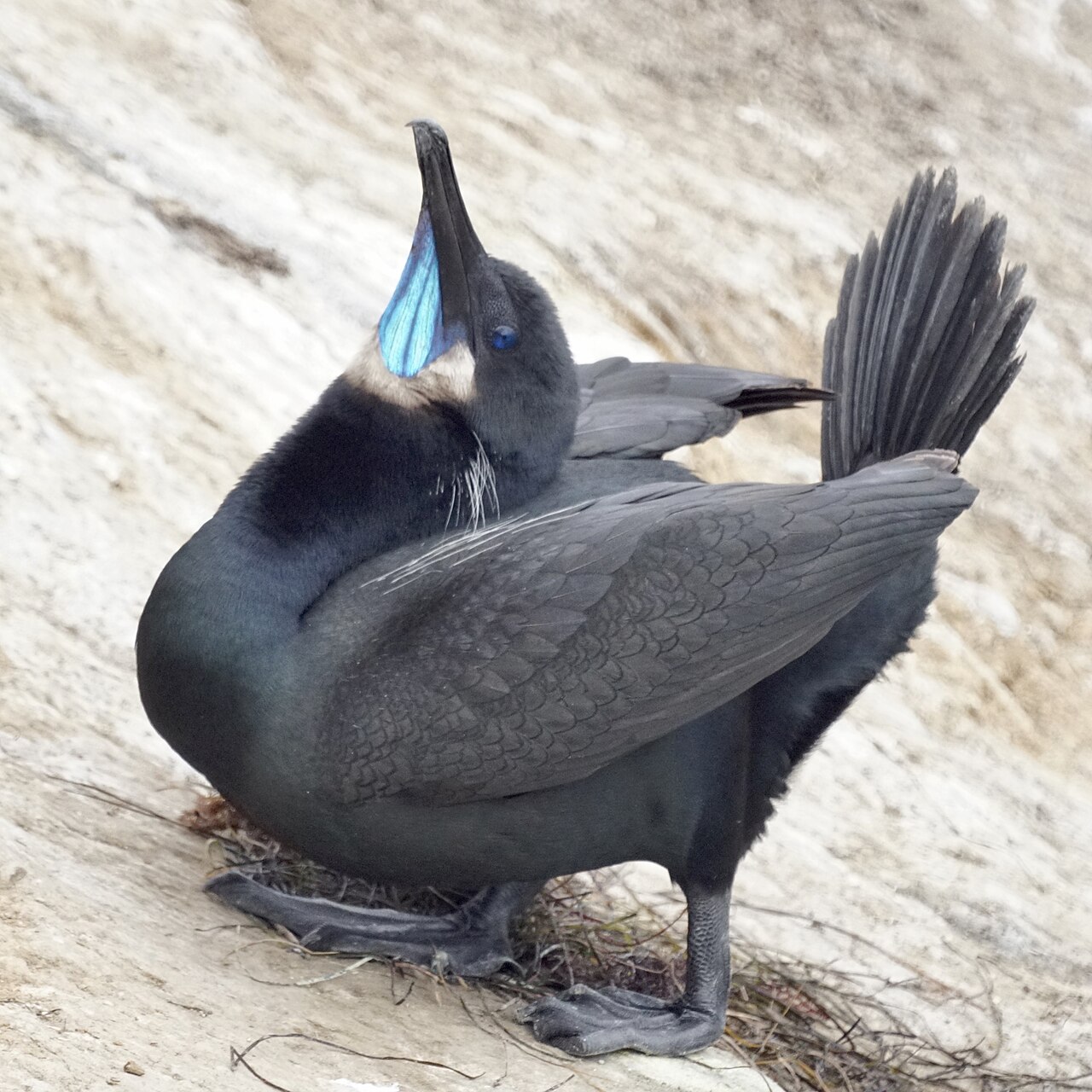
Red-faced Cormorant breeds on some of the most remote cliffs of the North Pacific, from Kamchatka and the Kuril Islands to the Aleutians and the Pribilof Islands in the Bering Sea. It is known by the bright red bare skin around the eye, which extends further across the face than in any related species. Unlike most cormorants it often nests alone or in small, scattered groups rather than dense colonies.
Voice
At the nest it gives the low, harsh croaking and grunting calls typical of cormorants, especially during the head-nodding courtship display. At sea the species is silent. Recordings are scarce, fitting a bird that rarely breeds anywhere near people.
Recording: Andrew Spencer — CC BY-NC-SA 3.0 · Tolstoi Point, St. Paul Island, Alaska, United States · xeno-canto
Identification
The breeding plumage is glossy greenish-black with purple and bronze iridescence, a double crest on the head, and white plumes on the flanks and neck. Its main feature is the bright red bare facial skin, larger and extending further past the eye than in the closely related Pelagic Cormorant. The bill is slightly heavier than that species' too. Outside the breeding season the crests and plumes disappear and the red of the face fades.
Confusion species
Pelagic Cormorant is nearly identical in shape and colour but has a smaller red facial patch that does not extend past the eye, a lighter bill, and usually shows only a single crest. Where the two breed together, Red-faced Cormorant starts nesting earlier and takes the higher, drier ledges on the cliff face. The far larger Double-crested Cormorant has an orange-yellow throat patch instead of a red facial patch and almost entirely lacks this species' red skin.
Habitat
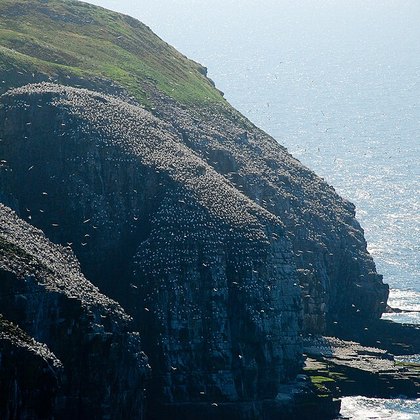
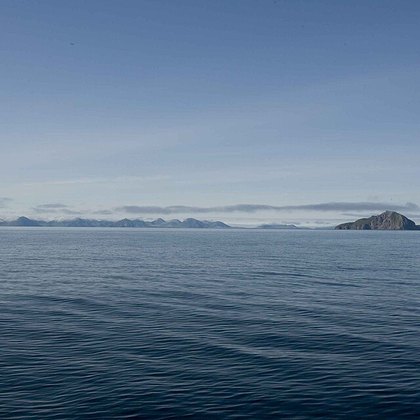
It nests on steep cliff faces above the surf, often as an isolated pair rather than in a dense colony. It forages close to shore as a bottom feeder, diving mainly for gunnels, sculpins and other bottom-dwelling fish. It stays close to its breeding grounds year-round and almost never leaves the coast for open ocean.
Where the bird is most often found, arranged by the USNVC — the vegetation classification of the United States and Canada — and CMECS for sea and coast.

Range and movements
The range runs from Kamchatka and the southern Kurils through the Aleutians and Pribilof Islands to islands off southern Alaska. Since the late 1950s it has expanded east along the south coast of Alaska and has become common as far as Prince William Sound. It is essentially a permanent resident; beyond this range it occurs only exceptionally as a straggler.
- Resident
- Breeding (summer)
- Winter
- Passage
- dark = core range, pale = thinly spread
Where and when to look
St. Paul Island in the Pribilofs is one of the few places where nests can be viewed well from accessible clifftops; look for the bright red facial skin against the dark rock. Check any candidate carefully against the far more numerous Pelagic Cormorant, since the two look similar at a distance.
Conservation
Least Concern (LC), with a population of roughly 130,000 birds that has increased in recent decades. Even so it is considered a species of concern: its entire world population breeds on a handful of island groups in the Bering Sea and North Pacific, so a single oil spill could affect a large share of the species.
Scientific name
Urile urile | (Gmelin, 1789)
Gmelin described the species in 1789 as Pelecanus Urile, using the local, Russian-derived name for the bird, possibly referring to the Kuril Islands; it has since been moved to another genus, hence the parentheses around author and year. In 1856 Bonaparte used the same name for the new genus Urile, with this species as its type — but the genus fell out of use and the species remained in Phalacrocorax for decades, until molecular research in 2014 restored Urile. The type locality is Kamchatka.