All species › Gannets and cormorants › Cormorants and shags › Pelagic Cormorant
Pelagic Cormorant | Urile pelagicus
Pelagische aalscholver | Cormorán Pelágico
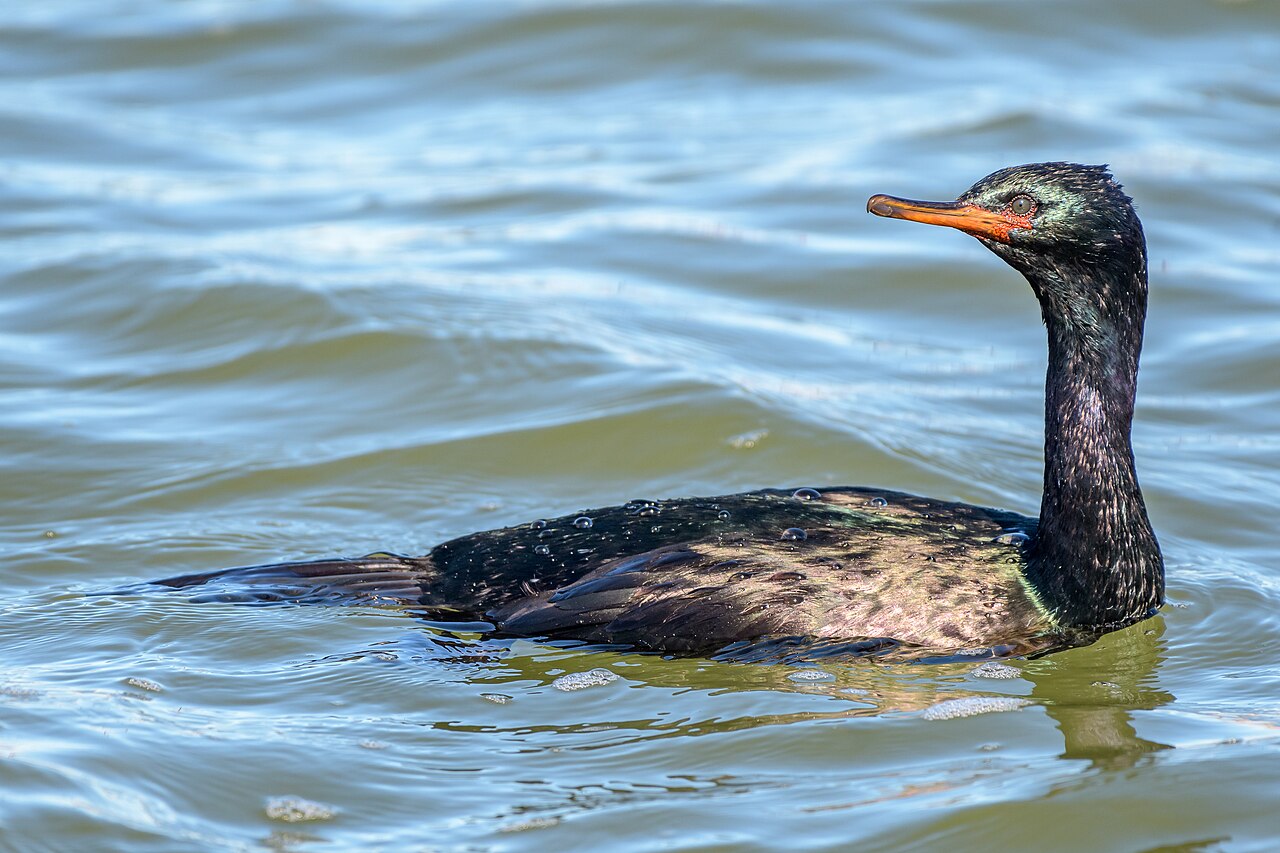
Pelagic Cormorant is the smallest and slenderest cormorant of the Pacific coast, breeding scattered along rocks and cliffs from Alaska to Baja California. In breeding dress it shows a small red facial patch, two thin crests and white flank patches against otherwise glossy greenish-black plumage. Despite its name, it rarely ventures far from shore.
Voice
Just before taking off, especially during the breeding season, it gives a brief, low call, with a clear difference between the calls of male and female during display; after landing both sexes sound the same. When threatened it responds with a harsh gargling noise. Otherwise the species is largely silent at sea.
Recording: Ian Cruickshank — CC BY-NC-SA 4.0 · Helliwell Park, Hornby Island, British Columbia, Canada · xeno-canto
Identification
Outside the breeding season the bird is uniformly black with a metallic sheen and lacks the ornamental plumes of breeding dress. In breeding plumage it grows two thin crests on the head, fine white plumes on the head and neck, white patches on the flanks, and a small patch of bare skin below the eye that turns bright magenta. Juveniles are uniformly dark brown and lack the adult's sheen. The slender body, thin neck and fine bill separate it in any plumage from the other two Pacific cormorants.
Confusion species
Brandt's Cormorant is larger and heavier-built, with a blue rather than red throat or facial patch. Red-faced Cormorant looks similar to Pelagic Cormorant but has a larger red facial patch that extends further past the eye, a heavier, pale yellowish bill, and it also breeds earlier in the season. From the much larger Double-crested Cormorant, Pelagic Cormorant is told mainly by its small size and thin, straight bill.
Habitat
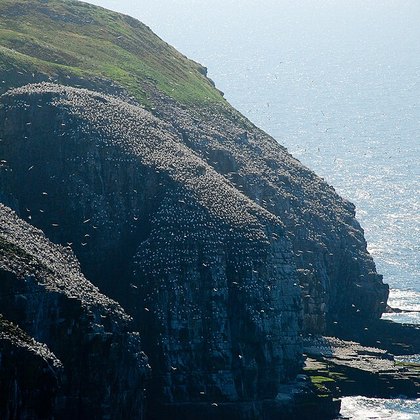
It nests on rocks, cliffs and rocky shorelines along the whole Pacific coast, usually as an isolated pair or small group rather than a large colony, returning to the same ledge year after year. It forages in sheltered bays and around kelp beds and rocks close to its nest site, diving as deep as forty metres for bottom-dwelling fish and crustaceans. It avoids open ocean and fresh water.
Where the bird is most often found, arranged by the USNVC — the vegetation classification of the United States and Canada — and CMECS for sea and coast.


Range and movements
The range extends from Alaska to Baja California along the American west coast, and on the Asian side from Chukotka to Kyushu. Birds from subarctic parts of the range leave for winter, while those from temperate and subtropical areas disperse only locally after breeding. Numbers probably remained stable through the twentieth century and have even increased along the coast of British Columbia.
- Resident
- Breeding (summer)
- Winter
- Passage
- dark = core range, pale = thinly spread
Where and when to look
Watch from a breakwater or rocky beach for solitary birds flying low over the water and giving a brief call just before taking off; that, together with its small size, is often the quickest way to tell it from the other two Pacific cormorants. During the breeding season the bright magenta facial skin shows well through binoculars.
Conservation
Least Concern (LC); the world population is estimated at around 400,000 birds, with more than 120,000 already counted in North America alone in the 1980s, most of them in Alaska. The trend is stable to slightly increasing. Oil pollution and entanglement in commercial gillnets are the best-known risks.
Scientific name
Urile pelagicus | (Pallas, 1811)
Pallas described the species in 1811 as Phalacrocorax pelagicus; it has since been moved to another genus, hence the parentheses around author and year. It stood in Phalacrocorax for nearly two centuries, until molecular research in 2014 showed that it forms its own branch among the cormorants together with Brandt's and Red-faced Cormorant; once that was accepted (2021) it was placed in the genus Urile. pelagicus is Latin for 'of the open sea' — a name that, given its preference for the coastal zone, turns out somewhat overstated. The type locality is eastern Kamchatka and the Aleutian Islands.