All species › Gannets and cormorants › Cormorants and shags › Great Cormorant
Great Cormorant | Phalacrocorax carbo
Aalscholver | Cormorán grande
In North America the Great Cormorant occurs as the subspecies Phalacrocorax carbo carbo, the same race that breeds on the rocky coasts of Western Europe. It is the largest and heaviest cormorant on the continent, with a thick neck, a blocky head and a heavy hooked bill. It only gained a firm foothold along the northeast coast during the twentieth century, and has since grown from a scarce breeder into an increasingly familiar sight.

Voice
Nesting pairs are noisy, giving a series of low, gurgling and grunting sounds at the nest and during courtship; like other cormorants the species is largely silent away from the colony. On the often crowded colonies of Canada and Newfoundland this racket, mixed with the calls of other seabirds, forms a constant background noise.
Recording: Sunny Tseng — CC BY-NC-SA 4.0 · Juodkrantės (cormorant colony), Lithuania · xeno-canto
Identification
Adults are black with a bronze-to-green sheen on the back, a white throat patch and yellowish bare skin at the base of the bill. In breeding dress a white thigh patch and scattered white plumes on the head and neck are added. Juveniles are browner, with a pale throat and a white belly that contrasts sharply with the darker breast and head — a contrast lacking in young Double-crested Cormorants. The heavy build and thick neck also separate the species from other North American cormorants at a distance.
Confusion species
The far more numerous Double-crested Cormorant is smaller and slimmer, with an orange-yellow rather than white throat patch and no white thigh patch in breeding dress. The young Double-crested Cormorant is also uniformly dull brown, whereas young Great Cormorant shows a clearly whiter belly. Where the two occur together — mainly in winter along the northeast coast — the Great Cormorant's much heavier build is often visible from a distance.
Habitat
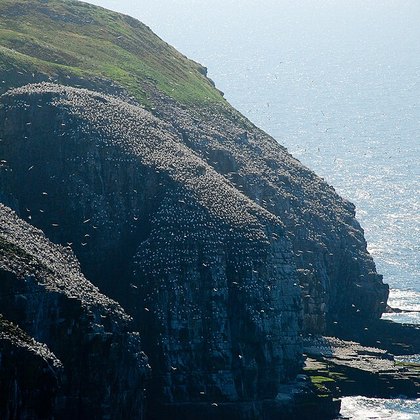
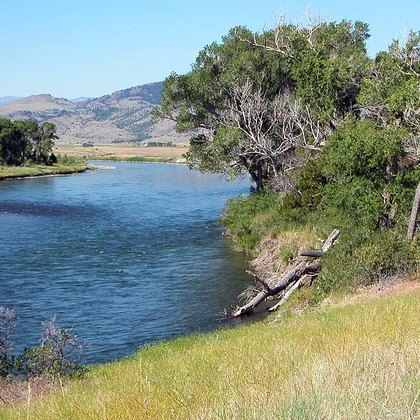
It breeds on rocky headlands and islands along the coast, preferring bare cliffs with an open view over the sea. Outside the breeding season it also uses jetties, breakwaters and, increasingly in recent decades, large rivers such as the Hudson and the Delaware. Unlike elsewhere in its global range, where it also breeds on freshwater lakes and rivers, the North American population remains strongly tied to the coast.
Where the bird is most often found, arranged by the USNVC — the vegetation classification of the United States and Canada — and CMECS for sea and coast.


Range and movements
Well into the twentieth century the Great Cormorant was a scarce, local breeder confined to the north shore of the Gulf of St. Lawrence and Newfoundland. Since then the population has grown substantially and its breeding range has expanded into Nova Scotia and, in recent decades, into Maine. In winter birds move south along the coast to northern Florida, with growing numbers wintering on large rivers inland.
- Resident
- Breeding (summer)
- Winter
- Passage
- dark = core range, pale = thinly spread
Where and when to look
Look for the species in winter along rocky shorelines and jetties of New England and the Mid-Atlantic states, often among groups of Double-crested Cormorants; the much heavier build and white throat patch stand out even at a distance. At the breeding colonies of the Gulf of St. Lawrence, look for the white thigh patches of breeding plumage.
Conservation
Not threatened worldwide (LC); the North American population has grown substantially in recent decades and expanded its range, after being reduced in many places by earlier persecution. As elsewhere, the species is sometimes viewed as a competitor by fisheries interests, which locally leads to disturbance at colonies.
Scientific name
Phalacrocorax carbo | (Linnaeus, 1758)
Linnaeus described the species in 1758 as Pelecanus Carbo; the type locality was originally 'Europe', restricted in 1920 by Hartert to the rock-nesting form of the North Atlantic. The genus Phalacrocorax was established in 1760 by Brisson — Greek for 'bald raven', after the bare skin around the bill. carbo is Latin for 'charcoal', after the bird's entirely black colour. The North American birds belong to the same subspecies as the rock-nesting cormorants of Western Europe.