All species › Waterfowl › Ducks, swans and geese › Ruddy Duck
Ruddy Duck | Oxyura jamaicensis
Rosse stekelstaart | Malvasía canela
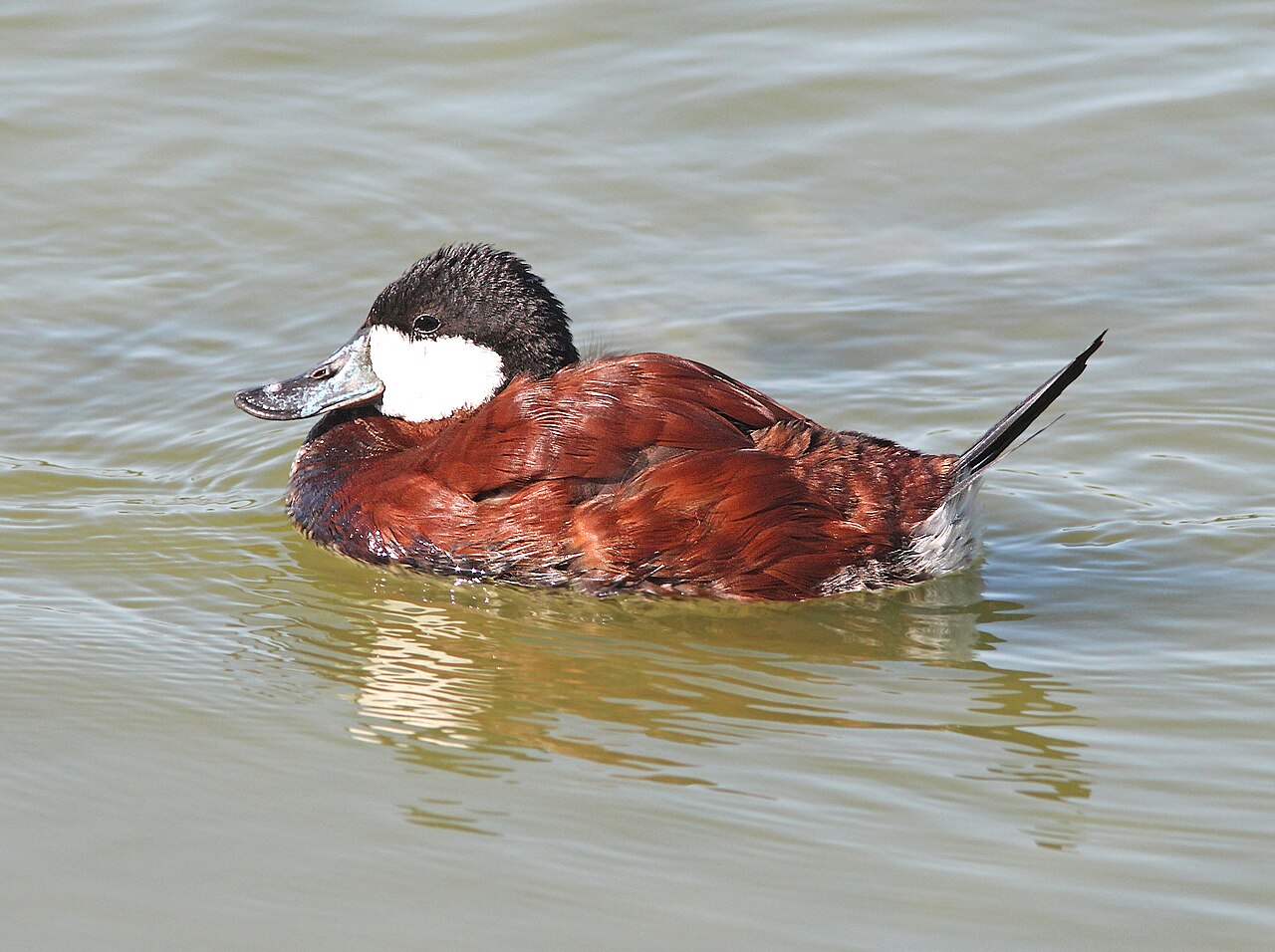
Ruddy Duck is a compact, dumpy diving duck with a thick, spatulate bill and a stiff tail it often holds cocked upright like a fan. The male switches from a dull greyish-brown winter plumage to a bright chestnut breeding plumage with a black cap, white cheeks and a bright blue bill — one of the strongest plumage changes of any North American duck. It breeds scattered across the marshes of the interior prairies and winters in large groups on coastal bays and reservoirs across almost the whole continent.
Voice
The species is largely silent; the male's only call is a belch-like note produced during courtship. In the so-called bubbling display he rapidly slaps his bill against his inflated, air-filled neck, producing a string of bubbles in the water, ending in that final belching note; at the same time he slaps the water with his feet, making a popping sound, and holds the tail cocked upright. The female is more vocal: a nasal call to gather her brood, a high-pitched call rejecting unwanted males, and a hiss when threatened.
Recording: Paul Marvin — CC BY-NC-SA 4.0 · Otay Lakes, San Diego Co., California, United States · xeno-canto
Identification
The breeding male has a black cap against bright white cheeks, a uniformly chestnut body and a sky-blue bill. Outside the breeding season the same male turns dull greyish-brown above and paler below, with a grey bill, but keeps the black cap and white cheek. The female and immature male are uniformly brownish with one faint dark stripe across the pale cheek and a dark bill. In every plumage the upperwing is uniformly dark without any pale patch, and the tail is stiff and often held cocked upright above the water — the silhouette of a small, dumpy body with a large head and a short, thick bill is recognisable in any plumage.
Confusion species
Masked Duck (Nomonyx dominicus) is clearly smaller, shows a white wing patch that Ruddy Duck lacks, and carries two dark cheek stripes on the female and non-breeding male instead of one. A non-breeding male or female could suggest a female Bufflehead or goldeneye at a distance, but both of those have a finer bill and lack the stiff, often upright tail. From the eiders, which in this region are far larger and heavier, Ruddy Duck is set apart by size alone, as well as by its near-exclusive use of fresh or lightly brackish water.
Habitat
It breeds on shallow marsh lakes and ponds with dense shoreline vegetation, where the nest hangs two to twenty-five centimetres above the water among cattail, bulrush or grass; roughly eighty-six per cent of the breeding population sits in the prairie marshes of the northern interior. Outside the breeding season it seeks open water: coastal bays, estuaries, reservoirs and unfrozen lakes, both fresh and brackish. It feeds by diving to the bottom, straining mud through the bill for midge larvae and other invertebrates; on migration and in winter it eats more plant material.
Where the bird is most often found, arranged by the USNVC — the vegetation classification of the United States and Canada — and CMECS for sea and coast.




Range and movements
Breeds from southern Alberta, Saskatchewan, Manitoba and interior British Columbia south through the northern Great Plains and the Intermountain West to California, Arizona and New Mexico. Winters along almost the entire coast of the United States and across the southern interior, with well-known concentrations on Chesapeake Bay and Currituck Sound, and passes through a large part of the states in between. In the highlands of central Mexico and in parts of Guatemala and El Salvador part of the population stays in the same place year-round, non-migratory, as it does on a few Caribbean islands.
- Resident
- Breeding (summer)
- Winter
- Passage
- dark = core range, pale = thinly spread
Where and when to look
In winter look for large, tight rafts of small ducks riding low on the water on lakes, reservoirs and coastal bays; a group that dives almost in unison and resurfaces well away from where it went down is typical of this species. Even outside the breeding season a male sometimes performs his bubbling display, which settles the identification at a distance at once.
Conservation
The species is listed as Least Concern (LC). The global breeding population is estimated at 1.3 million birds and was stable between 1966 and 2019. The main threats are loss and degradation of marsh in the prairie region and pollution of wintering waters. A separate chapter is the introduction to Britain, where escaped waterfowl-collection birds established a population from the late 1950s that interbred with the endangered White-headed Duck; a large-scale control programme cut the British total from about 5,500 birds in 2000 to under a hundred by 2014, and since 2016 the European Union has banned the import and release of the species.
Scientific name
Oxyura jamaicensis | (Gmelin, 1789)
Gmelin described the species in 1789 as Anas jamaicensis, based on an earlier account and plate published by John Latham in 1785, with Jamaica as the type locality; because it was later placed in another genus, author and year stand in parentheses. The genus Oxyura was introduced in 1828 by Charles Lucien Bonaparte, from Greek oxys, 'sharp', and oura, 'tail' — 'sharp-tail', after the stiff, pointed tail feathers that mark the whole group. jamaicensis is New Latin for 'of Jamaica'. Since the southern, Andean population is treated as a separate species (Oxyura ferruginea), Ruddy Duck no longer carries any subspecies; the two were formerly classified as a single, wider-ranging species.