All species › Waterfowl › Ducks, swans and geese › Masked Duck
Masked Duck | Nomonyx dominicus
Maskerstekelstaart | Malvasía enmascarada
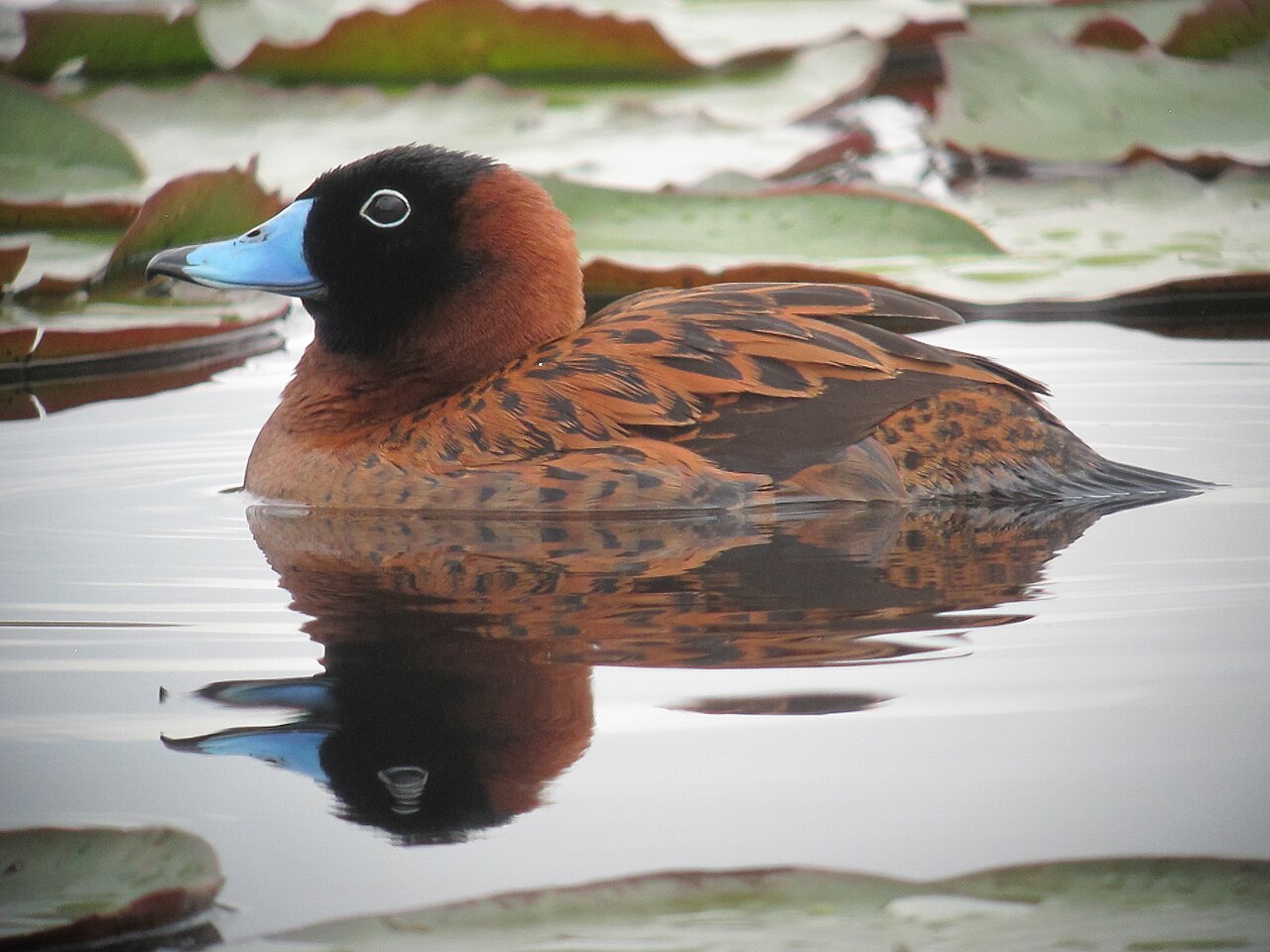
Masked Duck is the smallest stiff-tailed duck in the Americas; it sits hidden in dense aquatic vegetation and, at the first sign of danger, dives out of sight rather than takes flight. The adult male in breeding plumage carries a rusty body with a black face and a bright blue bill; females and non-breeding males are inconspicuously barred brown. A population in the extreme south of Texas is the only one that shows itself regularly outside the tropics.
Voice
For a duck the species is quiet, and its call is rarely heard because the bird almost never shows itself in the open. What is known is a low, soft grunting and a series of soft whistled notes; in courtship the male gives a soft, repeated oo-oo-oo, usually from within cover. The lack of a far-carrying call fits a bird that seeks safety in silence and cover rather than in flight.
Recording: Fernando Igor de Godoy — CC BY-NC-SA 4.0 · Campinas, Campinas, State of São Paulo, Brazil · xeno-canto
Identification
The breeding male is rusty to chestnut with a black face and forehead, a mottled, dark-blotched back and flanks, and a bright blue bill. Females, non-breeding males and juveniles are barred pale brown with a light, buffy head crossed by two dark stripes — one through the eye, one lower across the cheek — a pattern no other North American duck shows. Both sexes reveal a white patch on the wing in flight, against an otherwise dark upperside. The tail is short, pointed and stiff, characteristic of the group of stiff-tailed ducks to which the species belongs, and at just over thirty centimetres this is the smallest member of that group in the New World.
Confusion species
Ruddy Duck (Oxyura jamaicensis) is clearly larger, lacks the white wing patch entirely — its upperwing is uniformly dark — and shows only a single dark cheek stripe on the female and non-breeding male, rather than two. The male Ruddy Duck also carries a blue bill in the breeding season, but has a black cap set against a white face, never the fully black face of Masked Duck. A diving female could briefly suggest a grebe at a distance, but lacks the grebe's fine pointed bill and the sharply striped head pattern.
Habitat
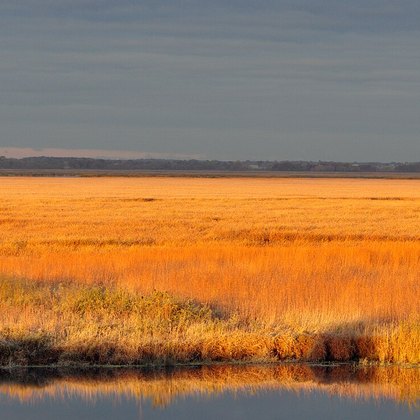
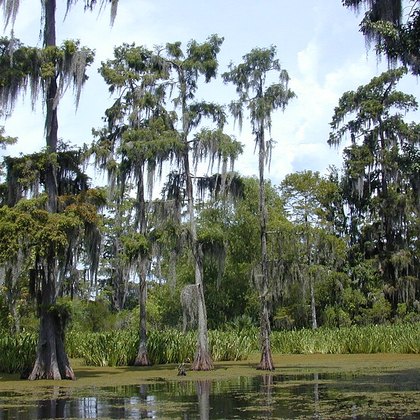
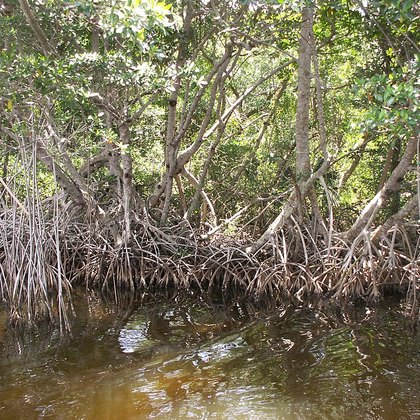
It stays in densely vegetated fresh water: marsh and ponds with rooted and floating aquatic plants, often surrounded by dense trees or shrubs, as well as mangrove swamp and flooded rice fields. Cover matters to this species more than open water: it forages by diving among the stems and, when disturbed, prefers to sink gradually out of sight rather than fly. Open, unvegetated water and dry land it avoids almost entirely.
Where the bird is most often found, arranged by the USNVC — the vegetation classification of the United States and Canada — and CMECS for sea and coast.


Range and movements
In the United States only a small, local population on the coastal plain of southern Texas, from the Rio Grande Valley northward, estimated at a few thousand birds; elsewhere in the country, as far as Florida and even Georgia, it is only a rare vagrant. Farther south it is largely resident: through Mexico, Central America, the Greater Antilles and South America as far as Argentina and Brazil, with local movements governed more by water level than by season. True migration, as shown by most ducks in this region, is absent.
- Breeding (summer)
- Winter
- Passage
- dark = core range, pale = thinly spread
Where and when to look
Search dense stands of cattail or bulrush along the edges of resacas (cut-off river channels in the Lower Rio Grande Valley) and ponds in the Rio Grande Valley, for instance at Santa Ana or Laguna Atascosa National Wildlife Refuge, and stand still in one spot rather than walking the shoreline. A bird sinking silently out of sight is often the only sign that a Masked Duck is present.
Conservation
The IUCN lists the species as Least Concern (LC), helped by its wide range, estimated at over eight million square kilometres; no reliable global total exists, but a 1998 estimate put the Texas population at roughly 3,800 birds. Marsh loss to agriculture and development, and hunting pressure in parts of the range, are named as the main risks, though there is no sign of rapid decline. The species is considered not rare but rarely seen, precisely because of the hidden life that defines it.
Scientific name
Nomonyx dominicus | (Linnaeus, 1766)
Linnaeus described the species in 1766 as Anas dominica, giving the locality broadly as 'South America' at the time, later narrowed to Santo Domingo on Hispaniola — the source Linnaeus drew on, an earlier account by Brisson, pointed to that place. The species was then placed among the stiff-tailed ducks as Oxyura dominica, before the American ornithologist Robert Ridgway placed it in a genus of its own, Nomonyx, in 1880, still the only species in it; because the species has changed genus twice since its original description, author and year stand in parentheses. dominicus is Latin for 'of Santo Domingo', after that type locality.