All species › Tubenoses › Petrels, shearwaters and diving petrels › Scopoli's Shearwater
Scopoli's Shearwater | Calonectris diomedea
Scopoli's pijlstormvogel | Pardela cenicienta mediterránea
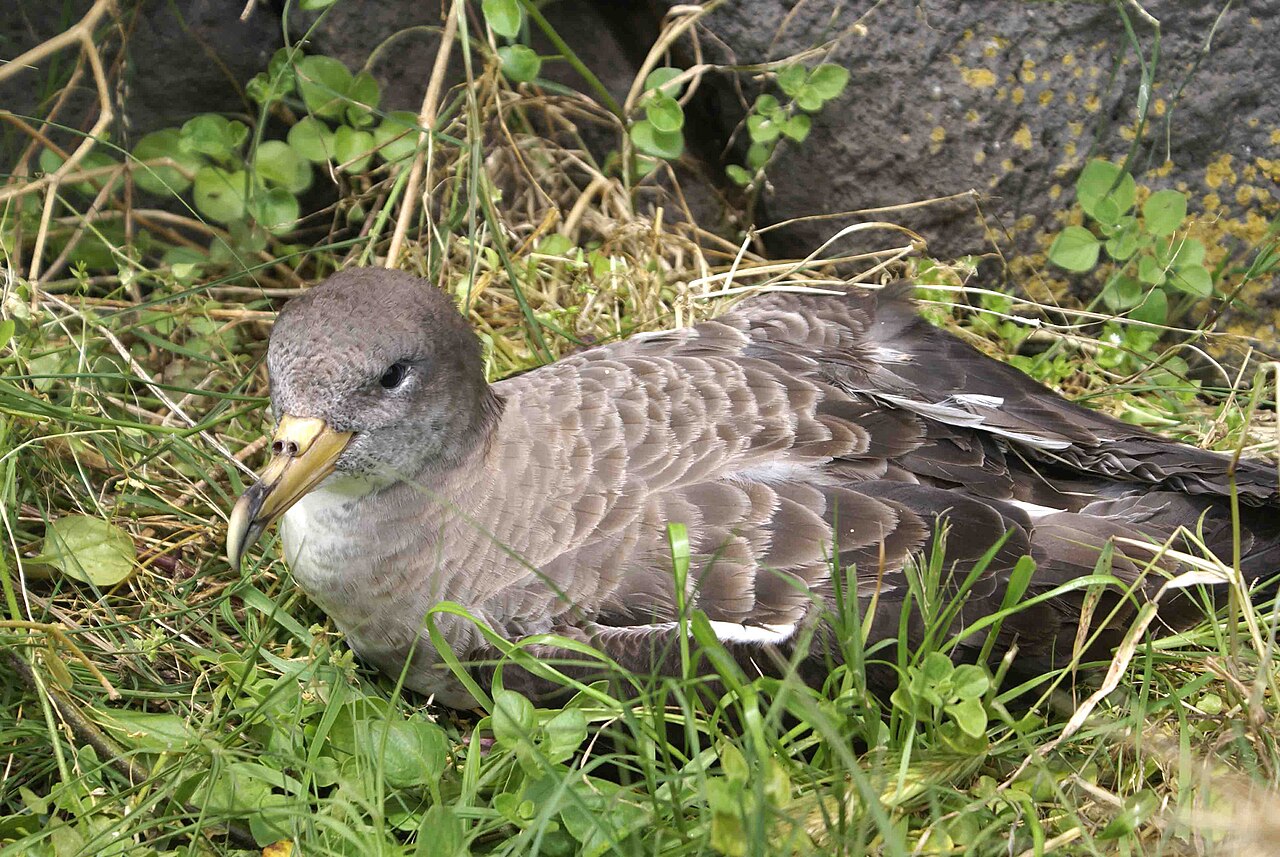
Scopoli's Shearwater is a large, greyish-brown shearwater of the Mediterranean that in late summer reaches, in small numbers, as far as the Gulf Stream off the American east coast. It is best told from its close twin, Cory's Shearwater, by the pattern of the underwing, and it has only been recognized separately in North America since the two species were split in the twenty-first century.
Voice
At the breeding colony, in the Mediterranean, a hoarse, howling, gurgling call rises at night from the nest burrows among the rocks, in a dull, undulating rhythm. At sea, in the waters this guide covers, it is silent like most shearwaters; anyone who encounters it here sees it gliding low over the water without a sound. Nothing is known of its voice within this area, simply because it does not breed here.
Recording: Carlo Fracasso — CC0 · Ventotene, Provincia di Latina, Lazio, Italy · xeno-canto
Identification
A large shearwater, brownish-grey above and white below, with a gradual rather than sharp transition between the two colours; the bill is yellowish with a dark tip. Male, female and young bird are barely distinguishable. In flight the slow, swinging wingbeat stands out, alternating with long glides on stiff, broad wings — a heavier, less hurried flight style than in most smaller shearwaters. The best mark separating it from Cory's Shearwater lies in the underwing: on Scopoli's Shearwater, long white tongues extend far into the dark wingtip, reaching the outermost primary, giving the underwing a paler look overall.
Confusion species
Cory's Shearwater (Calonectris borealis) is nearly identical in colour and size but slightly larger and heavier, with a broader, less interrupted dark trailing edge to the underwing; at sea the two are often not separated and mixed flocks get counted as one or the other. Great Shearwater (Ardenna gravis) is darker overall, with a sharper line between upperparts and underparts and dark underwing linings. Sooty Shearwater (Ardenna grisea) is smaller, with a straighter, more hurried flight and narrower wings. Separating the two at sea nearly always requires a good look at the underwing, or a photograph.
Habitat
Within this guide, Scopoli's Shearwater lives exclusively over open, warm ocean water, usually well offshore above the Gulf Stream. It does not breed in North America; its breeding grounds are on islands and cliffs in the Mediterranean. In the United States it is therefore never seen on land, only from a boat far out at sea.
Where the bird is most often found, arranged by the USNVC — the vegetation classification of the United States and Canada — and CMECS for sea and coast.
Range and movements
Scopoli's Shearwater breeds on islands in the Mediterranean, from the Balearics and Sardinia to Crete and the Aegean, with its largest colony on the Tunisian island of Zembra. After breeding, part of the population passes through the Strait of Gibraltar into the Atlantic and follows the upwelling zones along the west coast of Africa. Small numbers reach the Gulf Stream off North Carolina in summer and early autumn, usually among flocks of the far more numerous Cory's Shearwater; elsewhere along the American coast it is a great rarity known from only a few records. Because the two species were only recently split, this presence in American waters went largely unnoticed for a long time.
- Breeding (summer)
- Passage
- dark = core range, pale = thinly spread
Where and when to look
Look for Scopoli's Shearwater on a boat trip in the Gulf Stream off North Carolina, in summer, among the far more numerous Cory's Shearwaters; check every bird's underwing pattern, since at a distance the two species cannot be told apart. A good camera with a fast shutter speed is often essential to confirm the identification afterwards.
Conservation
The world population is large and the species is not considered threatened, though there is concern over bycatch in fisheries and over disturbance and predation by rats and cats on the breeding islands. Numbers outside the breeding season, such as in American waters, are poorly quantified because the species was for a long time not counted separately from Cory's Shearwater.
Scientific name
Calonectris diomedea | (Scopoli, 1769)
Giovanni Antonio Scopoli described the species in 1769 as Procellaria diomedea; because it has since been moved to another genus, author and year stand in parentheses. The genus Calonectris was introduced in 1915 by Mathews and Iredale, from Greek for 'beautiful swimmer'. The species name diomedea refers to Diomedes, the Greek hero whose companions were said to have turned into seabirds after his death — the same myth that gave the albatross family, Diomedeidae, its name. No precise original type locality was designated; in 1946 the Tremiti Islands in the Adriatic Sea were fixed as the type locality instead.