All species › Tubenoses › Petrels, shearwaters and diving petrels › Cory's Shearwater
Cory's Shearwater | Calonectris borealis
Kuhls pijlstormvogel | Pardela cenicienta atlántica
Cory's Shearwater is the largest shearwater regularly seen off the Atlantic coast of the United States: a heavy, broad-winged seabird that turns up in decent numbers every summer in the Gulf Stream from North Carolina to off Massachusetts. It does not breed in North America but on islands in the Atlantic off Europe and Africa, and occurs here only as a non-breeding summer and autumn visitor.
Voice
On the breeding islands a hoarse, howling, gurgling duet rises at night from the burrows among the rocks, by which pairs and neighbours recognize each other in the dark. In the waters this guide covers, far from the colonies, it is silent by day like most shearwaters. What an observer here hears is therefore rarely more than the splash of wings as a bird lifts off the water.
Recording: Sven Normant — CC BY-NC-SA 4.0 · SW Sein Island (French continental slope), France · xeno-canto
Identification
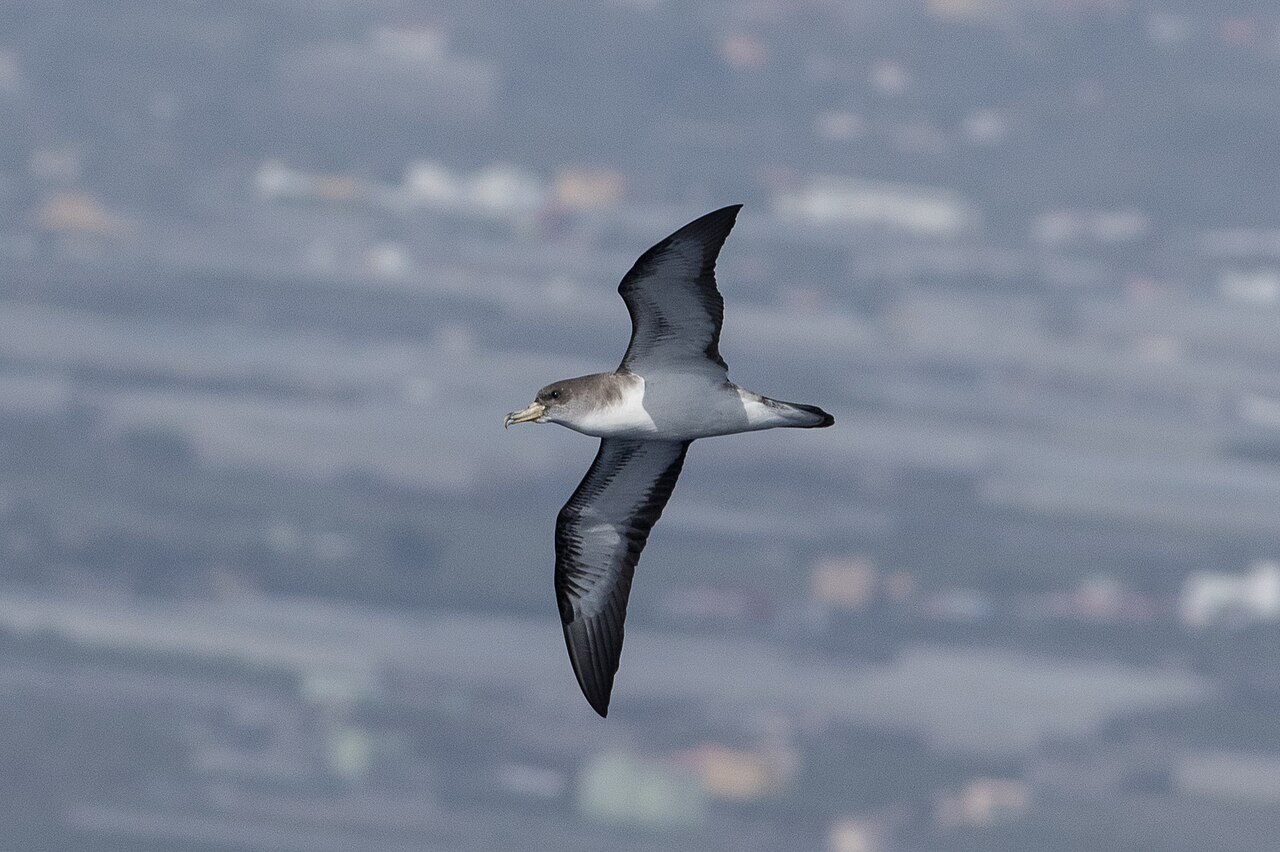
A large, heavy shearwater, brownish-grey above and white below, with a yellowish bill with a dark tip and a smooth, not sharp, transition between the colours on head and neck. Male, female and young bird cannot be told apart by appearance. The wings are broad and the wingbeat slow and heavy, with long glides on stiffly held wings — a bulkier, more laboured flight style than in most other shearwaters. On the underwing the dark trailing edge at the wingtip is broader and less broken by white than in the closely related Scopoli's Shearwater, with little to no white on the outermost primaries.
Confusion species
Scopoli's Shearwater (Calonectris diomedea) is nearly identical but averages slightly smaller and lighter-built, with more white on the underwing reaching the outermost primary; at sea the difference is usually only settled with a good photograph. Great Shearwater (Ardenna gravis) has a more sharply defined dark cap and a black belly patch, with a quicker-beating, less laboured flight. Sooty Shearwater (Ardenna grisea) is smaller and darker, with narrower wings and a straighter, more hurried flight. In mixed flocks over the Gulf Stream, Cory's Shearwater usually forms the majority, which complicates picking out the rarer species among them.
Habitat
Within this guide, Cory's Shearwater is a bird of open, warm ocean water, especially over and along the edge of the Gulf Stream, well offshore. It does not breed in North America; its colonies lie on rocky islands off the Azores, Madeira and the Canary Islands. Along the coast itself, in bays or on the beach, it is essentially never seen.
Where the bird is most often found, arranged by the USNVC — the vegetation classification of the United States and Canada — and CMECS for sea and coast.
Range and movements
Cory's Shearwater breeds in the eastern Atlantic, from the Azores south to the Canary Islands and east to Galicia and the Berlengas Islands off Portugal. After the breeding season, which occupies the colonies from late February to October, mainly young and non-breeding birds disperse across the Atlantic Ocean. In the United States it is regularly seen from June to November over the Gulf Stream off North Carolina and further north to the waters around Massachusetts and Cape Cod, with smaller numbers off New Jersey and Virginia and occasionally as far as off Nova Scotia. Further south, in the Gulf of Mexico, it is much scarcer.
- Breeding (summer)
- Passage
- dark = core range, pale = thinly spread
Where and when to look
The best chance is a pelagic boat trip in the Gulf Stream off Cape Hatteras, North Carolina, from June to November, where Cory's Shearwater is often the most numerous shearwater. Look closely at the underwing of every bird in a group, since a single Scopoli's sometimes hides among the many Cory's.
Conservation
The world population is large and stable to increasing, and the species is listed as Least Concern (LC). Bycatch in longline fisheries along the migration route and in the wintering grounds off southern Africa is the main known threat, alongside disturbance and predation by rats and cats on a few breeding islands.
Scientific name
Calonectris borealis | (Cory, 1881)
Charles B. Cory described the species in 1881 as Puffinus borealis, based on a specimen taken off Chatham Island, Massachusetts; because it has since been moved to another genus, author and year stand in parentheses. The genus Calonectris was introduced in 1915 by Mathews and Iredale. The species name borealis is Latin for 'northern', reflecting that the type locality, off the Massachusetts coast, was the northernmost known site for the species.