All species › Tubenoses › Petrels, shearwaters and diving petrels › Wedge-tailed Shearwater
Wedge-tailed Shearwater | Ardenna pacifica
Wigstaartpijlstormvogel | Pardela del Pacífico
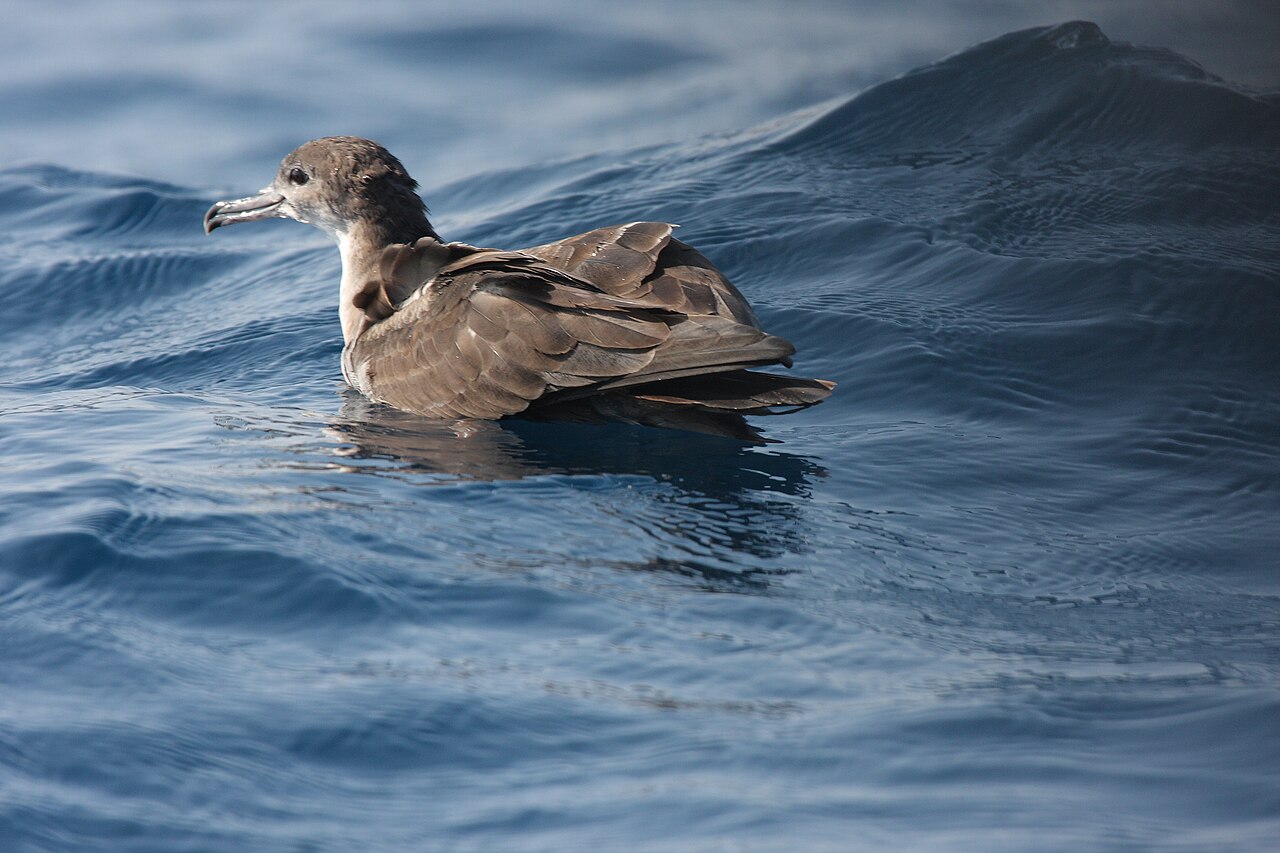
The Wedge-tailed Shearwater is a tropical seabird with a long, pointed tail that sets it apart in flight from most other shearwaters. It breeds in two colour morphs, pale and dark, on islands across the Pacific and Indian oceans, with one colony inside the guide area: San Benedicto, in Mexico's Islas Revillagigedo. Outside the breeding season it ranges widely over open water, occasionally turning up off the California coast.
Voice
At sea the Wedge-tailed Shearwater is essentially silent; only the splash of water and the hiss of its wings betray its approach. At the colony it is different: at night a long, wailing moan rises from the nesting burrows as pairs find each other at the nest. By day the birds leave the colony and it falls quiet. Anyone who meets it at sea in North America therefore hears only its wingbeats.
Recording: Kathryn Hodder — CC BY-NC-SA 4.0 · Round Island, Mauritius · xeno-canto
Identification
The dark morph is uniform chocolate-brown on head, breast and underparts alike; the pale morph has white underparts sharply set off against brown upperparts. Both morphs have a slender, slightly curved pale bill and pink feet that do not project beyond the long, wedge-shaped tail in flight. Flight is markedly slow: a few loose, elastic wingbeats alternate with long glides low over the water, quite unlike the stiffer, hurried flight of most other shearwaters. Juveniles resemble adults of the same colour morph.
Confusion species
The dark morph is confused with Sooty Shearwater (Ardenna grisea) and Short-tailed Shearwater (A. tenuirostris), both of which have a short, rounded tail and dark feet against the Wedge-tailed's long wedge-shaped tail and pink feet. Pink-footed Shearwater, also pale-billed and pink-legged, has a shorter, rounded tail and a heavier, stiffer flight. Of the three, the Wedge-tailed shows by far the slowest, most buoyant flight.
Habitat
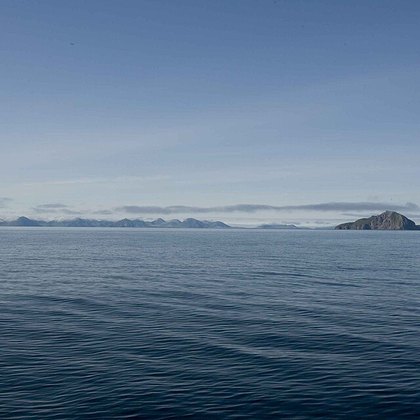
Outside the breeding season the Wedge-tailed Shearwater lives entirely on open, warm ocean water, usually well offshore where sea-surface temperatures stay above roughly 25 to 27 degrees. It nests in burrows it digs itself in the loose, scrub-covered soil of small, predator-free islands; dense cover and soft ground are essential. It avoids rocky coastlines and cooler water outside the tropics and subtropics.
Where the bird is most often found, arranged by the USNVC — the vegetation classification of the United States and Canada — and CMECS for sea and coast.
Range and movements
The species breeds on scattered islands across the tropical and subtropical Pacific and Indian oceans, from the Seychelles and Mascarenes to Hawaii; within the guide area San Benedicto in Mexico's Islas Revillagigedo is the only colony. Outside the breeding season it disperses over the surrounding oceans, east into Mexican waters south of the Gulf of California, where it is seen regularly off Guerrero. California lies at the far edge of that range: there are only a few dozen accepted records, almost all between late July and October.
- Resident
- Breeding (summer)
- Winter
- Passage
- dark = core range, pale = thinly spread
Where and when to look
Look for it on boat trips off the coast of Guerrero and farther south, in warm, deep water well offshore, often among mixed feeding flocks of other seabirds. Watch for the long, pointed tail and the slow, buoyant wingbeat: that sets it apart at a distance from the far more numerous dark shearwaters sharing the same waters.
Conservation
The world population is large, likely numbering several million pairs spread across dozens of colonies, and the species is listed as Least Concern (LC). On individual islands, introduced rats and cats still threaten the ground-nesting birds, and, like other shearwaters, it suffers from fisheries bycatch and from plastic ingested along with its food.
Scientific name
Ardenna pacifica | (Gmelin, 1789)
Gmelin described the species in 1789 as Procellaria pacifica, after the Pacific Ocean, where the described bird came from; because it was later moved to another genus, author and year stand in parentheses. The genus Ardenna was established by Reichenbach in 1853, with Great Shearwater as its type species. The type locality is restricted to the Kermadec Islands, northeast of New Zealand.