All species › Passerines › Wagtails and pipits › Siberian Pipit
Siberian Pipit | Anthus japonicus
Siberische pieper | Bisbita siberiano
The Siberian Pipit is the Asian counterpart of the American Pipit, treated as one species with it until 2024 and kept separate since. In the guide area it is a visitor to the outer Aleutians and the west coast of Alaska, almost always among or beside American Pipits.
Voice
The call is a cheep given in series, longer held and more strongly modulated than that of American Pipit — measurements come out at roughly eighty milliseconds against sixty-five, which makes it sound more like Meadow Pipit. That difference can be heard in the field by a trained ear and captured on a recording; it is one of the arguments on which the species was split in 2024. The song, a series of accelerating chee notes in a descending song flight, is not heard in North America.
No recording with a suitable Creative Commons licence has been found for this species yet; what to listen for is described below.
Identification
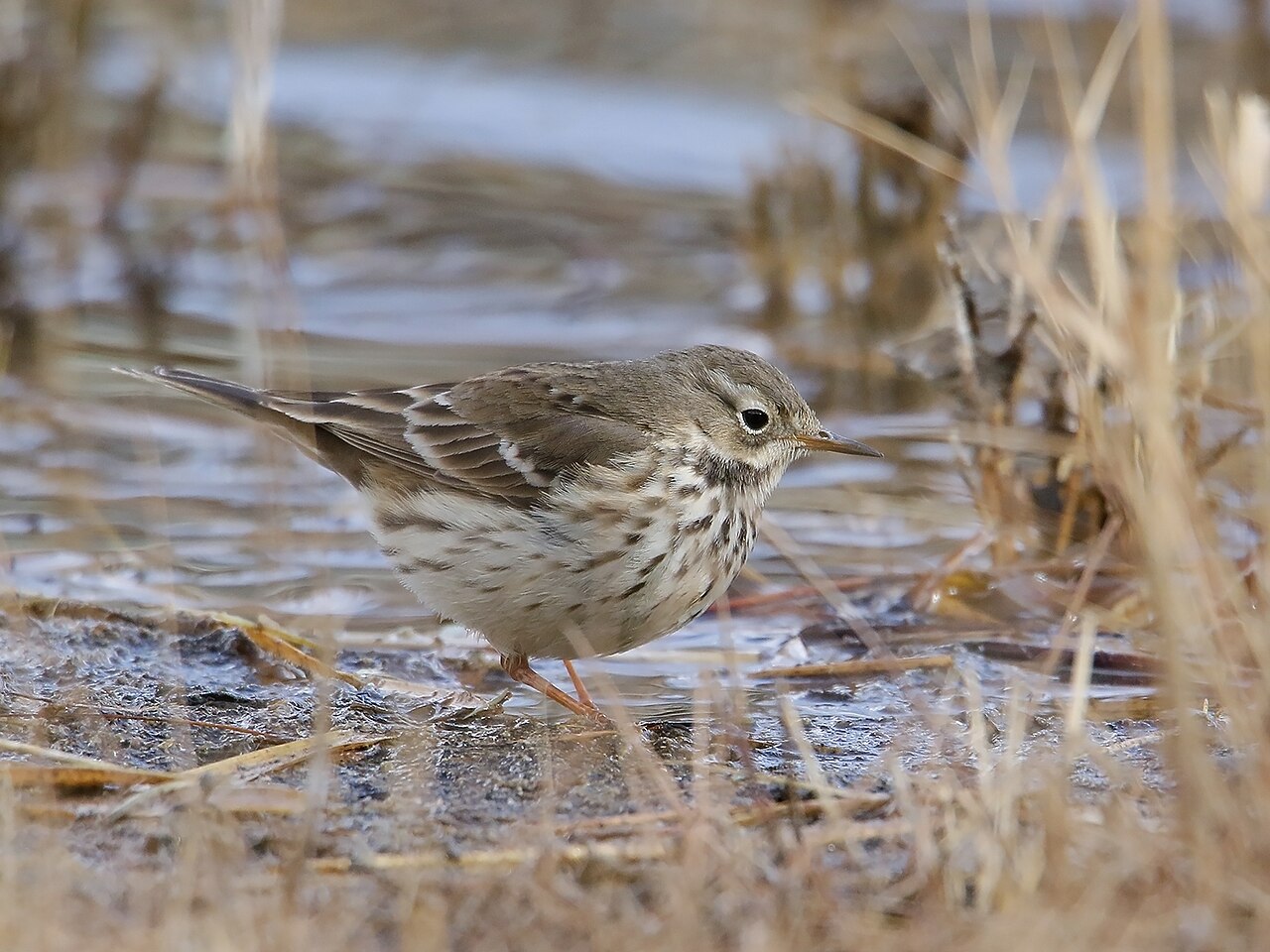
A medium-sized pipit with grey-brown, little-marked upperparts and an unstreaked rump. The underparts are white to dingy white — not buff — with heavy, blackish tear-drop streaks running well down the belly and along the flanks in longitudinal lines. On each side of the throat stands a thick black malar patch that flares downward into the breast streaking, sometimes closing into a dark necklace. The legs are bright pink. The white tips of the median coverts are narrow and crescent-shaped.
Confusion species
American Pipit is the only real confusion species: it is buff to grey-brown below with brown-washed flanks, usually has dark legs, a brown rather than black malar patch with pale feathering mixed in, less and browner streaking below, and broad, squared-off white tips to the median coverts. None of these is conclusive on its own, since both species vary; the flight call is the most reliable pointer. Red-throated Pipit has a streaked rump and two pale mantle lines.
Habitat
Breeds in damp mountain meadows, shrub tundra and open ground above treeline in Siberia and Kamchatka, usually along streams and in wet hollows. Outside the breeding season it uses short, wet grassland, field margins, rice fields, river and lake shores and drying mud edges. Birds reaching western Alaska are found on gravel beaches, in low coastal grassland and on bare ground near villages.
Where the bird is most often found, arranged by the USNVC — the vegetation classification of the United States and Canada — and CMECS for sea and coast.






Range and movements
The range lies in northern to eastern Russia: from the southeastern Taymyr Peninsula and the western Siberian Plateau eastward from the Lena, the Yakutsk region and Lake Baikal to the Chukotka Peninsula, the Commander Islands, Sakhalin and the Kurils. Wintering runs from Japan and Korea to southern and southeastern continental Asia, with western records reaching Israel and Türkiye. In North America it appears on the westernmost Aleutians and along the northwest coast of mainland Alaska; because of the recent split, the full record total cannot yet be reconstructed from older observations.
Where and when to look
Look for it in May and from late August to early October on Attu, Shemya or Adak, and work through pipit flocks for a bird with white, heavily streaked underparts and bright pink legs. Record the call: for now that is the only feature that will make a record stand, since every single plumage character overlaps with American Pipit.
Conservation
Because the species entered the world lists only in 2024, it has not yet been evaluated by the IUCN (NE); the parent species was listed as not threatened, and the range of japonicus is extensive and largely thinly settled. There is no separate count series, so nothing is established about the trend. In East Asia the loss of wet grassland and the conversion of rice fields may be costing it wintering sites, but that has not been measured for this species separately.
Scientific name
Anthus japonicus | Temminck; Schlegel, 1847
Temminck and Schlegel described the form in 1847 as Anthus pratensis japonicus, that is as a subspecies of Meadow Pipit, from a specimen from Japan; as the name has stayed within Anthus, author and year appear without parentheses. The species name japonicus simply means 'of Japan'. The genus Anthus goes back to Greek anthos, in Pliny the name of a small bird of grassland. The form was afterwards long placed with the American Pipit under the joint name Anthus rubescens; genetic and acoustic work published in 2023 led to the split that the international lists adopted in 2024.