All species › Passerines › Wagtails and pipits › American Pipit
American Pipit | Anthus rubescens
Pacifische waterpieper | Bisbita norteamericano
A slim, plain brown ground bird that walks over bare soil instead of hopping and pumps its tail without pause as it goes. It breeds on the Arctic tundra and high above the treeline, and winters in thousands on fields, mudflats and beaches. Anyone meeting it in winter rarely sees a single bird: it comes in loose flocks that call a sharp pip-pit as they lift.

Voice
The call is a sharp, thin pip-pit, usually in flight, and often the first sign that a flock is going up. The song is a long series of uniform, high notes, chee-dee chee-dee chee-dee, that barely changes in speed or tone. There are no song posts on the tundra, so the male climbs to thirty metres or more, sings in the air and then sinks back with tail spread and wings raised. In winter it is almost silent; only the flight call is heard.
Recording: Manuel Grosselet — CC BY-NC-SA 4.0 · Colonia Yanashi, San Jerónimo Tlacochahuaya, Oaxaca, Mexico · xeno-canto
Identification
Slim, with a thin, pointed bill, dark legs and a fairly long tail whose white outer feathers show as it takes off. In winter it is grey-brown above with faint streaking and off-white to buff below, with heavy brown streaks on breast and flanks. In breeding plumage the head is greyish, the underparts a warm ochre and the streaking much finer or almost absent, most clearly so in the birds of the Rocky Mountains. Male and female cannot be told apart, and juveniles resemble the winter plumage. Behaviour is the best mark: it walks rather than hops, and the tail pumps without stopping.
Confusion species
Sprague's Pipit (Anthus spragueii) of the prairie is paler, scaly on the back, has pale legs and a large pale eye in a pale face, hardly pumps its tail and keeps hidden in tall grass. Siberian Pipit (Anthus japonicus), which reaches Alaska and the west coast, is colder in tone, more heavily and blackly streaked, and has pink legs. Meadow Pipit (Anthus pratensis), a vagrant from Europe, is greener on the back and has a long hind claw. Beyond the family, pipits in the field are most often taken for sparrows and buntings: those hop, have a conical bill and do not pump the tail.
Habitat
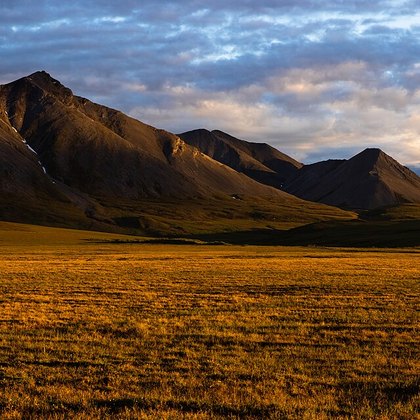
In the breeding season short, wet vegetation on the Arctic tundra and above the treeline in the high mountains: sedge flats, snowmelt hollows and scree. Outside it, bare and level ground — ploughed fields, stubble, sod farms, river and lake shores, mudflats and sandy beaches. It avoids everything that stands up: forest, scrub and long grass. Snow cover it cannot use, and its winter range shifts with the snow line accordingly.
Where the bird is most often found, arranged by the USNVC — the vegetation classification of the United States and Canada — and CMECS for sea and coast.


Range and movements
A breeding bird of Alaska, Arctic Canada, Greenland, Labrador and Newfoundland, and further south in the high mountains as far as California, Colorado and Utah. It migrates on a broad front across the whole continent and winters from the southern United States far into Mexico, where thousands feed on the fields of the central plateau; a small number reach Guatemala and El Salvador, too few to put on the map. On the west coast different birds breed and winter in the same states, so that it is present there all year. The European Water Pipit was regarded as the same species until the 1980s; the split rests on differences in call, plumage and breeding range.
- Resident
- Breeding (summer)
- Winter
- Passage
- dark = core range, pale = thinly spread
Where and when to look
In October and November a freshly ploughed or newly harvested field is the best place: walk the edge and watch for movement, because the birds keep low among the clods and stay quiet until they flush. They then rise together calling, swing round and drop in again a little further on. In summer you have to climb to them: above the treeline, in the damp meadows just below the snowfields.
Conservation
Least Concern (LC) on the Red List — the assessment already takes into account the split of Siberian Pipit as a species of its own. Measured on the birds themselves it is numerous but not stable: the estimate for the broadly defined species is around twenty million birds, with a decline of some thirty per cent since 1970. The pressure comes from mountain meadows growing in, drained wintering grounds, and change in the tundra and the high mountains.
Scientific name
Anthus rubescens | (Tunstall, 1771)
Marmaduke Tunstall described the bird in 1771 as Alauda rubescens, among the larks, in a catalogue of British birds; he went by 'the Lark from Pensilvania' that Pennant and Edwards had figured earlier. Because the species was later moved to another genus, author and year stand in parentheses. The genus Anthus was introduced in 1805 by Bechstein; anthus is in Pliny the name of a small bird of grassland. rubescens is Latin for 'turning reddish', for the ochre underparts of the breeding plumage, and the type locality is Pennsylvania.