All species › Waders, gulls and terns › Skimmers, noddies, terns and gulls › Slaty-backed Gull
Slaty-backed Gull | Larus schistisagus
Kamtsjatkameeuw | Gaviota de Kamchatka
Slaty-backed Gull is the dark-backed gull of the northwest Pacific: a heavy, short-winged bird with a slate-grey mantle, bright pink legs and a broad white edge along the rear of the wing. For North America it is a visitor from Asia — annual in small numbers in western Alaska, and elsewhere on the continent a rarity that has turned up as far away as Texas and New England.

Voice
The long call lasts five seconds or more: one drawn-out introductory note followed by a series of shorter cries, delivered with the head first low and then thrown steeply up. There is also a wailing note of one to two seconds that rises and then slips back a little, and quick runs of three or four laughing notes. On taking flight and in alarm it gives a short, descending cowp. Young birds beg with a high, slightly reedy whistle quite unlike anything the adults produce.
Recording: Uku Paal — CC BY-NC-SA 4.0 · Nemuro, Hokkaido, Japan · xeno-canto
Identification
A large, thickset gull with a deep chest, a heavy bill and short wings that barely reach past the tail when perched. The adult has a dark slate-grey mantle — darker than that of any other gull of the northern Pacific — a yellow bill with a red spot, a yellow eye set in purplish to deep pink orbital skin, and bright pink legs. The wingtip is black, but between the grey of the arm and the black of the tip a row of white crescents runs across the primaries: the 'string of pearls', visible from above and below in flight, and the white trailing edge of the wing is broad. In winter the head is heavily smudged brown well down the neck. Young birds are plain brown and paler than a young Great Black-backed Gull, with a dark mask around the eye; grey comes to the back in the second year and full adult plumage in the fourth.
Confusion species
Vega Gull (Larus vegae) and American Herring Gull (Larus smithsonianus) share its range but have a far paler blue-grey mantle and no string of pearls. Lesser Black-backed Gull (Larus fuscus) is as dark above but much slimmer, with a narrow bill, long wings and yellow legs instead of pink. On the west coast of the United States the trap is Western Gull (Larus occidentalis), also dark-mantled, but with a heavier bill, no string of pearls and a narrower white trailing edge. Most similar of all are the hybrids: young of American Herring Gull crossed with Glaucous-winged Gull (Larus glaucescens) can come out dark enough to imitate this species, and in the field they cannot be named with certainty.
Compare gulls: legs, head, bill and wing tip side by side
Habitat
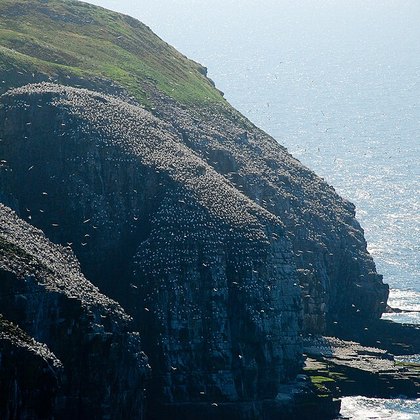
A coastal bird through and through: it breeds on sea cliffs, rocky islets and low coastal islands, and feeds on beaches, tidal flats, in river mouths and above all in fishing harbours and around fish-processing plants. Where salmon run up the rivers it follows the water far inland. In the Russian Far East and in Japan it also nests on the flat roofs of port towns, among the cranes and the sheds. Open ocean far from land it hardly uses; it stays where the bottom is shallow and where people bring fish ashore.
Where the bird is most often found, arranged by the USNVC — the vegetation classification of the United States and Canada — and CMECS for sea and coast.




Range and movements
Breeds along the coasts and lakes of northeastern Siberia, from the Bering Sea and Kamchatka south through the Kuril Islands to Hokkaido and northern Honshu, and winters along Japan, Korea, the Bohai Sea and as far as Taiwan. To North America it comes as a visitor: in western Alaska — the Bering Sea islands, the coast at Nome, the Aleutians — it can be found annually in small numbers, mainly in summer. Further east and south it is a pronounced wanderer, with records in California, on the Great Lakes, in Texas, in New England and on Newfoundland, and even a handful in Europe. Reports away from Asia have risen sharply over recent decades, which is put down mostly to better knowledge of the plumages among observers.
- Resident
- Breeding (summer)
- Winter
- Passage
- dark = core range, pale = thinly spread
Where and when to look
Anyone wanting to find it in North America unaided stands in June among the gulls at the river mouth or the fish plant at Nome, or on one of the Bering Sea islands. Look at the mantle first: darker than everything around it, even under flat cloud. Then confirm with two marks at once — the string of pearls on the spread wing and the broad white trailing edge — because those two together rule out a dark hybrid.
Conservation
The world population is put at about three hundred and forty thousand birds and the species is Least Concern (LC); the trend is not well known. It is one of the gulls that gain from people: fisheries, fish plants and landfills provide food, and port towns provide roof sites that foxes cannot reach. In parts of the breeding range it is treated as a nuisance for that reason, while at the same time it is a feared taker of eggs and chicks in some seabird colonies.
Scientific name
Larus schistisagus | Stejneger, 1884
The Norwegian-American ornithologist Leonhard Stejneger described the species in 1884 as Larus schistisagus, from birds he collected himself in the Bering Sea; it still stands in the same genus, and for that reason author and year carry no parentheses. Larus is the Latin form of Greek laros, an unspecified seabird in the classical writers. schistisagus is built from New Latin schistus, 'slate', and Latin sagum, 'cloak' or 'soldier's cloak' — the slate-grey mantle that gave the bird its name. The type locality is Bering Island in the Commander Islands, off the coast of Kamchatka.