All species › Waders, gulls and terns › Skimmers, noddies, terns and gulls › Glaucous-winged Gull
Glaucous-winged Gull | Larus glaucescens
Beringmeeuw | Gaviota de Bering
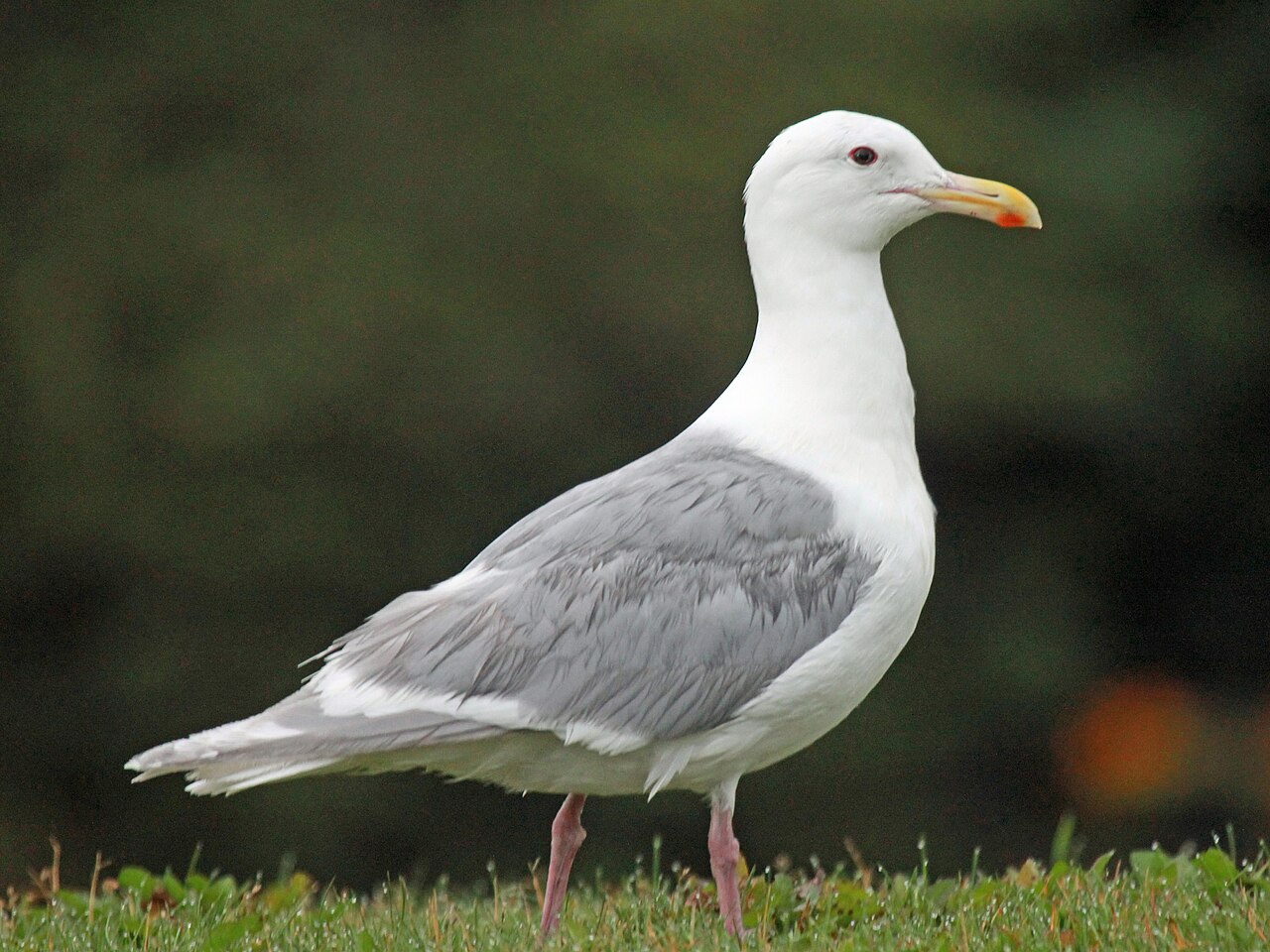
Glaucous-winged Gull is the large gull of the North Pacific, and the only one whose wingtips are exactly the same grey as the mantle: there is no black anywhere in the plumage. From the Bering Sea to Puget Sound it is the default gull of every harbour, and in Vancouver, Victoria and Seattle it nests on flat roofs in the middle of the city.
Voice
The usual call is a low, piercing kiau, with a soft cow-cow-cow used between birds close together. The long call is a series of notes that starts high and grows shorter and lower as it runs on: on the Pacific coast this is the sound everybody hears as the sound of the sea. In the colony both male and female call, with a wide range of notes in courtship and threat, and from a city roof that calling carries down whole streets in the early morning. Young birds beg with a persistent whistling pipe.
Recording: Rachel Thurman — CC BY 4.0 · Hospital Drive and Salmon Creek Lane (near Juneau), Juneau City and Borough, Alaska, United States · xeno-canto
Identification
A large, heavily built gull with a big, rather flat head and a thick bill with a pronounced angle before the tip. The adult is white with a pearly grey mantle, and the wingtips carry that same grey with white spots in it, so that the end of the wing looks marked but never dark. The eye is dark brown, the bill yellow with a red spot, the legs pink; in winter the head is heavily smudged and streaked brown, well down the neck. Young birds are evenly grey-brown, including the wingtips and tail, with an all-black bill, and lack the sharp patterning of other young large gulls. Adult plumage comes in the fourth year.
Confusion species
Glaucous Gull (Larus hyperboreus) is bigger and paler, with pure white wingtips without any grey, a pale yellow eye, and as a young bird a pink bill with a crisply cut black tip instead of an all-black one. Iceland Gull (Larus glaucoides) is smaller and finer built, also with a white tip. American Herring Gull (Larus smithsonianus) has black wingtips and a pale eye. The most similar species is Western Gull (Larus occidentalis): where the two meet in Washington and Oregon they breed together, and most coastal gulls there are crosses with a mantle and wingtip falling between the two parents. For a certain Glaucous-winged Gull keep three things together: a wingtip the same shade as the mantle, a dark eye, and on young birds a wholly black bill.
Compare gulls: legs, head, bill and wing tip side by side
Habitat
The rocky intertidal is its real workplace: mussel beds, kelp and pools among the rocks, where it takes sea urchins and crabs at low water and drops shells onto the stones from a height. It also uses sandy beaches, river mouths, harbours, fish quays and landfills, and follows fishing boats right into port. It nests on treeless islets, low cliffs, wharves, warehouses and flat roofs in town. Inland it hardly goes beyond the rivers the salmon run up.
Where the bird is most often found, arranged by the USNVC — the vegetation classification of the United States and Canada — and CMECS for sea and coast.




Range and movements
Breeds along the coasts of the North Pacific, from eastern Siberia, Kamchatka, the Kuril and Commander Islands east through the Aleutians and the Pribilofs and through southern Alaska to northern Washington. Many birds stay near the colony all year as long as the harbour remains ice free; the rest move south, to California and Baja California, and on the Asian side to Japan. Over the last half century it has settled in the cities: roofs around the harbours of Vancouver, Victoria and Seattle now hold a noticeable share of the southern breeders. Away from the Pacific coast it is rarely seen.
- Resident
- Breeding (summer)
- Winter
- Passage
- dark = core range, pale = thinly spread
Where and when to look
Any harbour between Anchorage and Seattle will produce it, all year round; on a perched bird look at the end of the folded wing and compare it with the back — the same grey, with white spots in it, is the mark. South of the Canadian border a question mark comes with it: expect a share of the birds to be crosses with Western Gull, and watch for birds whose wingtip is noticeably darker than the mantle. The dark eye is the quickest help at all ages.
Conservation
The world population is estimated at about three hundred and eighty thousand breeding birds, and overall numbers stayed fairly stable between 1968 and 2015; the species is rated Least Concern (LC). Around the Salish Sea it is another story: numbers there have roughly halved since the 1980s, and at the same time the diet has shifted from fish to refuse and earthworms taken on land. Researchers point to the decline of small coastal fish, because without fish pairs raise too few chicks; pollution of coastal waters and the closing of open landfills play their part as well.
Scientific name
Larus glaucescens | Naumann, 1840
The German ornithologist Johann Friedrich Naumann described the species in 1840 as Larus glaucescens, from North American material; it still stands in the same genus, and for that reason author and year carry no parentheses. Larus is the Latin form of Greek laros, an unspecified seabird in the classical writers. glaucescens means 'becoming blue-grey', from Latin glaucus and Greek glaukos, blue-grey — exactly the colour of the wingtip that separates the species from every other large gull. As a type locality the description gives no more than 'North America'.