All species › Passerines › Wagtails and pipits › Sprague's Pipit
Sprague's Pipit | Anthus spragueii
Prairiepieper | Bisbita llanero
Sprague's Pipit is the only pipit wholly tied to the original mixed-grass prairie of the northern Great Plains. It breeds nowhere else in the world, and with the conversion of prairie to cropland it has become one of the most steeply declining songbirds in North America.
Voice
The male sings high in the air, up to roughly a hundred metres, in a series of gliding arcs; a song flight may last half an hour on end and in a few birds has been timed at up to three hours. The song itself is a thin, downward-sliding series of four to eight paired notes, tsee-a tsee-a tsee-a, each pair lower and slower than the last. Because the bird flies so high, the song is usually heard without being traced to the singer. The call on the ground and on flushing is a short, dry chip, far less sharp than that of American Pipit.
Recording: Jacob Saucier — CC BY-NC-SA 4.0 · 4 km E of St. Marie, Valley County, Montana, United States · xeno-canto
Identification
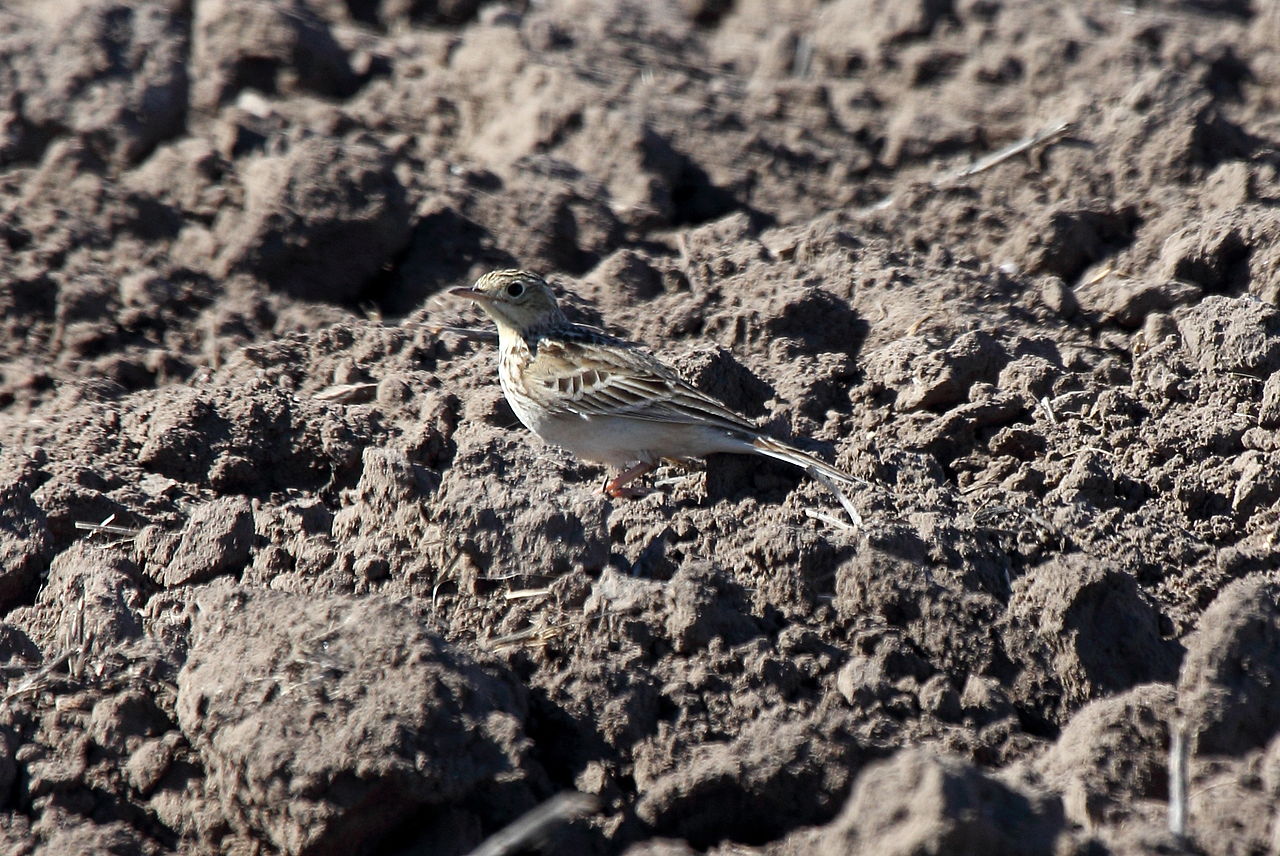
A stocky, pale pipit with a scaly upperside: the feathers of mantle and back have dark centres and broad pale fringes, so the pattern reads as blocked rather than streaked. The head is plain, without a clear supercilium or malar stripe, which leaves the dark eye looking large and isolated on a pale face. The crown is finely streaked black. The underparts are white with a buff wash and fine stippling across the breast, the flanks all but unstreaked. The legs are pale pink to flesh-coloured, the tail short with much white in the outer feathers. Unlike other pipits it barely pumps its tail.
Confusion species
American Pipit is darker and plainer above, has dark legs, a greyer face with a pale supercilium, and pumps its tail constantly; it also moves in flocks, while Sprague's stays solitary even in winter. Vesper Sparrow likewise shows white outer tail feathers, but has a conical seed-eating bill, a chestnut shoulder patch and a distinct eye-ring. From all the grassland sparrows Sprague's Pipit differs in the thin, pointed insect-eater's bill. When flushed it shows as a pale, scale-patterned bird that drops back into the grass after a short erratic flight.
Habitat
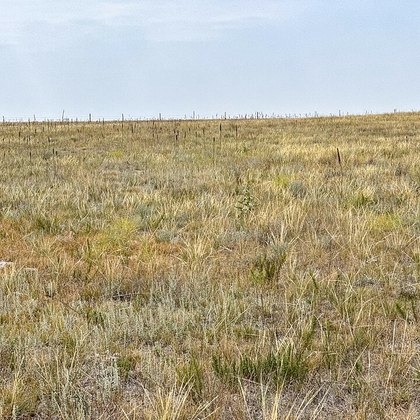
Native mixed-grass prairie with a sward roughly fifteen to thirty centimetres high, of blue grama, junegrass and wheatgrasses, without shrubs and without bare ground. Lightly grazed native rangeland is used; cropland and sown exotic grasses are almost never used. In winter it occupies shortgrass prairie, desert grassland of the Chihuahuan highlands and grazed grassland, again in sward of middling height and density.
Where the bird is most often found, arranged by the USNVC — the vegetation classification of the United States and Canada — and CMECS for sea and coast.


Range and movements
The breeding range lies in a band from southern Alberta, southern Saskatchewan and southwestern Manitoba through Montana and the two Dakotas to the western edge of Minnesota. Migration runs through the central Great Plains. Wintering takes place in southern Texas, Oklahoma, the Gulf states as far as Alabama, southern New Mexico and Arizona, and above all in the grasslands of northern and central Mexico: Chihuahua, Coahuila, Durango, Zacatecas, Nuevo León, Tamaulipas and San Luis Potosí, with smaller numbers further south on the plateau. The division among Mexican states is in part inferred from the described winter range rather than from counted numbers.
- Breeding (summer)
- Winter
- Passage
- dark = core range, pale = thinly spread
Where and when to look
The best chance is in May and June on a prairie reserve in Montana or southern Saskatchewan: stand out at sunrise and listen upward, because the song comes from a point in the sky you will only find with binoculars. On the ground the bird often goes unnoticed; it flushes late and drops again within a few tens of metres.
Conservation
The IUCN lists the species as Vulnerable (VU). The Breeding Bird Survey shows a decline of about 3.9 per cent per year between 1967 and 2023, a cumulative loss of roughly ninety per cent; the 2025 State of the Birds lists it as an orange-alert tipping point species. Partners in Flight puts the breeding population at about 1.4 million birds. Conversion of mixed-grass prairie to cropland and to sown pasture is the main cause, on the breeding grounds and in the Mexican wintering range alike; limited grazing holds the sward at the right height, while absence of grazing or fire and the spread of shrubs make the ground unusable.
Scientific name
Anthus spragueii | (Audubon, 1844)
Audubon described the species in 1844 as Alauda spragueii, from a specimen taken near Fort Union in North Dakota; because it was later moved to Anthus, author and year stand in parentheses. The species name honours Isaac Sprague, the artist who accompanied Audubon on his 1843 journey up the Missouri. The genus Anthus goes back to Greek anthos, in Pliny the name of a small bird of grassland. Audubon himself called the bird the Missouri Skylark, after the song flight; Spanish bisbita llanero means 'pipit of the plains'.