All species › Waders, gulls and terns › Skimmers, noddies, terns and gulls › Vega Gull
Vega Gull | Larus vegae
Vegameeuw | Gaviota de Vega
Vega Gull is the large white-headed gull of northeastern Siberia, and in North America it breeds at a single site: St. Lawrence Island in the Bering Sea. It is the counterpart of American Herring Gull on the far side of the Bering Strait — a shade darker on the mantle, a deeper pink on the legs — and until recently it was counted as the same species.
Voice
The voice is that of any large white-headed gull: yelping, mewing and a short clucking kek-kek-kek. The long call begins with the head low to the ground, swells into a series of loud descending cries kyow-kyow-kyow and ends with the bill pointing straight up. Standing among hundreds of gulls on St. Lawrence Island the voice is of little help: this species cannot be told from American Herring Gull by sound. Begging young give a thin, persistent piping and peck at the red spot on the parent's lower mandible.
Recording: Bo Shunqi 薄顺奇 — CC BY-NC-SA 4.0 · 碧海金沙,Fengxian, Shanghai, Shanghai, China · xeno-canto
Identification
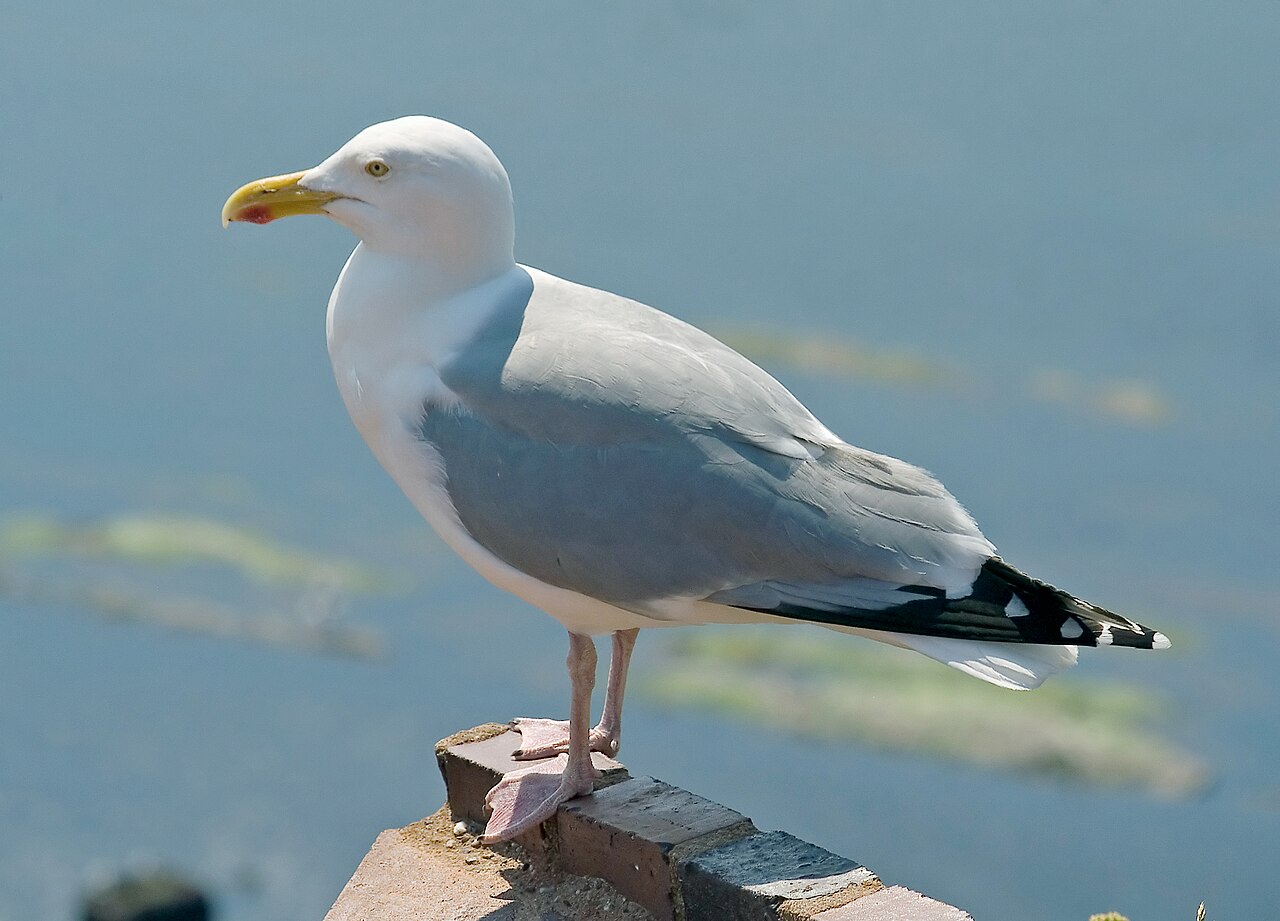
The adult is white with a medium grey mantle, noticeably darker than that of American Herring Gull, and black wingtips carrying one large white mirror on the outermost primary. The legs are bright to deep pink, the bill yellow with a red spot, and the ring around the eye is red; the iris ranges from pale yellow to almost dark, so the eye rarely looks as stern as an American Herring Gull's at close range. In winter the head, neck and breast are heavily dark-streaked, the densest markings forming a collar low on the neck. The sexes look alike; the male is larger and heavier in head and bill. Full adult plumage comes only in the fourth year: first-year birds are evenly dark brown with an all-black bill, second- and third-year birds an untidy mixture of brown and grey.
Confusion species
American Herring Gull (Larus smithsonianus) has a paler mantle, usually a pale iris with a yellow-orange orbital ring, and finer head streaking in winter; the spread wingtip shows more white. Slaty-backed Gull (Larus schistisagus) is far darker slate grey, with a broad white trailing edge and a row of white spots along the wingtip. Glaucous-winged Gull (Larus glaucescens) has wingtips the same grey as the mantle, with no black at all. Iceland Gull (Larus glaucoides) is smaller and gentler-headed, with a short bill and much less black in the tip. From 1900 well into this century the Vega Gull stood in the lists as a form of Herring Gull and then of American Herring Gull; it is now classified as a species of its own, but around the Bering Strait the characters grade into one another and many single birds are left unnamed.
Compare gulls: legs, head, bill and wing tip side by side
Habitat
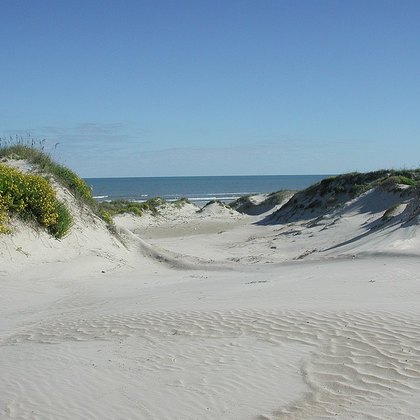
For breeding it uses the low arctic coast: gravel bars and rocky islets in river mouths, sand ridges between lagoons, and flat tundra just behind the tideline. Outside the breeding season it is a bird of the shoreline rather than the open ocean — harbours, river mouths, beaches and fish quays, in Asia right into the middle of large port cities. On St. Lawrence Island it sits on low cliffs and shingle beaches among the auks and the other gulls. It hardly occurs far inland.
Where the bird is most often found, arranged by the USNVC — the vegetation classification of the United States and Canada — and CMECS for sea and coast.




Range and movements
Breeds in arctic Siberia from Taymyr east to Chukotka and the New Siberian Islands, and on the American side only on St. Lawrence Island in the Bering Sea. Most birds winter along the rocky coasts of Japan, Korea and eastern China. In Alaska it is annual in the west — at Gambell on St. Lawrence Island and along the coast at Nome — with scattered records from the Aleutians and the Pribilofs. What changed over the last century is less the range than the classification: the same birds were called Herring Gull, then American Herring Gull, then Vega Gull.
- Breeding (summer)
- Passage
- dark = core range, pale = thinly spread
Where and when to look
The surest place is Gambell on St. Lawrence Island in late May and June, where it sits on the gravel ridges among Slaty-backed and Glaucous Gulls; check the mantle tone against its neighbours first, then the red orbital ring. Away from Alaska every claim is an identification problem: photograph the spread wing from above and below, because the pattern of black and white in the primaries is the only feature that can still be worked on afterwards. In winter birds the difference shows most clearly in side light, with an American Herring Gull beside them for comparison.
Conservation
The Red List does not assess Vega Gull separately: there it still falls within the herring gull group, and this guide takes that state of affairs literally as 'Not Evaluated (NE)'. Siberian numbers are thought to be large, but they are not counted apart, and little can be said with confidence about the trend. In North America a single island colony is involved, so anything that happens on St. Lawrence Island affects the entire American breeding stock at once.
Scientific name
Larus vegae | Palmén, 1887
Johan Axel Palmén described the bird in 1887 as Larus argentatus var. vegae, that is as a form within the Herring Gull; because the genus has not changed since, author and year stand without parentheses. Larus is the Latin form of Greek laros, an unspecified seabird in the classical writers. vegae refers to the ship Vega, in which Adolf Erik Nordenskiöld made the first passage of the Northeast Passage in 1878–1880; Palmén worked up the birds of that voyage. The type locality is Pidlin in northeastern Siberia. Larus vegae is carried here as a species of its own.