All species › Waders, gulls and terns › Skimmers, noddies, terns and gulls › American Herring Gull
American Herring Gull | Larus smithsonianus
Amerikaanse zilvermeeuw | Gaviota argéntea americana
The American Herring Gull is the bird most North Americans mean when they say 'seagull': pale grey above, pink-legged, and present wherever water and refuse come together. It breeds from Alaska to Newfoundland and winters from the Aleutians to Mexico and the northern Caribbean. And yet it has declined by some eighty per cent in a little over fifty years.

Voice
The loudest sound in any harbour: the long call, a series of loud bugling klee-yoo cries delivered with the head first low and then thrown far back, which carries from one bird to the next. There is also a fast laughing ha-ha-ha in answer to another gull, a loud kee-ow in alarm, and a soft mewing note used to get the attention of a mate or chick. Young birds beg with a persistent, plaintive squealing that hangs over a colony all summer. Stand on a quay and you will hear the whole repertoire within a minute.
Recording: Valerie Heemstra — CC BY-NC-SA 4.0 · Wells Township (near Wells), Delta County, Michigan, United States · xeno-canto
Identification
A large gull with a pale grey mantle, a white head and white underparts, and legs that are dull pink at every age. The bill is large but fairly slim, yellow with a red spot on the lower mandible; the eye is pale yellow with a yellow to orange orbital ring, which gives the bird its hard, staring look. The wingtip is black with only small white mirrors. In winter the head and especially the neck become heavily streaked with brown. It takes four years to reach adult plumage: first-year birds are grey-brown with a dark tail and a black bill, second-year birds gain a pale eye and a black-tipped bill, and third-year birds already resemble the adults but keep a black tail band.
Confusion species
Ring-billed Gull (Larus delawarensis) is clearly smaller, with yellow legs and a crisp black ring around a slim bill. California Gull (Larus californicus) is slightly smaller and darker grey, with greenish-yellow legs, a dark eye and both a black and a red spot on the bill. Iceland Gull (Larus glaucoides) is paler, smaller-billed, and has a wingtip with no black at all or only a grey shadow. Vega Gull (Larus vegae) of the Bering Sea has a darker grey mantle, deeper pink legs and usually a darker eye. In first-year birds the resemblance to Ring-billed Gull is greatest: that species looks paler and greyer with a sharply defined tail band, where the young American Herring Gull is uniformly dark brown with an entirely dark tail.
Compare gulls: legs, head, bill and wing tip side by side
Habitat
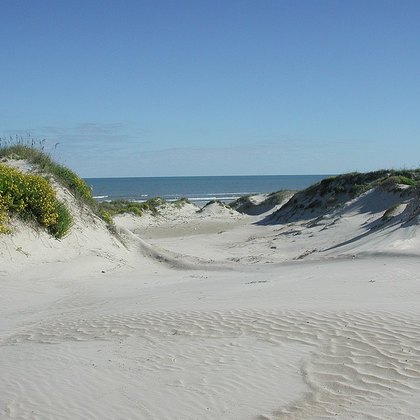
Coasts, river mouths, mudflats and harbours, but just as readily large inland lakes, reservoirs, rivers, ploughed fields and landfills. Breeds in colonies on islands, salt marsh and sandbars out of reach of ground predators, and on flat roofs in towns. On migration and in winter it follows open water: wherever a river stays ice-free below a dam it will be standing there, and wherever a fishing harbour unloads its nets as well. Closed forest and dry desert are the only landscapes it is missing from.
Where the bird is most often found, arranged by the USNVC — the vegetation classification of the United States and Canada — and CMECS for sea and coast.




Range and movements
Breeds from northern and western Alaska east across subarctic Canada to Baffin Island and Newfoundland, and south into the northeastern United States, the Great Lakes and along the Atlantic coast to North Carolina; on the Pacific side it breeds no further than southern British Columbia. In winter the picture shifts far south: from the Aleutians down the west coast to Nayarit, along the whole Gulf coast, and inland to Honduras and the northern Caribbean. By the late nineteenth century it had almost been shot out along the Atlantic coast for feathers and eggs; from the 1930s to the 1960s it grew fast, and has fallen back since. Where landfills closed and fisheries threw less overboard, numbers dropped hardest.
- Resident
- Breeding (summer)
- Winter
- Passage
- dark = core range, pale = thinly spread
Where and when to look
Walk a harbour or a reservoir with a big gull flock in November and work through the birds by age: it is the best way to learn this species' four plumages in a single morning, and only once they are familiar does every other large gull become visible. Watch the legs while you do it — dull pink at every age — because that is the one feature in this species that does not change with the years.
Conservation
Still one of the most numerous large gulls on the continent, but the trend is bleak: between 1966 and 2021 numbers fell by about three per cent a year, some eighty per cent in all. It is on the Common Birds in Steep Decline list. Larus smithsonianus has no Red List category yet, because as a newly split species it has not been assessed on its own. Overfishing, closed landfills, oil pollution and the deliberate control of colonies near airports and tern colonies all play a part.
Scientific name
Larus smithsonianus | Coues, 1862
Elliott Coues described the bird in 1862 as Larus Smithsonianus; in the nineteenth century a specific name referring to a person or an institution was still written with a capital. Author and year stand without parentheses, since the genus has never changed. The name honours the Smithsonian Institution in Washington, and through it the English chemist James Smithson, from whose bequest it was founded. The type locality is given broadly — the eastern and western coasts of North America — and for a long time the bird was treated as a subspecies of the European Herring Gull (Larus argentatus); it is now treated as a species of its own.