All species › Waders, gulls and terns › Skimmers, noddies, terns and gulls › Kelp Gull
Kelp Gull | Larus dominicanus
Kelpmeeuw | Gaviota dominicana
The Kelp Gull is the big black-backed gull of the southern hemisphere: from Patagonia to South Africa, Australia, New Zealand and the coast of Antarctica it is the commonest large gull there is. In North America it is a vagrant, with one exception — from 1989 into the 1990s a handful of pairs bred on the Chandeleur Islands off Louisiana, where they interbred with American Herring Gulls. It is the only gull on the Atlantic and Gulf Coasts with a black back and greenish-yellow legs.
Voice
A strident, hard kee-och is the best-known call, shorter and sharper than the barking of a Great Black-backed Gull. The long call is a deep, far-carrying series of laughing notes, the head first low and then thrown far back; in a colony dozens of birds answer one another at once. At the nest there is a short nasal alarm, and between partners a soft mewing. Anyone who sees one in North America will almost certainly not hear it: these are single birds among silent flocks of other gulls.
Recording: African Bioacoustics Community — CC BY-NC-SA 4.0 · Cape Town, Cape Town, Western Cape, South Africa · xeno-canto
Identification
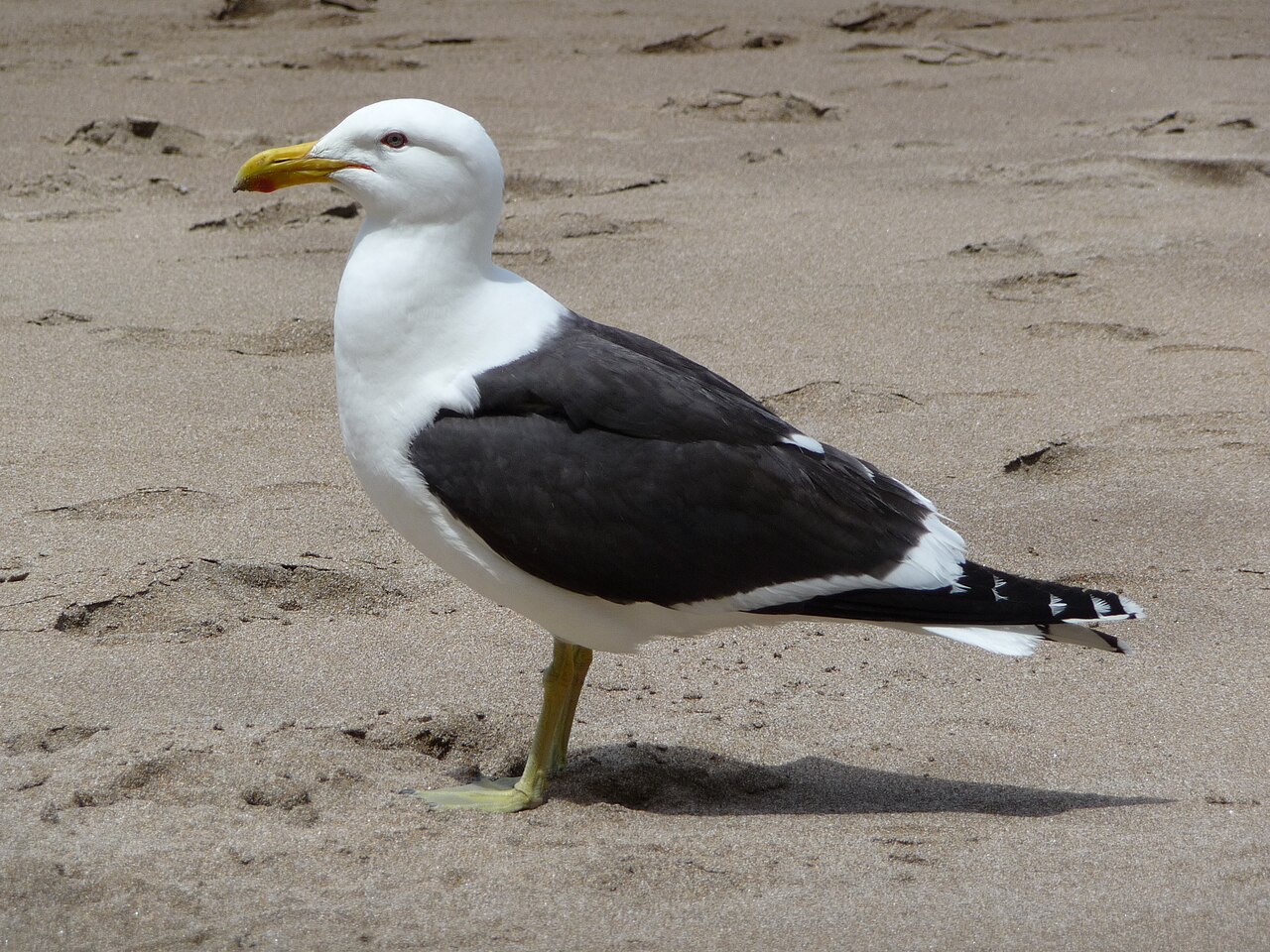
A large gull with a black mantle and upperwing, a white head that stays almost unstreaked even in winter, and a heavy yellow bill with a large red spot that often runs up onto the upper mandible. The legs are greenish yellow, brightest in breeding birds, and the eye is usually dark, in some birds pale or greyish, with a red orbital ring. The wingtip is almost wholly black: there is only one small mirror on the outermost primary, and a full black band across the fifth. Young birds are grey-brown with a dark bill and a broad black tail band, and take three to four years to mature. In silhouette the head is somewhat flatter and the bill heavier than on an American Herring Gull of comparable size.
Confusion species
Great Black-backed Gull (Larus marinus) is the bird it stands among in the east: as black on the back, but far bigger and heavier, with pink legs, a pale eye and much more white in the wingtip — a large mirror on the ninth primary against the Kelp Gull's pinhead. Lesser Black-backed Gull (Larus fuscus) also has yellow legs, but is slimmer and smaller, slate grey rather than black, and yellow-eyed. Slaty-backed Gull (Larus schistisagus) of the Bering Sea is dark as well, but pink-legged. And then there are the Chandeleur birds: hybrids with American Herring Gull (Larus smithsonianus), with a mantle midway between and legs between pink and yellow — on those, no single mark helps any more.
Compare gulls: legs, head, bill and wing tip side by side
Habitat
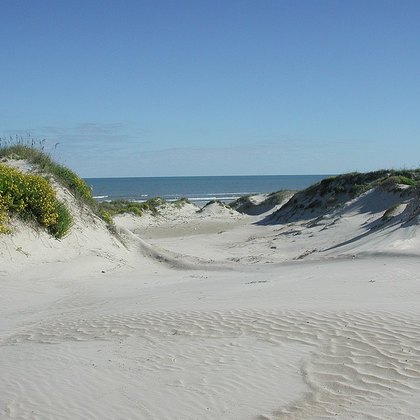
In the southern hemisphere a bird of every kind of coast there is: rocky shores, sandy beaches, estuaries, fishing harbours, and landfills in great numbers. Nests on the ground on islands and bare coastal flats, in colonies or singly, in a shallow scrape lined with a little plant material. The North American breeding site was of the same kind: low sandy islands with sparse vegetation, shared with terns and American Herring Gulls. Birds that turn up here are almost always found on the coast, on a beach or in a harbour, and occasionally inland at a large lake.
Where the bird is most often found, arranged by the USNVC — the vegetation classification of the United States and Canada — and CMECS for sea and coast.




Range and movements
The range takes in the coasts of South America, southern Africa, Australia, New Zealand, the subantarctic islands, Madagascar and the Antarctic Peninsula — one of the few gulls with a truly southern, pole-encircling distribution. The first American record dates from 1989, on the Chandeleur Islands; a small group held on there into the 1990s, breeding with American Herring Gulls, until Hurricane Katrina largely washed the islands away in 2005. Since then there have been scattered records in Texas, Maryland and Indiana, and since 2025 a bird at Milwaukee on Lake Michigan that keeps returning to the same spot. On this guide's map only Louisiana is coloured, and that rests on that single colony.
- Breeding (summer)
- Winter
- Passage
- dark = core range, pale = thinly spread
Where and when to look
Do not count on finding it here — count on seeing a Great Black-backed Gull or a hybrid. Anyone who still wants to try should work through the black-backed gulls on a landfill or a Gulf Coast beach in October and November one by one, checking three things on every bird at once: leg colour, eye colour and the amount of white in the wingtip. A photograph of the spread wing is not a luxury here but the only way to get a record accepted.
Conservation
Least Concern (LC) worldwide and increasing in many places; southern Africa alone holds eleven thousand pairs. That success has a darker side: off Patagonia, Kelp Gulls peck open wounds on the backs of swimming southern right whales, and on seabird islands they take the eggs and chicks of other species. In North America the species is too rare to speak of a conservation status at all.
Scientific name
Larus dominicanus | Lichtenstein, 1823
Martin Hinrich Carl Lichtenstein described the species in 1823 as Larus dominicanus, the name it still bears, so author and year stand without parentheses. dominicanus refers to the Dominican friars, whose white habit with a black mantle has the same pattern as the bird. The described specimen came from the coast of Brazil. Five subspecies are recognised, all in the southern hemisphere, from South America and southern Africa to Madagascar and Antarctica.