All species › Passerines › Cardinals and allies › Western Tanager
Western Tanager | Piranga ludoviciana
Louisianatangare | Piranga carirroja
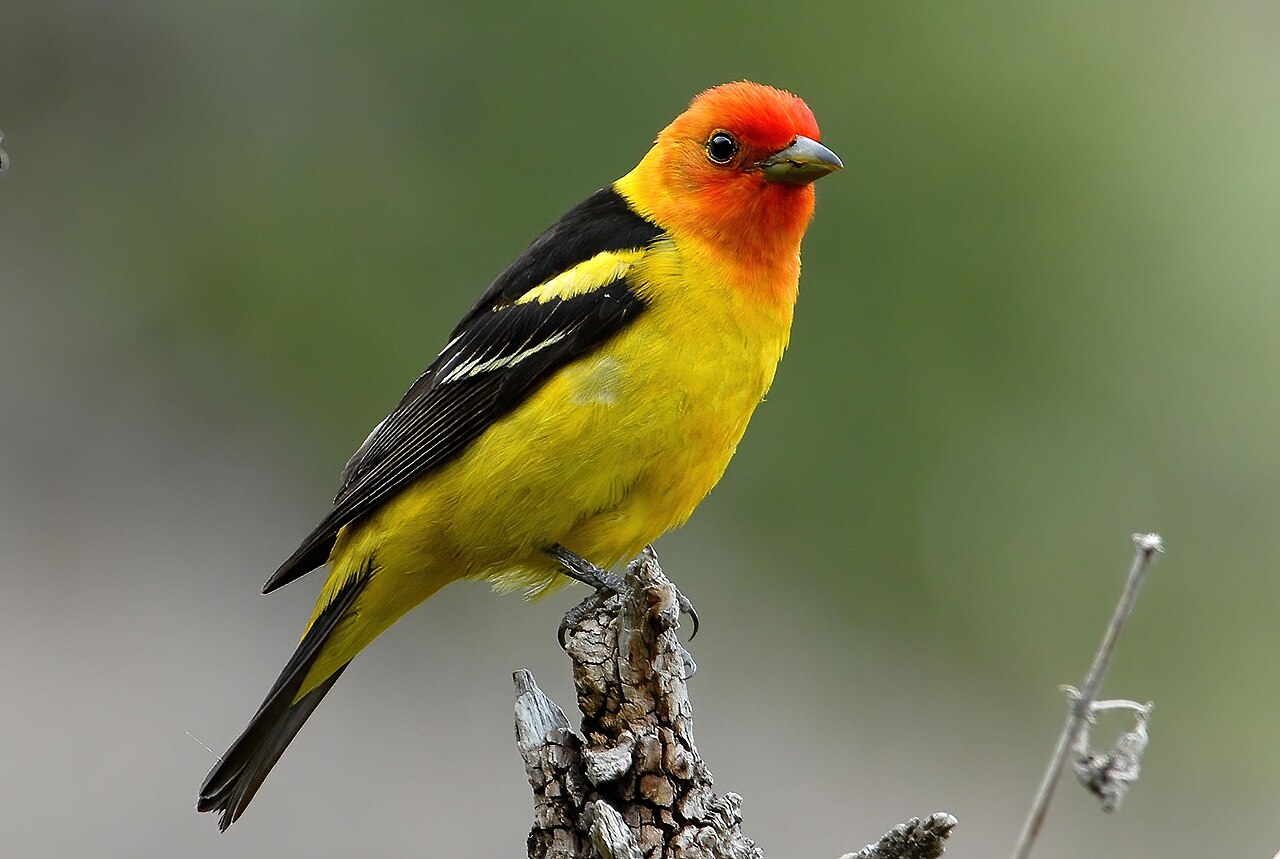
The Western Tanager is the tanager of the conifer forests of western North America: a yellow bird with a black back, black wings and, in the male, a red-washed head. It breeds farther north than any other tanager, reaching southeastern Alaska and the southern Northwest Territories, and moves to Mexico and Central America for the winter.
Voice
The song is a series of short, hoarse phrases with pauses between them, similar in rhythm to an American Robin but burrier and more monotonous. The contact call is a rising two- or three-syllable pit-er-ick, often the first sign of a bird sitting high in the canopy. A dry prit is also given. The male sings from a branch in the upper half of a conifer, usually without moving.
Recording: Jonathon Jongsma — CC BY-SA 4.0 · Four Mile Draw Rd, Custer State Park, South Dakota, United States · xeno-canto
Identification
The breeding male is yellow on head, breast, belly, nape and rump, with a black mantle, black tail and black wings carrying two wingbars: the upper one broad and yellow, the lower one narrow and white. The head is orange-red, deepest on forehead and throat; that colour comes from rhodoxanthin taken in with the food and is much weaker outside the breeding season. The female is yellow-green below and grey-green on the back, without red, with the same two wingbars on dark grey wings. The bill is thick, conical and pale horn-coloured.
Confusion species
Summer Tanager and Hepatic Tanager lack wingbars, and their males lack a black back. Flame-colored Tanager has a dark-streaked back, two white wingbars and white tips to the primary coverts; females of the two are much alike, but Flame-colored shows the back streaking while Western has a plain grey-green back. Male Scarlet Tanager is wholly red with black wings and no clear wingbars. Females and immatures are also confused with orioles, but those have a slender pointed bill instead of a thick conical one.
Habitat
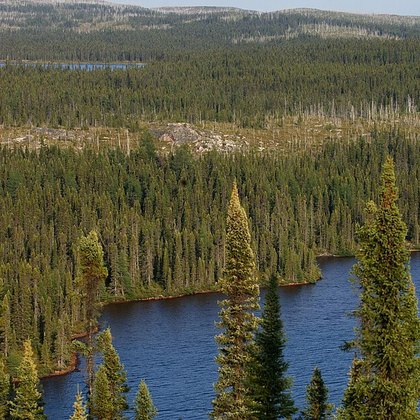
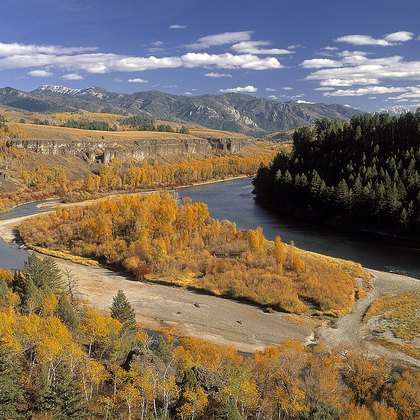
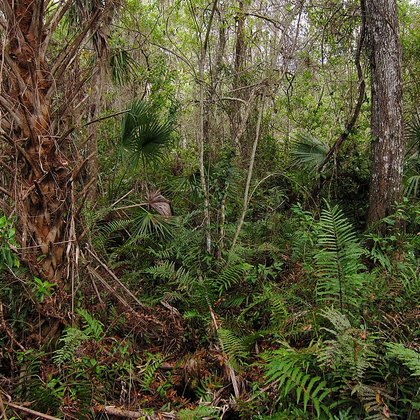
Open coniferous and mixed woodland in the mountains and along the west coast, up to about 3000 metres: Douglas-fir, ponderosa pine and lodgepole pine, plus cottonwood and willow woodland along streams. Dense closed stands are avoided; forest edge, burns and cut-over ground with standing trees are used. On migration it also appears in orchards, parks and gardens. In winter it occupies pine-oak woodland, low scrub and coffee plantations in Mexico and Central America.
Where the bird is most often found, arranged by the USNVC — the vegetation classification of the United States and Canada — and CMECS for sea and coast.




Range and movements
The breeding range runs from southeastern Alaska, the southern Northwest Territories and British Columbia south through the whole of the western United States to northern Baja California, and east to western Texas, central New Mexico, central Colorado and western South Dakota. Migration is on a broad front through the Southwest and along the eastern edge of the Rocky Mountains; on the Great Plains the species is mainly a passage migrant. It winters from southern Baja California and southeastern Sonora to southern Tamaulipas and on south through Central America. Scattered records turn up in the east of the continent every year.
- Resident
- Breeding (summer)
- Winter
- Passage
- dark = core range, pale = thinly spread
Where and when to look
Look for it in May and June high in the crown of a ponderosa pine or Douglas-fir, and go by the call: the rising pit-er-ick gives it away before you see it. During spring migration an isolated grove or a city park in the desert states is the best place, where migrants gather in small parties.
Conservation
The species is listed as of Least Concern. Partners in Flight puts the breeding population at about 15 million birds, and the Breeding Bird Survey shows an increase between 1966 and 2019. Continued logging of mature conifer forest and the loss of streamside woodland reduce breeding habitat locally, while on the wintering grounds the conversion of shade coffee to sun coffee removes trees. Collisions with windows and lit buildings during nocturnal migration cost birds every year.
Scientific name
Piranga ludoviciana | (Wilson, 1811)
Alexander Wilson described the species in 1811 as Tanagra ludoviciana, from a specimen collected by the Lewis and Clark expedition; because it was later moved to Piranga, author and year stand in parentheses. The genus name Piranga goes back to tijepiranga, a Tupi name for a small bird in Brazil, and was introduced by Vieillot in 1808. The species name ludoviciana means 'of Louisiana' — not the present state, but the French colonial Louisiana Territory, where the type came from.