All species › Passerines › Shrike-babblers, Erpornis and vireos › White-eyed Vireo
White-eyed Vireo | Vireo griseus
Witoogvireo | Vireo ojiblanco
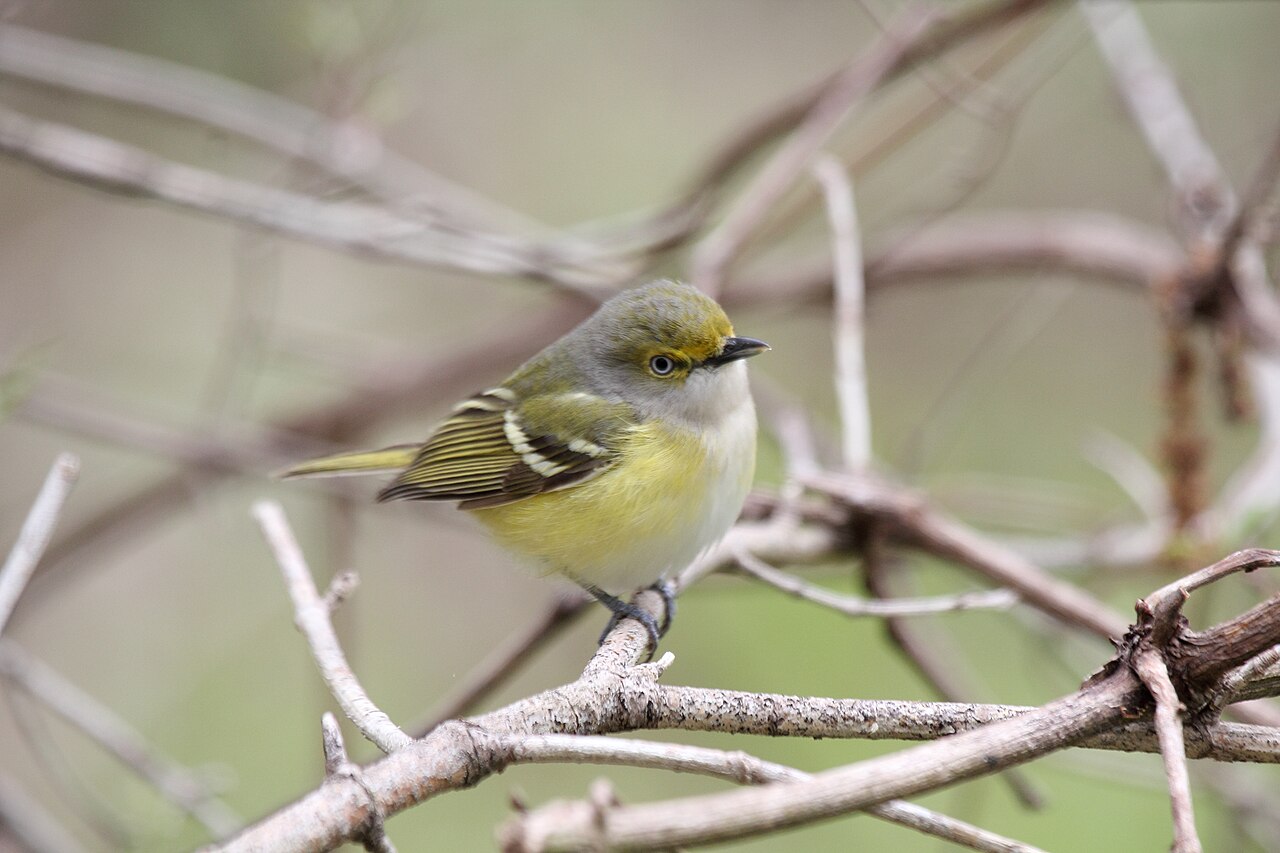
The White-eyed Vireo is the vireo of dense thickets in the eastern United States: a small, grey-green bird with yellow spectacles and, when adult, a white iris. It usually stays out of sight in cover and is almost always detected by sound first.
Voice
The song is a rapid, harsh and nasal phrase of five to seven notes, bracketed at both ends by a sharp chik; a common rendering is chick-per-weeoo-chick. The male repeats one phrase type a number of times and then switches to another; a single bird's repertoire runs to dozens of variants. Imitations of other species are worked in between phrases. Calls are a short zip and a harsh nasal mew resembling that of Blue-gray Gnatcatcher. On the wintering grounds females sing as well; in the breeding season only males do.
Recording: steve — CC BY-SA 4.0 · Hillsborough, Orange County, North Carolina, United States · xeno-canto
Identification
Grey-green above, white below with sharply set-off yellow flanks, two white wing bars and yellow spectacles broadest in front of the eye. The adult's iris is white to yellowish white and visible at close range; in first-calendar-year birds it is still dark. The bill is short and heavy with a small hook. The sexes are alike. The bird forages slowly, step by step, usually within two metres of the ground, and stretches its neck with the bill pointed up when singing.
Confusion species
Thick-billed Vireo of the Bahamas and the Cayman Islands, a vagrant to Florida, has a dark iris and diffuse yellow across the whole underside rather than on the flanks only. Bell's Vireo is paler, lacks the yellow spectacles, has a much vaguer eye-ring and a long tail that it swings from side to side continually. Blue-headed Vireo has a blue-grey head with crisp white spectacles and a white throat. A first-year White-eyed Vireo with a dark eye causes most of the confusion: then watch for the sharply bounded yellow flanks against a white belly.
Habitat
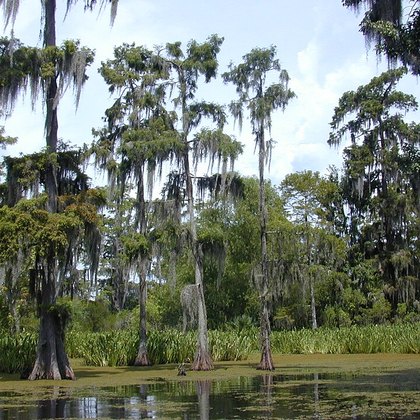
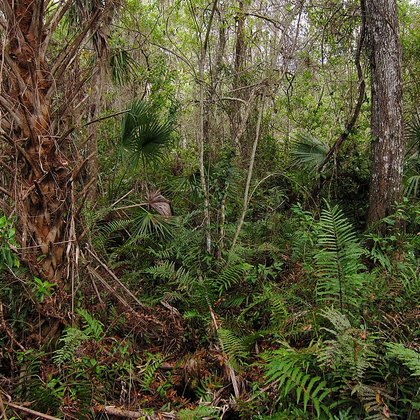
Dense low scrub: old fields with brambles and thorn shrubs, clearcuts, forest edge, streamside thickets, and in the south also the shrub layer under swamp forest. An impenetrable shrub layer matters more than the tree species. Outside the breeding season also in mangrove edge, dry coastal coppice and neglected lots.
Where the bird is most often found, arranged by the USNVC — the vegetation classification of the United States and Canada — and CMECS for sea and coast.




Range and movements
Breeds in the eastern United States from New England and southern Michigan southwards, and west to Nebraska, Kansas and central Texas. Along the Gulf coast, in Florida and in eastern Mexico it is resident; Bermuda holds its own non-migratory subspecies. Northern populations move out and winter in Cuba, the Bahamas, along the Gulf coast and in Central America as far as Honduras and Nicaragua. Migration is concentrated in April and in September and October.
- Resident
- Breeding (summer)
- Winter
- Passage
- dark = core range, pale = thinly spread
Where and when to look
Learn the song; a singing male is audible on almost any overgrown ground in the southeast in May and June, including in the middle of the day. Pishing works well on this species: the bird often comes to the outer edge of the shrub and then shows the white iris and the yellow flanks. Expect to hear it before you see it.
Conservation
The species is listed as least concern and the North American Breeding Bird Survey shows a stable to slightly increasing long-term trend; abandonment of farmland and the scrub that follows create new breeding habitat. Brood parasitism by Brown-headed Cowbird occurs and lowers nesting success locally. In the northwest of the range, where scrub grows back into forest, it drops out in places.
Scientific name
Vireo griseus | (Boddaert, 1783)
Boddaert described the species in 1783 as Tanagra grisea, on the basis of a coloured plate; because it was later placed in Vireo, author and year stand in parentheses. The type locality 'Louisiana' was restricted to New Orleans by Burleigh and Lowery in 1945. Vireo is the Latin name of a green migratory bird, related to virere 'to be green'; griseus is Medieval Latin for 'grey'. The English name refers to the white iris, which the original plate did not show.