All species › Passerines › Shrike-babblers, Erpornis and vireos › Thick-billed Vireo
Thick-billed Vireo | Vireo crassirostris
Dikbekvireo | Vireo piquigrueso
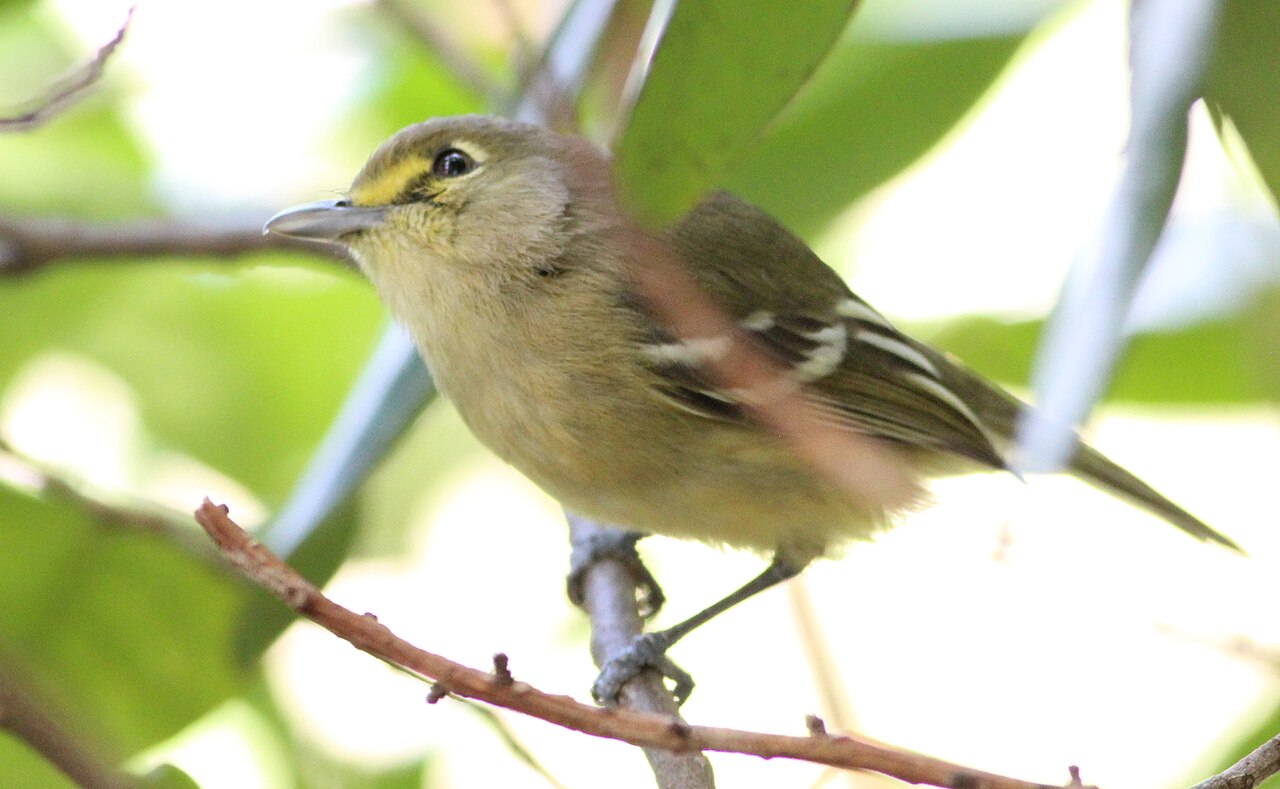
The Thick-billed Vireo is the vireo of Bahamian and Caribbean coastal scrub: a stocky bird with a heavy, hook-tipped bill and yellow spectacles. It is resident on its islands; in North America it counts as a vagrant, with nearly all records on the Atlantic coast of southern Florida.
Voice
The male sings through the year, outside the breeding season as well. The song is a short, nasal phrase of three to six notes, usually opened and closed with a sharp chik, repeated at short intervals. Each male holds a handful of phrase types and works through one before moving to the next. The call is a rasping, nasal mew, also given when an observer comes close to the nest.
No freely licensed recording has been found for this species yet; what to listen for is described below.
Identification
Greyish to brownish olive above, pale to dingy yellow below, with two white wing bars and two yellow spots in front of the eye that run into a broken eye-ring. The bill is heavy by vireo standards and broad at the base, with a clear hook. The iris is dark brown to grey. Male and female cannot be told apart by plumage. The bird moves slowly and methodically through the scrub and usually stays inside cover.
Confusion species
White-eyed Vireo is the main confusion species and winters in the same area. It has a white iris when adult, white rather than yellowish underparts with sharply set-off yellow flanks, and a smaller bill. Thick-billed Vireo has diffuse yellow across the whole underside and a dark iris. White-eyed Vireo's song is sharper and more explosive and includes imitations of other species; the Thick-billed's is flatter and more nasal. In southern Florida the combination of yellow underparts, dark eye and heavy bill is the proof.
Habitat
Dry coastal scrub on limestone (called coppice in the Bahamas), thickets behind the dunes, mangrove edge and second-growth broadleaf woodland. It forages at all heights of the vegetation but mostly in the lower half, picking insects and small fruits from leaf and twig. Planted gardens and neglected lots on inhabited islands are used as well.
Where the bird is most often found, arranged by the USNVC — the vegetation classification of the United States and Canada — and CMECS for sea and coast.





Range and movements
Five subspecies on separate island groups: the Bahamas, the Turks and Caicos Islands, Île de la Tortue off Haiti, the northern cays of Cuba and the Cayman Islands. The species does not migrate. In the United States there are a few dozen accepted records, nearly all in the coastal parks of southeastern Florida and on the Florida Keys, concentrated between December and May. Individual birds have sung and held territory there for several months.
- Resident
- Breeding (summer)
- Winter
- Passage
- dark = core range, pale = thinly spread
Where and when to look
Search by sound rather than by sight: the bird stays in dense coppice and gives itself away mainly by the repeated nasal phrase. On the Florida coast it pays in spring to check every 'White-eyed Vireo' with yellowish underparts. Watch the iris colour, since a first-year White-eyed Vireo has no white eye yet either.
Conservation
The IUCN places the species in the least concern category; the population is regarded as stable and no range-wide threats have been identified. On the individual islands the pressures are local: development of coastal coppice for tourism and housing, and hurricanes that strip the shrub layer over large areas. The Île de la Tortue subspecies has the smallest range and is the least well known.
Scientific name
Vireo crassirostris | (Bryant, 1859)
Henry Bryant described the species in 1859 as Lanivireo crassirostris, from a specimen from New Providence in the Bahamas; because it was later placed in Vireo, author and year stand in parentheses. Vireo is the Latin name of a green migratory bird, related to virere 'to be green'. The species name crassirostris comes from crassus 'thick' and rostrum 'bill' — the English and Dutch names are a literal translation of it.