All species › Gamebirds › Partridges, pheasants, grouse and allies › White-tailed Ptarmigan
White-tailed Ptarmigan | Lagopus leucura
Witstaartsneeuwhoen | Lagópodo Coliblanco
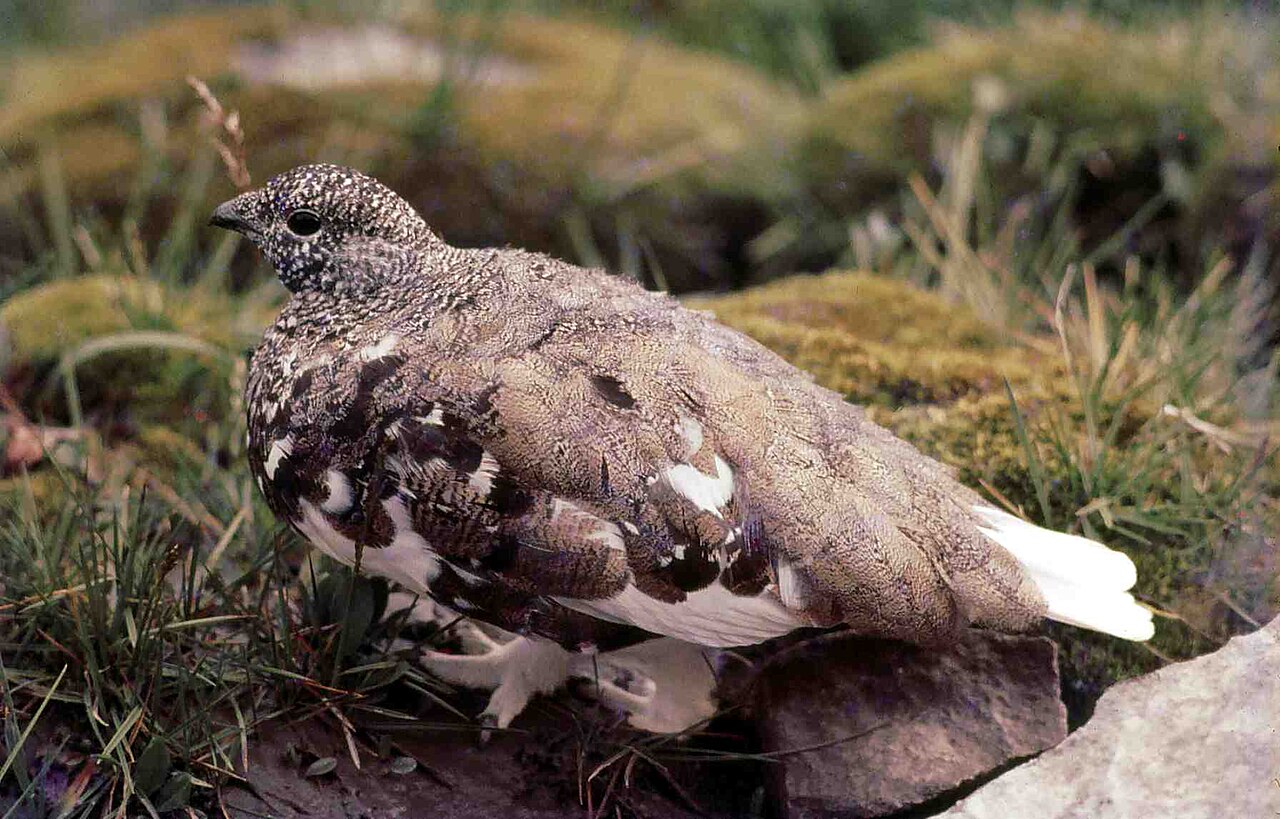
The White-tailed Ptarmigan is North America's smallest ptarmigan and the only grouse that lives above the treeline all year round, in the bare rockland of the high Rocky Mountains. Its plumage changes three times a year, from snow white to mottled brown-grey and back again, keeping it almost invisible against the ground in every season. Only the white tail, which never changes colour, gives it away when it flushes.
Voice
During display the male gives a soft, clucking kuk-kuk-kuk from a boulder, a call that rarely carries far and is easily lost in the wind over open slopes. When flushed it utters a hoarse, clucking kok-kok-kok while running off or flying low. The female answers her chicks with a soft, repeated ticking note. Compared with the loud, far-carrying calls of the Willow Ptarmigan, this species' voice is weak — fitting for a bird that relies on camouflage rather than distance for safety.
Recording: Logan McLeod — CC BY-NC-SA 4.0 · Yukon, Unorganized, Yukon, Yukon Territory, Canada · xeno-canto
Identification
In winter it is entirely white, with only the black bill, dark eyes and, in the male, an occasional red comb for contrast. In summer it is densely patterned in blackish brown, grey and buff, finer and greyer than the other two ptarmigans, and lacking the black tail both of them have — in this species the tail stays white in every plumage. The spring and autumn transitional plumages are a patchwork of white and brown feathers coming in together. Females are slightly duller brown than summer males but otherwise barely distinguishable. The silhouette is compact and round, with a short tail, a short bill and feathering that runs down over the toes like snowshoes.
Confusion species
Rock Ptarmigan (Lagopus muta) is slightly larger, keeps a black tail in every plumage, and the male shows a sharp black eye-stripe in winter — features entirely absent in White-tailed Ptarmigan. Willow Ptarmigan (Lagopus lagopus) is larger and heavier still, also black-tailed, and lives lower down in willow scrub rather than bare rock; ranges overlap only in the extreme northwest. At a distance a white winter bird on a rock can also be mistaken for a patch of snow — the black bill and its moving shape are then the only giveaway.
Habitat
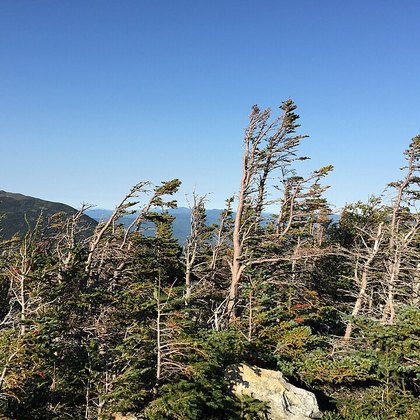
White-tailed Ptarmigan lives above the treeline all year: on alpine meadows with low forbs and scattered boulders in summer, and in winter among krummholz (crooked, wind-pressed tree growth at the treeline) — the last conifers, flattened into a wind-pruned mat just below the ridgelines — and rock crevices where wind keeps the snow thin enough to expose food. Boulders and talus give cover from raptors and the wind; dense low willow supplies the winter twigs it lives on almost exclusively at that season. It avoids closed forest and dense low vegetation, as well as bare, plantless rock desert.
Where the bird is most often found, arranged by the USNVC — the vegetation classification of the United States and Canada — and CMECS for sea and coast.


Range and movements
Resident, with only limited vertical movement: in winter birds move from the highest ridges to somewhat lower, more sheltered slopes with krummholz. The native range follows the Rocky Mountains from Alaska and western Canada south to New Mexico; in the twentieth century the species was successfully introduced to the Sierra Nevada of California and the Uinta and Wasatch ranges of Utah, where it now holds self-sustaining populations. Warming temperatures are slowly pushing the treeline upward and squeezing its habitat from below — research in Colorado already shows a slight decline in the lowest-elevation populations.
- Resident
- Breeding (summer)
- Passage
- dark = core range, pale = thinly spread
Where and when to look
Look for it in summer on a hike well above treeline, where it often sits motionless among the rocks until you almost step on it — one of the tamest grouse on the continent. In July and August watch for small family groups along the edge of melting snowfields, where chicks hunt insects at the meltwater's edge.
Conservation
Least Concern (LC), with stable populations across most of the range, though its remote habitat makes exact numbers hard to estimate. The main concern is climate warming, which shrinks alpine habitat from below while leaving nowhere higher to retreat to above the peaks.
Scientific name
Lagopus leucura | (Richardson, 1831)
Richardson described the species in 1831 as Tetrao (Lagopus) leucurus, with Lagopus then only a subgenus within the grouse genus Tetrao; since Lagopus was raised to full genus rank, author and year stand in parentheses. Lagopus is Greek for 'hare-foot', after the densely feathered legs and toes; leucura means 'white-tailed'. The type locality lies in the Rocky Mountains at 54° North, in the northern Canadian Rockies near the British Columbia–Alberta boundary.