All species › Gamebirds › Partridges, pheasants, grouse and allies › Rock Ptarmigan
Rock Ptarmigan | Lagopus muta
Alpensneeuwhoen | Lagópodo alpino
Rock Ptarmigan is the most widely distributed ptarmigan in the world, found from the Aleutians to the highest islands of the Canadian Arctic and across Greenland. Like its relatives it moults into a different plumage three times a year, but what sets it apart is a black tail that shows in every plumage and, in the male in winter, a sharp black stripe through the eye. Above the vegetation line, on bare rock and polar desert, it is often the only bird present all year.
Voice
The male displays with a low, grating cackle that sounds like tearing cardboard — a series of dry, krrr-like notes, often given from a boulder or during a short gliding display flight. The alarm call is a short, hoarse croak, repeated as the bird runs off or flies low. Compared with the soft clucking of White-tailed Ptarmigan this voice carries further across the bare, echoing rock. During courtship the male also gives a soft hissing note just before mating.
Recording: Johan Södercrantz — CC BY-NC-SA 4.0 · Flatruet, Berg Municipality, Jämtlands län, Sweden · xeno-canto
Identification
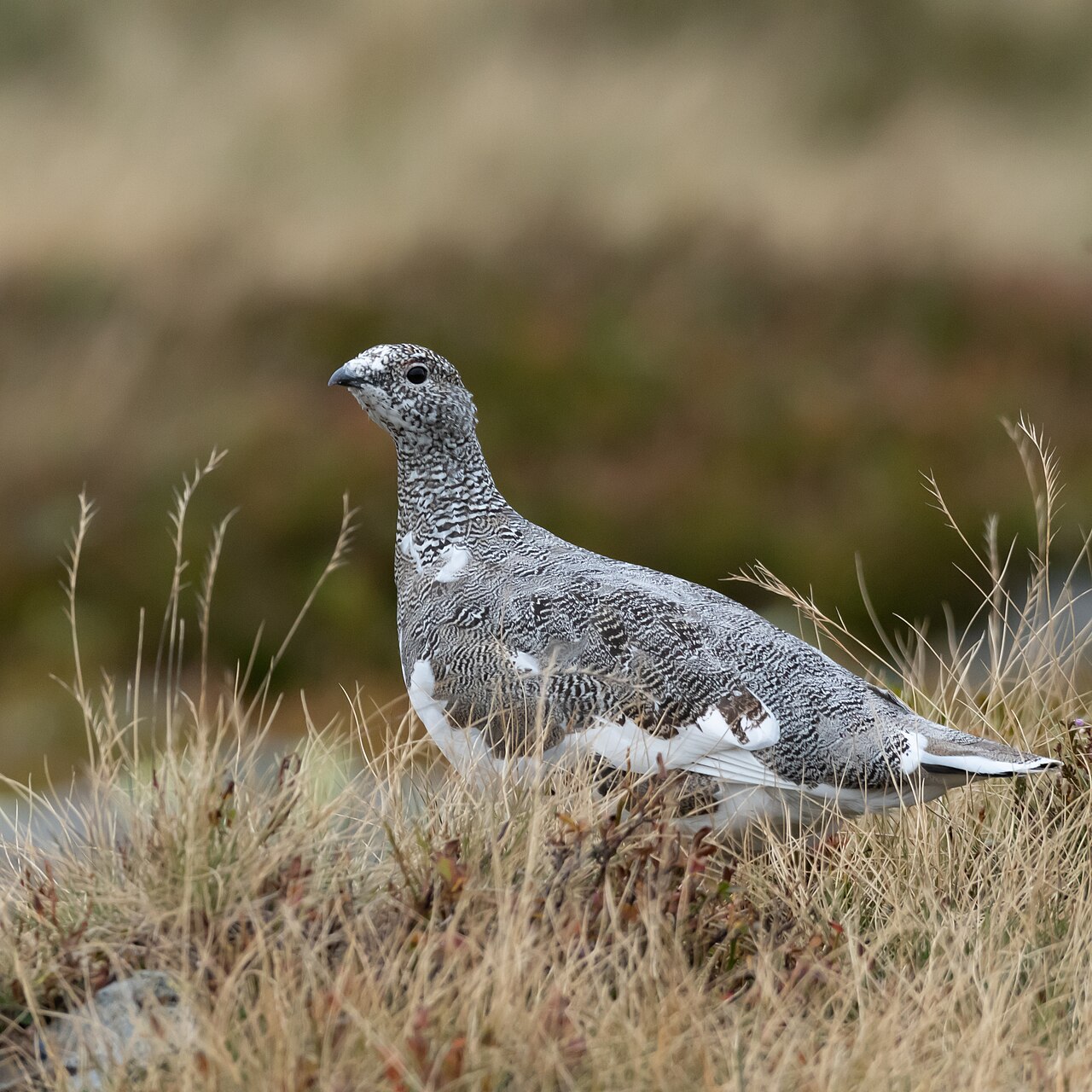
In winter it is entirely white with a black tail and, in the male, a broad black stripe running from the bill through the eye — a feature the female lacks. In summer it is finely patterned in greyish brown and black, more even and greyer than the coarser, rustier summer pattern of Willow Ptarmigan. The spring and autumn transitional plumages form a patchwork of white and dark feathers, and in autumn the male alone briefly wears a grey 'autumn plumage' of its own before turning white. The bill is shorter and the head rounder than in Willow Ptarmigan, and as in all ptarmigan the legs are feathered down to the toes.
Confusion species
White-tailed Ptarmigan (Lagopus leucura) is smaller, keeps a white rather than black tail in every plumage, and the male lacks the black eye-stripe; their ranges barely overlap, except locally in southern Alaska. Willow Ptarmigan (Lagopus lagopus) is larger and heavier, with a coarser, rustier summer pattern and, without the male's black eye-stripe, a heavier bill; in Alaska and northern Canada the two species breed side by side, Rock Ptarmigan on the bare heights and Willow Ptarmigan in the scrub below.
Habitat
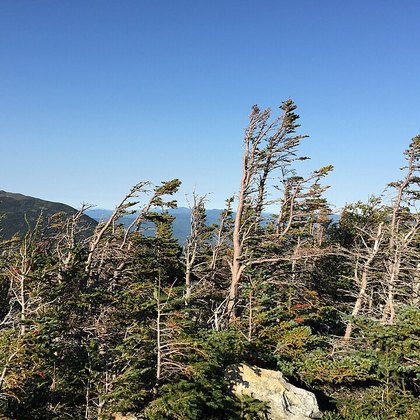
Rock Ptarmigan breeds on bare, windswept tundra and rocky mountain slopes above the treeline, where low forbs, lichen and loose stone are the only cover. In winter it seeks shelter in rock crevices and the low krummholz (stunted, wind-bent tree growth at the treeline) at the upper edge of the forest, surviving on the buds and twigs of dwarf willow and birch. On the highest Arctic islands it breeds even in polar desert with little more than scattered moss cushions. It avoids dense forest and thick low vegetation, as do the other ptarmigans.
Where the bird is most often found, arranged by the USNVC — the vegetation classification of the United States and Canada — and CMECS for sea and coast.



Range and movements
Resident across almost all of Arctic and alpine North America: all of Alaska including the Aleutians, the mountains and tundra of Yukon, the Northwest Territories and Nunavut, northern British Columbia, and northern Quebec and Newfoundland and Labrador, plus the whole of Greenland. Birds at the highest latitudes make short winter movements to somewhat lower, sheltered slopes, but there is no true migration. It is the only ptarmigan found on the bare, treeless Aleutian Islands, where several local subspecies have been described.
- Resident
- Breeding (summer)
- Winter
- Passage
- dark = core range, pale = thinly spread
Where and when to look
Look on bare summits above the tundra in summer, where the male guards his territory from a prominent rock; the black eye-stripe is visible even at a distance. In the Aleutians and northern Alaska this is often the only grouse you will encounter, and there, thanks to its remote habitat, it is unafraid of people.
Conservation
Not threatened (LC); the world population is large and most of the range lies beyond human disturbance. Local declines have been reported in parts of Scandinavia and Scotland, outside North America, linked to shrinking mountain habitat and a changing snow regime; no such trend has yet been established for the North American populations.
Scientific name
Lagopus muta | (Montin, 1781)
Montin described the species in 1781 as Tetrao mutus, among the grouse of the genus Tetrao; since it was placed in the genus Lagopus, author and year stand in parentheses. Lagopus is Greek for 'hare-foot'; muta is Latin for 'mute' or 'silent', referring to the soft, subdued display call compared with other grouse. The type locality is simply 'Sweden' — Montin worked from specimens taken in the Swedish mountains, without naming a more precise place.