All species › Waders, gulls and terns › Sandpipers and allies › Wilson's Phalarope
Wilson's Phalarope | Phalaropus tricolor
Grote Franjepoot | Falaropo tricolor
Wilson's Phalarope reverses the usual division of labour: the female wears the brighter plumage, wins a male and then moves on, while the male incubates alone and raises the young. It is the only one of the three phalaropes that never leaves the interior — it breeds in prairie marshes and then gathers in tens of thousands on salt lakes such as Mono Lake and Great Salt Lake. Swimming, it spins in tight circles so that the water funnels food up to the surface.
Voice
A fairly silent wader: away from the breeding grounds it is rarely heard. The usual note is a low nasal grunt, wurk or ahng, which from a rising flock carries over the water as a soft murmur. In courtship the female gives series of those same nasal notes while swimming after a male, and at the nest there is a shorter, harder oik. On the salt lakes, where thousands of birds lie together, the sound never rises above a low babble.
Recording: Aluisio Ribeiro — CC BY-NC-SA 4.0 · Sabáudia, State of Paraná, Brazil · xeno-canto
Identification
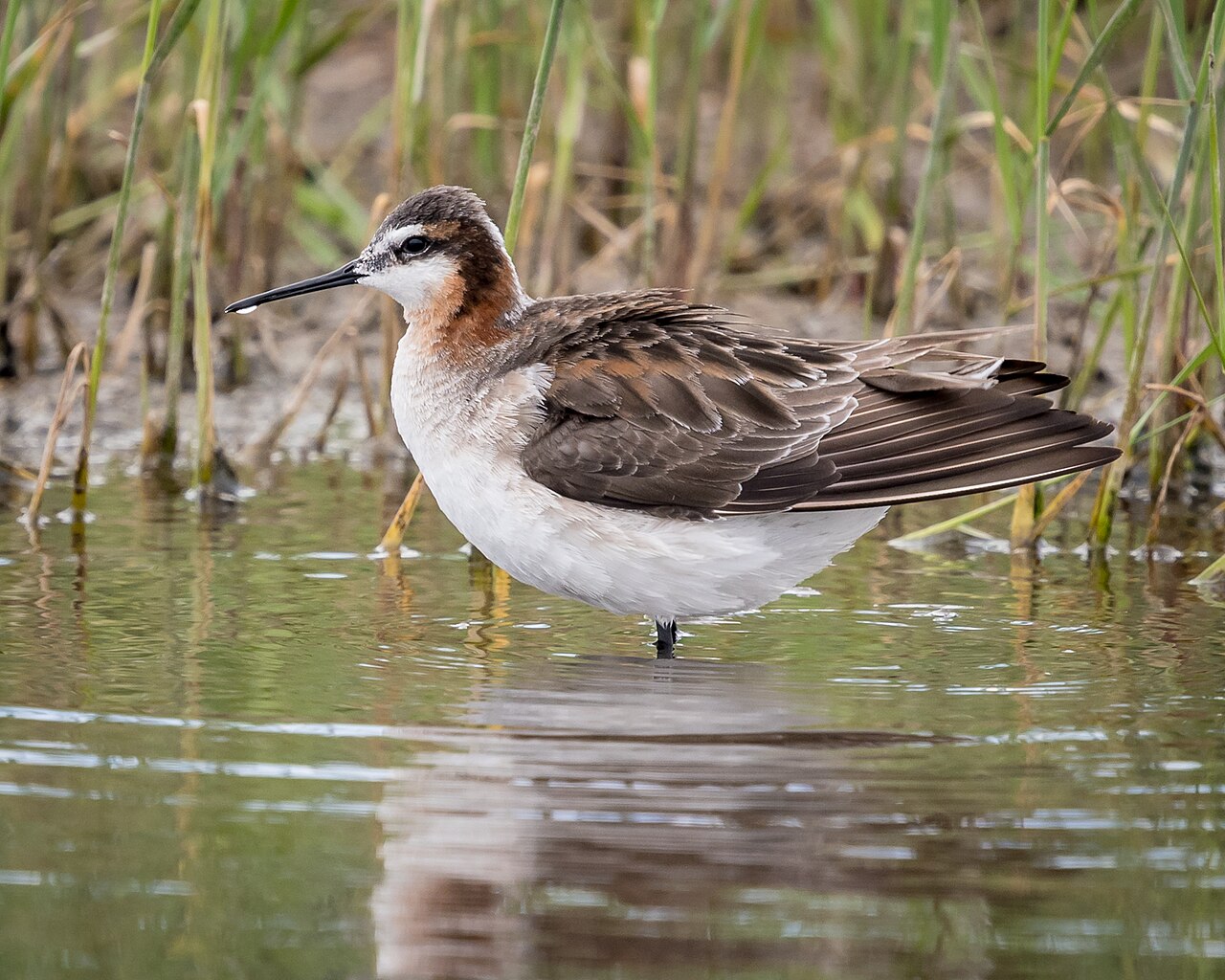
In this species it is the female that is the more strongly marked: pearl-grey crown and nape, a white throat, and a broad black band running from the eye down the side of the neck and turning chestnut behind, with a rusty wash on the foreneck. The male is a pale, browner version of the same pattern, with a dull cap and a faint neck stripe — and it is this duller bird that sits on the eggs. In non-breeding plumage the bird is plain pale grey above and white below, with a white face carrying no more than a faint dark smudge behind the eye, and with yellow legs. Juveniles have a dark scaly back with warm feather fringes, yellow legs and a buff wash on neck and breast. The bill is long, thin and perfectly straight, clearly longer than the head. In flight there is no white wingbar at all, but there is a white rump above a grey tail.
Confusion species
The three phalaropes are best separated on the bill: in Wilson's it is needle-fine and longer than the head, in Red-necked Phalarope (Phalaropus lobatus) needle-fine but short, and in Red Phalarope (P. fulicarius) short and distinctly thick, often with a yellow base. In breeding plumage Wilson's is the only one without a black cap and without white in the wing, with a chestnut neck band instead of a rufous throat patch or wholly red underparts. In winter it has a white face with at most a smudge behind the eye, while the other two carry a sharp black ear patch; its back is then plain grey rather than striped, and its legs are yellow rather than dark. On mud a winter Wilson's suggests a Lesser Yellowlegs, but that bird stands taller, has a grey-streaked breast and does not swim.
Compare sandpipers, snipes and allies: bill, legs, wing bar and rump
Habitat
Breeds at shallow, often slightly saline prairie marshes and wet meadows with a low, open margin it can walk through between the sedges. On migration it uses almost any shallow water in open country: clay pits, flooded fields, salt marsh and above all sewage ponds, which teem with midge larvae. The largest numbers, however, stand on the hypersaline lakes of the West — Mono Lake, Great Salt Lake, Lake Abert, Chaplin Lake — where brine shrimp and brine flies reach densities found nowhere else; it feeds on foot on the bare alkali flats around them too. Forest, deep water and the open sea are entirely absent from its life: it is the one phalarope that never goes to the ocean.
Where the bird is most often found, arranged by the USNVC — the vegetation classification of the United States and Canada — and CMECS for sea and coast.





Range and movements
A bird of the interior: the prairie provinces from Alberta to Manitoba and the southern interior of British Columbia, and in the United States from Washington and Oregon across the Great Basin and the northern Great Plains to Minnesota, Iowa and Wisconsin. As early as June and July the females leave the breeding grounds and gather on the salt lakes; there the birds moult their plumage in a few weeks and double their weight, then set off in one long flight across Central America to the salt lakes of the Andes and the plains of Argentina, far outside this the guide area. The northbound route in spring runs mainly up the Great Plains, the return broader and more westerly. Along the eastern edge of the range it has disappeared during the twentieth century from many districts where marshes were drained, while in the West it gained from irrigated fields and sewage ponds.
- Resident
- Breeding (summer)
- Winter
- Passage
- dark = core range, pale = thinly spread
Where and when to look
Go to a salt lake or a large sewage pond in the West between mid-July and late August: numbers are then at their peak and thousands of birds may be spinning on the water at once. In May, note which bird wears which plumage — the sharply marked ones are females, and anyone who finds a bird on eggs in June is looking at the duller male. At range a flock is recognisable by the movement alone: no other inland wader makes those small, quick turns on the surface.
Conservation
The species is assessed as Least Concern (LC), with a population put at about one and a half million birds and broadly unchanged since 1966. The risk lies not in the number but in the place: in autumn almost the whole population uses a handful of salt lakes, and those lakes are shrinking as their inflow is drawn off for cities and farming. At Great Salt Lake and Mono Lake this is already visible; if salinity climbs too far or the shore dries out, the brine shrimp the birds live on disappear. On the breeding grounds the draining of prairie marshes is the main cause of decline.
Scientific name
Phalaropus tricolor | (Vieillot, 1819)
Vieillot described the species in 1819 as Steganopus tricolor; because it was later placed in another genus, author and year stand in parentheses. Steganopus, Greek for 'covered foot', is still used in a few datasets, but the bird now stands in Phalaropus, a name formed from phalaris 'coot' and pous 'foot', after the lobed webs along the toes. tricolor is Latin for 'three-coloured', after the breeding plumage of grey, white and chestnut. The description rests on bird number 407 in Azara's account of the birds of Paraguay, and Paraguay therefore stands as the type locality.