All species › Waders, gulls and terns › Sandpipers and allies › Red Phalarope
Red Phalarope | Phalaropus fulicarius
Rosse Franjepoot | Falaropo picogrueso
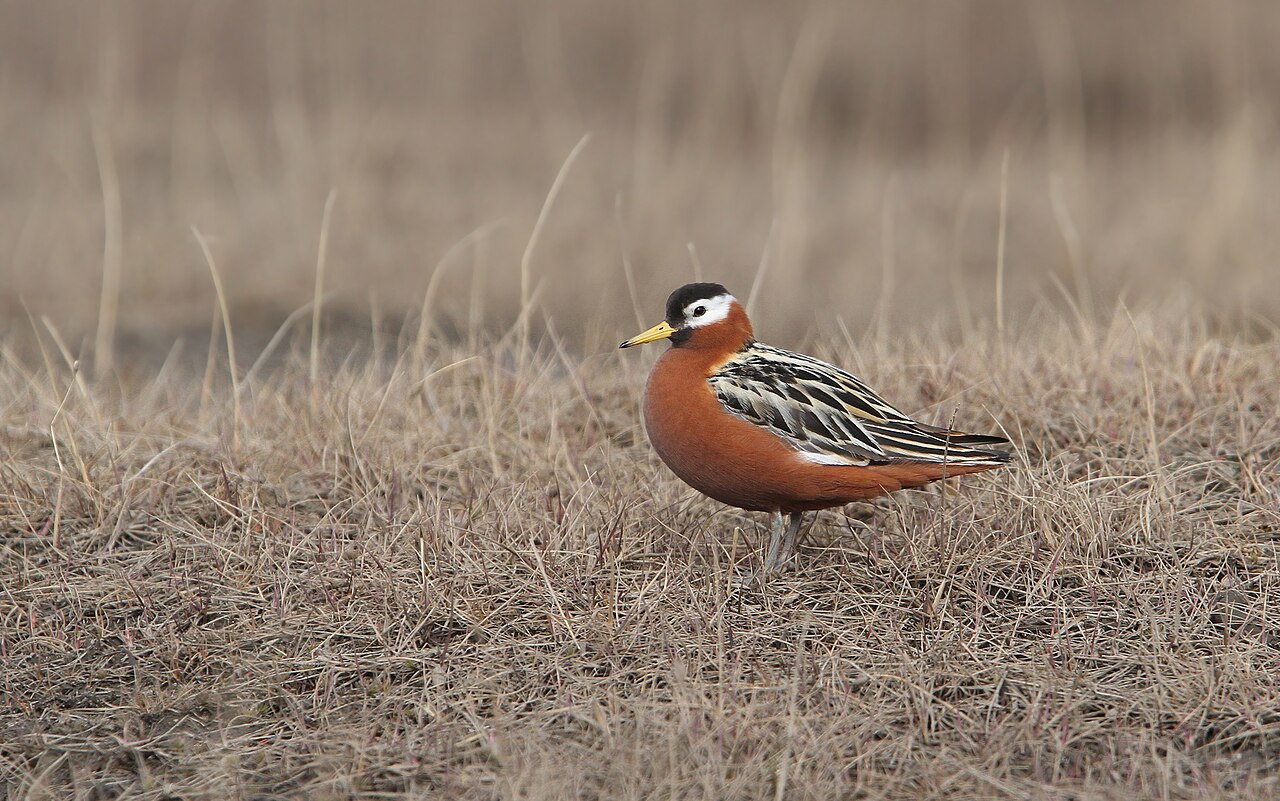
The Red Phalarope spends ten of the twelve months swimming on the open ocean and comes ashore only to breed, on the wet coastal tundra of the far north. Here too the female is the brighter bird: brick red from throat to tail, with a black cap and a white cheek — she wins a male, lays her eggs and leaves, after which the male incubates alone. In winter plumage the same bird is plain pale grey and white with a black patch through the eye, riding the swell like a fleck of foam.
Voice
The usual note is a high, short, sharp pit or wit, which a small party gives in a quick series as it lifts off. On the tundra there is also a rattling, slightly buzzy wit-wit-wit-wit, generally from a bird flying low over the pools. In display the female uses a drawn-out, plaintive preeep as she follows a male. At sea the species is mostly silent; a flock passing close by the boat yields at best a thin piping between the waves.
Recording: Avery Bartels — CC BY-NC-SA 4.0 · Old Crow, Yukon, Canada · xeno-canto
Identification
The breeding female cannot be mistaken: the whole underside from throat to tail base is deep brick red, the crown black, the cheek white, and the short thick bill yellow with a black tip. The male carries the same pattern but paler and more broken, with white mixed into the red and a streaked crown, and it is this male that sits on the eggs. In winter plumage the bird is plain, smooth pale grey above without streaking, white below, with a white crown and a sharp black patch running back from the eye. Juveniles have a dark back with warm feather fringes and a cream wash over neck and breast. The bill is the best character: short, broad-based and blunt, far thicker than in the other phalaropes, often with yellow at the base. In flight it shows a clear white wingbar and a dark centre to rump and tail; on the water it floats high and light, like a piece of cork.
Confusion species
Red-necked Phalarope (Phalaropus lobatus) is the most similar species: in winter plumage it has a striped rather than plain grey back, a darker and more extensive cap, and above all a needle-fine bill, where the Red Phalarope's is short and thick. In breeding plumage the difference is wide: Red-necked has a white throat with a rufous band along the neck, Red an entirely red underside with a white cheek. Wilson's Phalarope (P. tricolor) in winter has no black eye patch, has yellow legs and a much longer bill, and stays inland. A winter Red Phalarope on a beach can suggest a Sanderling, but it has lobed toes, a dark eye mask and takes to the water again almost at once.
Compare sandpipers, snipes and allies: bill, legs, wing bar and rump
Habitat
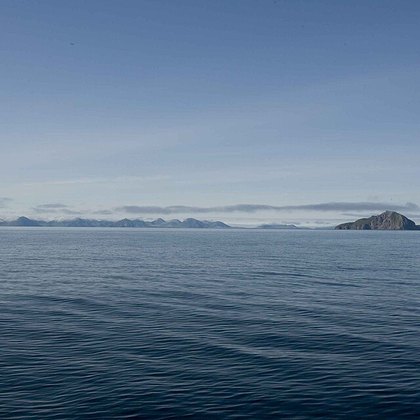
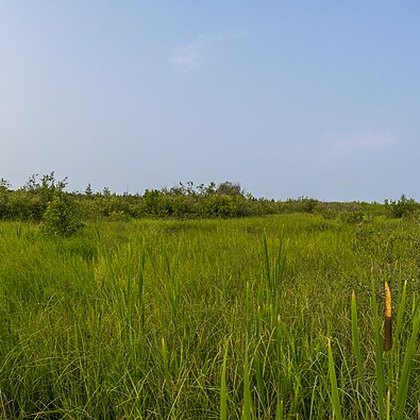
For most of the year it lives on the open ocean, by preference over upwellings, along current lines and in the broken water where tidal streams meet; that is where the plankton it lives on is driven together. It also follows large whales and feeds on the crustaceans they bring to the surface. To breed it chooses low, wet coastal tundra with many small pools and sedge marsh, usually close to the sea and rarely far inland. It makes little use of mudflats and sandy shores; a bird seen from land is generally one driven in by a gale, turning up on a harbour, a reservoir or even a car park.
Where the bird is most often found, arranged by the USNVC — the vegetation classification of the United States and Canada — and CMECS for sea and coast.


Range and movements
A breeder of the high tundra right around the pole: within this region from the north and west coasts of Alaska through the Canadian Arctic islands to Greenland, and beyond it across Iceland and Siberia. Migration is almost entirely over the sea; females leave as early as late June, males with the young only weeks later, and in autumn the birds lie well offshore. In winter they gather over the cold, productive currents: in the Pacific from California to Chile, in the Atlantic in the Gulf Stream off the south-eastern United States and off the coast of West Africa. Exactly where the largest concentrations lie shifts from year to year with the currents, and that is precisely why the species is so unpredictable from land.
- Resident
- Breeding (summer)
- Winter
- Passage
- dark = core range, pale = thinly spread
Where and when to look
Book a boat trip off the California coast in autumn or winter and search the slicks and rips: there the birds sit spinning as small grey-and-white specks, far too small to pick out from the beach. After an autumn gale, though, look on land — harbours, piers, reservoirs and even flooded fields then offer the one chance of the year of a bird within ten metres. Always check the bill first: short and thick means Red Phalarope, even when the plumage is grey and white.
Conservation
The species is assessed as Least Concern (LC), with a world population put at over two million birds, but numbers have fallen sharply in several regions since the middle of the last century. Because the birds spend nearly the whole year on the open sea, that trend is hard to measure and the causes are poorly known. Oil at sea is a direct threat: a floating bird with a thin coat of feathers rarely survives fouling. Surveys early in this century also found plastic in the stomachs of the great majority of the birds examined, and the plankton fields it depends on are shifting as the sea warms.
Scientific name
Phalaropus fulicarius | (Linnaeus, 1758)
Linnaeus described the species in 1758 as Tringa fulicaria, among the shanks; because it was later placed in another genus, author and year stand in parentheses. The description rests on Edwards's plate 142, and the type locality is Hudson Bay. fulicarius means 'coot-like', from Latin fulica 'coot', after the lobed toes; the genus name Phalaropus, from phalaris 'coot' and pous 'foot', says exactly the same thing over again. English and Dutch name the bird for its red breeding dress, while Spanish picks out the thick bill instead.