All species › Waders, gulls and terns › Sandpipers and allies › Red-necked Phalarope
Red-necked Phalarope | Phalaropus lobatus
Grauwe Franjepoot | Falaropo picofino
The Red-necked Phalarope is the smallest and finest-billed of the three phalaropes, a wader that swims like a duckling and spends its whole winter at sea. In this species too the female is the brighter and the noisier: she chooses and defends the male, lays her eggs and departs, while the male incubates alone and tends the chicks. On migration it spins in tight parties on shallow pools until an insect larva or a small crustacean floats up.

Voice
The usual note is a short, hard chik or kerrek, often given in a quick series as a party lifts off or gathers on the water. It sounds lower and drier than the sharp squeak of the Red Phalarope and carries a long way over water. On the tundra the female gives a sustained rattling tirr-tirr-tirr in display as she swims round a male. At the nest site and with chicks there is a soft, short chup; at sea the species is usually silent.
Recording: Teet Sirotkin — CC BY-SA 4.0 · Kvalnesvatnet, Vardø, Finnmark, Norway · xeno-canto
Identification
The breeding female has a slate head and breast, a sharply cut white throat patch, a small white spot above the eye and a broad orange-red band curving forward from the side of the neck; two golden braces run down the dark back. The male is browner and duller, with less red and a greyer pattern, and it is this male that incubates. In winter plumage the bird is grey above with pale lengthwise stripes across the back, white below, with a dark crown and nape and a sharp black patch behind the eye. Juveniles are blackish brown on the back with bright buff braces and a pinkish-buff wash over neck and breast. The bill is short but needle-fine and wholly black, the lightest bill of the three species. In flight it stands out by its small size, the clear white wingbar and the fast, swerving movement of a flock.
Confusion species
Red Phalarope (Phalaropus fulicarius) is the main confusion species: in winter its back is plain pale grey without striping and its bill is short and thick, while Red-necked has a striped back and a needle-fine bill; Red-necked is also noticeably smaller and darker-crowned. In breeding plumage Red is wholly red below with a white cheek, Red-necked grey with a white throat and a red side to the neck. Wilson's Phalarope (P. tricolor) is larger, has a much longer bill and yellow legs, has a white face without an eye patch in winter, and stays inland. On a pool a swimming Red-necked can be taken for some small waterbird; the needle bill, the lobed toes and the spinning settle the matter at once.
Habitat
Breeds on low Arctic tundra at the edge of small pools, peat ponds and sedge marshes, often near the coast but also in the broad river valleys of the interior. Outside the breeding season it lives at sea, over upwellings and along the current lines where tidal streams drive the plankton together; the mouth of the Bay of Fundy is the best known example of that in the east of the region. On migration through the West it also uses fresh water inland: alkaline lakes, reservoirs and above all sewage ponds, where it sometimes spins in hundreds. It avoids mudflats and the beach, taking almost all its food while swimming, from the surface film.
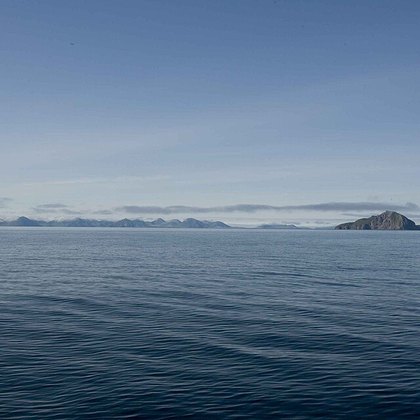
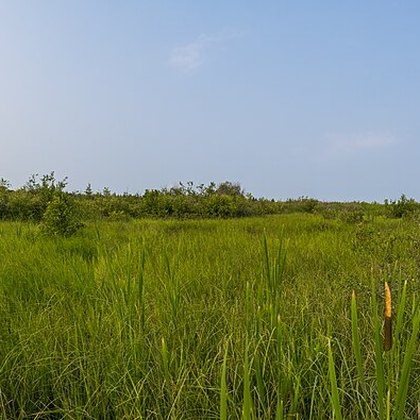
Where the bird is most often found, arranged by the USNVC — the vegetation classification of the United States and Canada — and CMECS for sea and coast.



Range and movements
A breeder right around the pole on the lower tundra: within this region from western and northern Alaska through Yukon and the Northwest Territories to Nunavut, along the Hudson Bay coasts of Manitoba and Ontario, in northern Quebec and Labrador, and in Greenland. Western birds travel partly overland through the Great Basin and leave the continent along the Pacific coast; eastern birds go by sea, with a long-standing gathering place in the Bay of Fundy. Wintering is at sea over cold, plankton-rich currents: in the western hemisphere from western Mexico to the waters off Peru, and beyond that in the Arabian Sea and around Indonesia. In the Bay of Fundy the autumn gatherings were still estimated in millions in the 1970s; those numbers collapsed in the 1980s and the great concentrations have not returned.
- Breeding (summer)
- Winter
- Passage
- dark = core range, pale = thinly spread
Where and when to look
Look for it between mid-August and late September on a sewage pond, a reservoir or an alkaline lake in the West: at such places it swims close to the bank and can at last be seen well. Then check the back — pale lengthwise stripes mean Red-necked, plain grey means Red. On the coast a seawatch with an onshore wind in September pays off, when small parties shoot past low over the water.
Conservation
The species is assessed as Least Concern and the world population is put at over four million birds, but the trend is hard to measure for a bird that lives on the open sea. In the north-west Atlantic the decline is clear enough: the millions that once gathered in the Bay of Fundy have gone, which is linked to changes in the amount of animal plankton there. Oil pollution and swallowed plastic affect it as they do the other phalaropes, and on the breeding grounds shrubs are spreading over the tundra. Because it picks its food from the surface film, any shift in the currents works through into its survival almost at once.
Scientific name
Phalaropus lobatus | (Linnaeus, 1758)
Linnaeus described the species in 1758 in the genus Tringa, among the shanks, as Tringa lobata; because it was later placed in another genus, author and year stand in parentheses. The description rests on Edwards's plate 143, and the type locality is Hudson Bay. lobatus is Neo-Latin for 'lobed', after the membranous lobes along the toes with which the bird swims; the genus name Phalaropus, from phalaris 'coot' and pous 'foot', points at the same toes. English names the bird for the red neck of summer, Dutch for the grey winter dress and Spanish for the thin bill.