All species › Storks › Storks › Wood Stork
Wood Stork | Mycteria americana
Kaalkopooievaar | Cigüeña americana
The Wood Stork is the only stork in North America: a big white bird with black flight feathers and a bare, dark grey head that rides over the shoulders like worn leather. It breeds in colonies in flooded cypress, and then rides thermals so high that it is hard to follow with the naked eye.

Voice
Away from the colony you will hardly ever hear one; a Wood Stork passing overhead is silent. At the nest it is another matter: the young beg with a drawn-out braying nyah-nyah-nyah that carries across the swamp and sounds more like a lamb than a bird, while the adults answer with a long hissing sigh. A colony of several hundred nests keeps up a steady noise audible from far off, without one sound in it that anybody would call a voice.
No freely licensed recording has been found for this species yet; what to listen for is described below.
Identification
Adults are white with black flight feathers and a black tail that only shows properly in flight. Head and upper neck are bare, dark grey and scaly, and run out into a heavy bill that curves down at the tip — no other large wading bird in the region has that. The legs are dark with dirty pink to dull yellow feet, which trail well beyond the tail in flight. Young birds still have a grey downy head and a yellowish bill and look far less severe for it. Aloft it flies with the neck stretched out and the wings held flat, alternating slow beats with long glides, often in a column of dozens of birds at once.
Confusion species
Great Egret (Ardea alba) is as white but has no black in the wing, carries a pointed yellow bill, and flies with the neck folded into an S. White Ibis (Eudocimus albus) is far smaller, has black only in the wingtips and a thin, red, curved bill. American White Pelican (Pelecanus erythrorhynchos) shares the white-and-black wing pattern and soars just as high, but is heavier built, carries an enormous orange bill with a pouch, and draws its head back between the shoulders. At distance the head settles it: bare, dark and carried far out in front belongs to this species and to no other.
Habitat
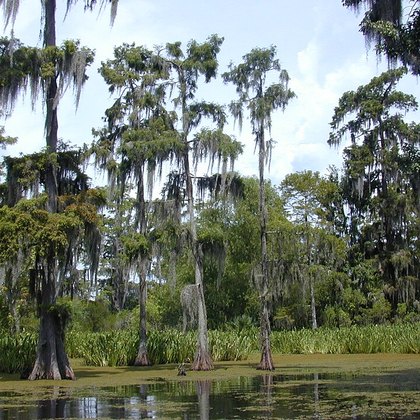
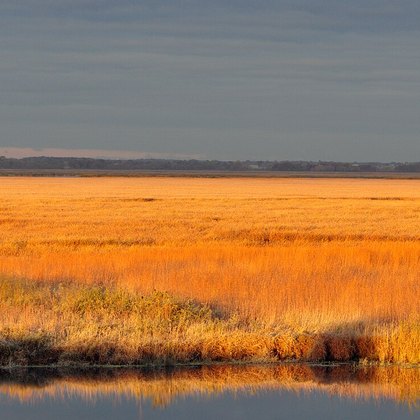
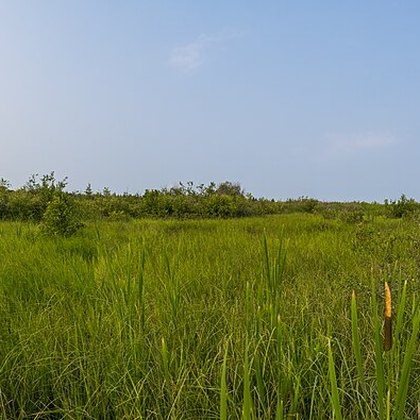
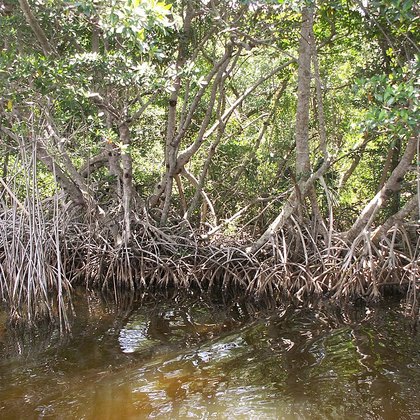
This is a bird of shallow, warm water: cypress swamps, flooded woodland, freshwater marsh, mangrove, ditches, roadside pools and drained fish ponds. What counts is not the pool but its depth — a hand's breadth to knee-deep water, in which fish become crowded together. A marsh that dries out slowly is therefore worth more to it than one that stays full all year, and over a season it moves from one shrinking pool to the next. Nests are placed over water, in cypress or mangrove, where a raccoon cannot reach them.
Where the bird is most often found, arranged by the USNVC — the vegetation classification of the United States and Canada — and CMECS for sea and coast.

Range and movements
In the United States it breeds from Florida north along the coastal plain into South Carolina, and since the 1990s in North Carolina as well; after nesting the birds wander as far as Texas, Arkansas and the lower Mississippi. Further south it is resident: along both coasts of Mexico, throughout Central America, on Cuba and Hispaniola, and far into South America. The centre of gravity in Florida shifted during the twentieth century — the great Everglades colonies emptied once the water there came to be steered by canals and levees, while colonies further north, in Georgia and the Carolinas, grew instead. The species follows the water, not the state line.
- Resident
- Breeding (summer)
- Winter
- Passage
- dark = core range, pale = thinly spread
Where and when to look
Look for it in the middle of the day, once the sun has warmed the air: that is when the birds leave their roost trees and spiral up by the dozen, white with black wingtips against the blue. To see one close, go early in the morning to a drying ditch or a drawn-down pond; there it stands among the herons with its bill in the water and its head half under.
Conservation
The global breeding population is put at about 450,000 birds and the Red List treats the species as of least concern. In the United States things went far worse for a long time: the southeastern population was listed as endangered in 1984, moved to threatened in 2014, and taken off the federal list altogether in March 2026, once the five-year average had passed ten thousand nesting pairs. The vulnerability has not gone away: a colony fails at a stroke if the water rises in spring instead of falling, and that depends on how the water in Florida is managed.
Scientific name
Mycteria americana | Linnaeus, 1758
Linnaeus described the species in 1758 as Mycteria americana and placed it at once in the genus Mycteria, which he set up for it; because it has never been moved out of it, author and year stand without parentheses. Mycteria comes from the Greek muktēr, 'snout' or 'nose', after the heavy bill. americana simply means 'of America'. The type locality is the warmer part of America, in practice Brazil: Linnaeus relied on the account Georg Marcgrave had made of the bird there in the seventeenth century.