All species › Tubenoses › Petrels, shearwaters and diving petrels › Trindade Petrel
Trindade Petrel | Pterodroma arminjoniana
Arminjon-stormvogel | Petrel de Trinidad
Trindade Petrel is the only petrel of its genus to reach the Gulf Stream off the American east coast with any regularity: from May to September a handful of birds turn up among the many shearwaters and storm-petrels of pelagic boat trips off Cape Hatteras. It breeds on two small, isolated island groups on opposite sides of the world and occurs in a light and a — in the Atlantic by far predominant — dark colour form.
Voice
At the breeding islands, far outside the area covered by this guide, a harsh, cackling call rings out at the burrow at night, similar to that of other large petrels of the genus Pterodroma. In the Gulf Stream off the American east coast, where the species reaches this area, it is, like most of its relatives, entirely silent.
Recording: Kathryn Hodder — CC BY-NC-SA 4.0 · Round Island, Mauritius · xeno-canto
Identification
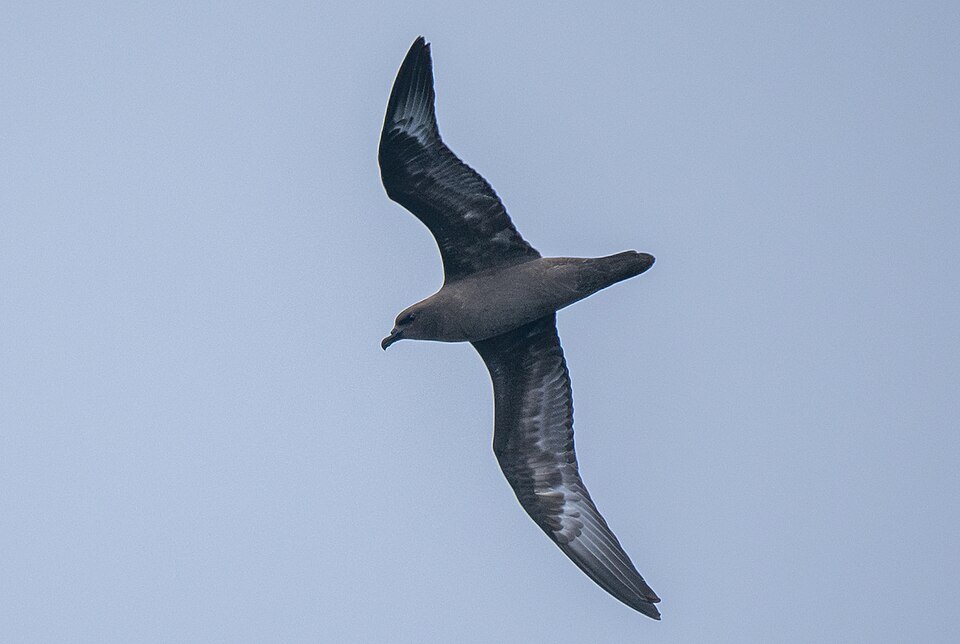
Trindade Petrel is a medium-sized to large petrel with a heavy black bill. The dark form, the one most often seen in the Atlantic, is almost entirely dark brown with only a faint paler base to the primaries; the light form has a white breast and belly that contrast sharply with the dark cap and upperparts, with intermediates combining both patterns. Male, female and juvenile look alike within each colour form. Flight is powerful and tumbling, with high banks on relatively broad wings, typical of the larger petrels of the genus Pterodroma.
Confusion species
From Kermadec Petrel, with which it even hybridises on Round Island and which is treated as a subspecies in the Pacific part of its range, Trindade Petrel is barely separable in the field; in the Gulf Stream off the American east coast this confusion hardly arises, however, since Kermadec Petrel almost never occurs there. From Black-capped Petrel, also seen in the Gulf Stream, which always shows a sharp black-and-white pattern with a white rump, the dark form of Trindade Petrel is told by the complete absence of white on rump and underparts. Bermuda Petrel, smaller and with a thinner bill, is always mostly white below. The combination of large build, heavy bill and predominantly dark colour remains the best mark in the Gulf Stream.
Habitat
Within this area Trindade Petrel is a bird of the open, warm Gulf Stream, well offshore where this warm current meets cooler coastal waters. For breeding it uses rocky ledges, cliffs and steep slopes on volcanic islands, entirely outside the area covered by this guide. It never uses land within North America.
Where the bird is most often found, arranged by the USNVC — the vegetation classification of the United States and Canada — and CMECS for sea and coast.
Range and movements
Trindade Petrel breeds on Trindade and Martim Vaz off the Brazilian coast and on Round Island near Mauritius in the Indian Ocean. From the Brazilian breeding islands, birds disperse north through the Atlantic to the Gulf Stream, where from May to September they are seen as a scarce but annual passage visitor off North Carolina, Virginia and Maryland; the first record for the area covered by the American Birding Association dates back to 1933. To the south the species reaches the coast of southern Brazil, and it is also reported sporadically off the eastern edge of the Caribbean islands. The population breeding in the Pacific, once considered the same species, has since been recognised as a separate species, Pterodroma heraldica.
Where and when to look
The best chance is a multi-day pelagic boat trip in the Gulf Stream out of Hatteras, North Carolina, between May and September, when specialised trips search specifically for rare petrels of open, warm water; look for the heavy black bill and the predominantly dark colour with no white on the rump.
Conservation
Trindade Petrel is considered Vulnerable (VU): its two breeding areas are small and isolated, and feral cats and rats have already wiped out or sharply reduced colonies on parts of the island groups. Ongoing habitat loss on the remaining islands is seen as a continuing threat. Within this area it is always the same small, annually returning numbers of passage birds from the Brazilian population.
Scientific name
Pterodroma arminjoniana | (Giglioli; Salvadori, 1869)
Italian zoologists Enrico Hillyer Giglioli and Tommaso Salvadori described the species in 1869 as Aestrelata Arminjoniana, based on material collected during the scientific round-the-world voyage of the Italian naval ship Magenta; because it has since been placed in another genus, author and year stand in parentheses. The genus Pterodroma was introduced in 1856 by Bonaparte, from the Greek for 'wing' and 'runner'. The species name honours Vittorio Arminjon, the Italian naval officer who commanded the Magenta during that voyage and was thereby involved in obtaining the type material. The type locality is Trindade, the South Atlantic island off Brazil that also gave the species its English name.