All species › Tubenoses › Petrels, shearwaters and diving petrels › Kermadec Petrel
Kermadec Petrel | Pterodroma neglecta
Kermadecstormvogel | Petrel de Kermadec
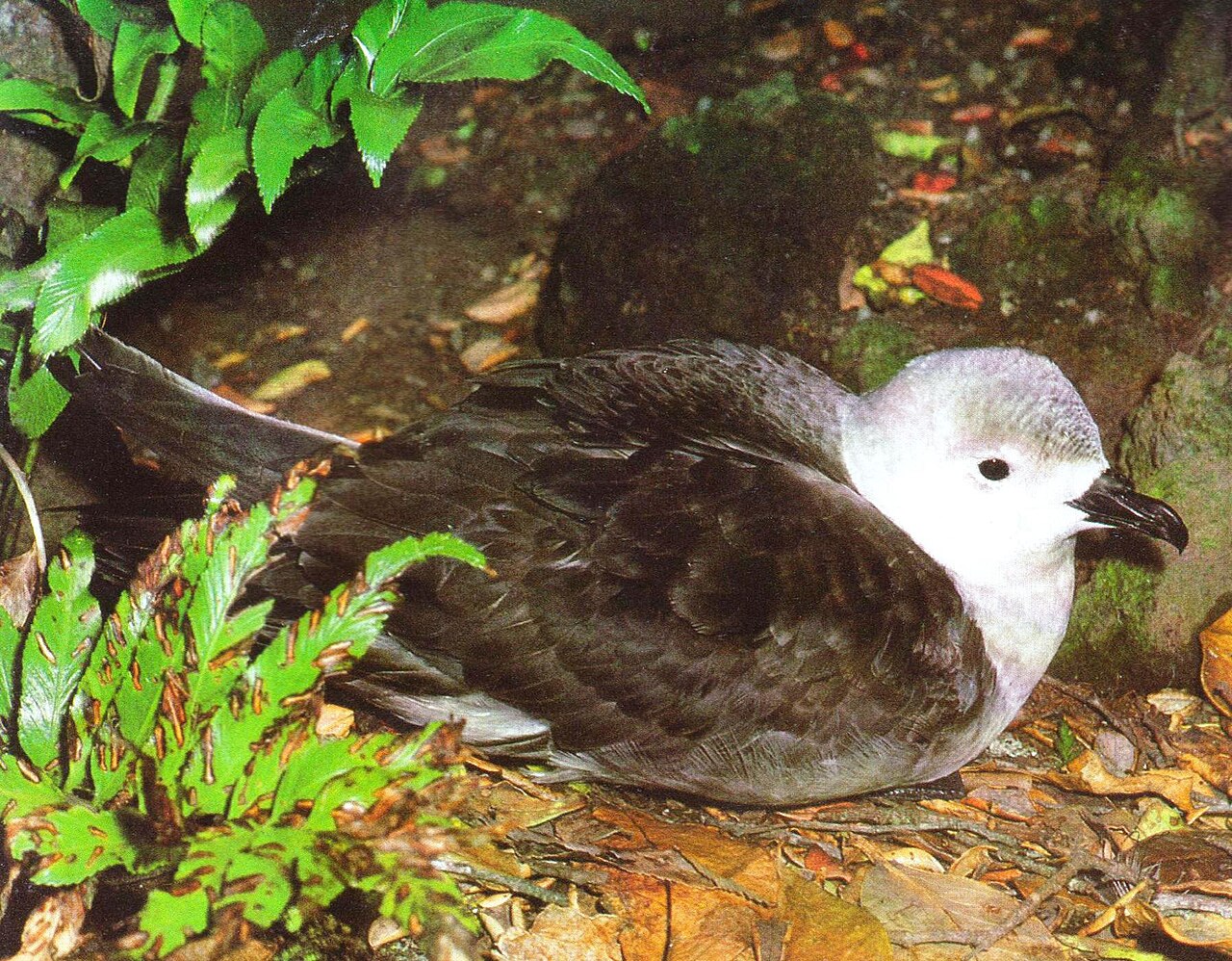
Kermadec Petrel is a vagrant to this area in the fullest sense: the only record ever from the American mainland was a single storm-driven bird on Southeast Farallon Island in 2017. The species itself, which occurs in a light, a dark and an intermediate form, breeds on a handful of island groups deep in the South Pacific and the Indian Ocean.
Voice
At the breeding islands, far outside this map's window, a harsh, cackling call rings out at the burrow and over the colony, mainly at dusk and at night. Within this area nothing of that sound can be heard: the one record involved a silent bird seen at sea, far from any colony.
No freely licensed recording has been found for this species yet; what to listen for is described below.
Identification
Kermadec Petrel is a large, thickset petrel with a heavy black bill and a short, wedge-shaped tail. The light form is mostly white with a grey-brown cap and mantle; the dark form, to which the sole American record belonged, is almost entirely deep brownish-grey, with double pale flashes on the underwing and thin whitish shafts on the upperside of the primaries. Intermediate forms combine features of both. Male, female and juvenile look alike within each colour form. Flight is powerful, with high, tumbling banks on relatively broad wings, appearing heavier than in most other petrels of the genus Pterodroma.
Confusion species
From the equally polymorphic Trindade Petrel, treated as a subspecies in the Pacific and with which it even hybridises on Round Island, Kermadec Petrel is barely separable in the field; the two are usually distinguished only on the breeding grounds or by genetic study. The dark form of Murphy's Petrel is slimmer and shows a faint pale chin, against the markedly thickset build and double pale underwing flashes of Kermadec Petrel. Mottled Petrel, unlike any form of Kermadec Petrel, has a sharply demarcated white belly. Given the species' extreme rarity in this area, caution and photographic documentation are called for with any claimed sighting.
Habitat
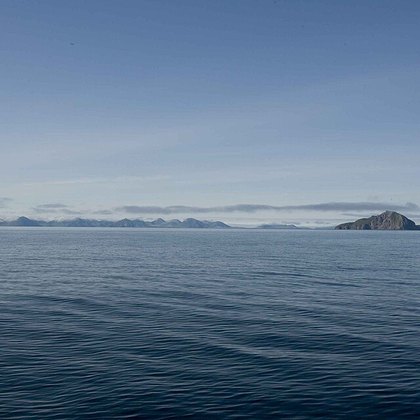
Within this area, Kermadec Petrel is, as far as the single record shows, a bird of the open sea far from shore. For breeding it uses rocky islets, cliffs and steep slopes on remote island groups in the South Pacific and Indian Ocean, entirely outside this map's window. As far as known, the species never uses land within North America.
Where the bird is most often found, arranged by the USNVC — the vegetation classification of the United States and Canada — and CMECS for sea and coast.
Range and movements
Kermadec Petrel breeds on the Kermadec Islands north of New Zealand, on Balls Pyramid near Lord Howe Island, and on Round Island near Mauritius in the Indian Ocean; at sea its range extends from Lord Howe Island to the Juan Fernández Islands off Chile. Wandering birds have been reported irregularly as far as Hawaiian waters and, sparingly, to about twenty degrees north off the Mexican Pacific coast. The only accepted record for the American continent came on 8 September 2017 at Southeast Farallon Island off California, most likely carried in on the fringes of Tropical Storm Lidia; it was at the same time the first record of the species away from Hawaii for the entire area covered by the American Birding Association.
Where and when to look
A targeted search is pointless: within this area Kermadec Petrel is a purely chance visitor, tied to exceptional tropical storm systems pushing in from the southwest. Anyone on a boat off the California coast during such a storm who sees a large, thickset, dark petrel with double pale underwing flashes would do well to take as many photographs as possible.
Conservation
Worldwide, Kermadec Petrel is not considered threatened, but on individual islands numbers have fallen sharply because of introduced cats, rats and, on one island, the Purple Swamphen: on Raoul Island, once home to roughly half a million birds, the species no longer breeds, and on Balls Pyramid the colony numbers fewer than a hundred birds. Within this area conservation is not an issue: here the species is a chance visitor with no population of its own.
Scientific name
Pterodroma neglecta | (Schlegel, 1863)
German-Dutch zoologist Hermann Schlegel described the species in 1863 as Procellaria neglecta; because it has since been placed in another genus, author and year stand in parentheses. The genus Pterodroma was introduced in 1856 by Bonaparte, from the Greek for 'wing' and 'runner'. neglecta is Latin for 'overlooked' or 'neglected', probably because the species had long gone unnoticed among the many, closely similar petrels of the Pacific. The type locality reads 'the Kermadec and Sunday Islands'; Sunday Island was at the time the common name for Raoul Island, the largest of the Kermadec Islands, so both names in the type locality in fact refer to the same island group.